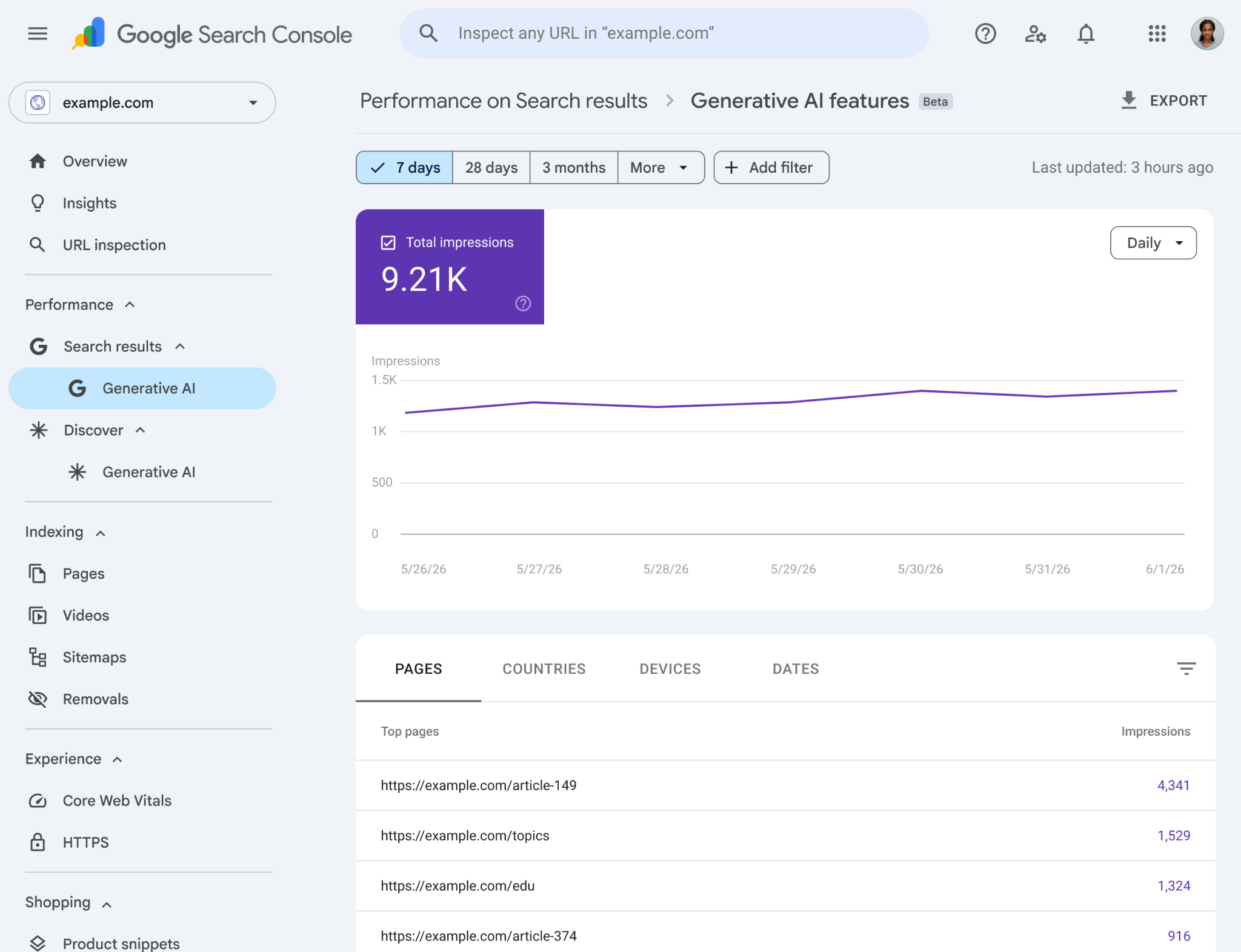
On June 3, 2026, Google launched a new Search Generative AI performance report in Search Console. It shows how often your pages appear inside AI Overviews and AI Mode on Google Search, plus generative features in Discover, broken down by pages, countries, devices, and dates. It is rolling out to a subset of sites first.
This is a real milestone. It is also a partial map of a much bigger territory.
For two years, the standard objection to taking AI search seriously was "you can't measure it." Google just removed that objection from its own product. The catch: the report only sees Google, only counts impressions, and only shows your own pages. That covers a slice of AI search. It leaves the rest of it dark.
Here is exactly what Google shipped, why it matters, and the three blind spots ai sightline google searyou still have to fill yourself.
TL;DR
Google added a dedicated Search Console AI performance report for AI Overviews, AI Mode, and Discover, rolling out to a subset of sites.
It reports impressions, pages, countries, devices, and dates. It does not report who else got cited or what the AI actually said.
It only covers Google surfaces. ChatGPT alone reached 900 million weekly active users in early 2026, and Search Console cannot see any of it.
Impressions are not clicks, and your pages are not the whole answer. Most AI citations point to third-party sites, not your domain.
Use the new report for the Google slice. Use a dedicated AI visibility platform like AI Sightline for the full picture across six platforms.
What Google actually shipped
The new report gives site owners a dedicated view of their visibility inside generative AI features on Google Search. Until now, that activity was folded into the overall performance report. Google is now breaking it out into its own view so you can see the AI portion on its own.
According to Google's announcement, the report surfaces five things:
Impressions: how often your URLs appeared in generative AI features in Search and Discover.
Pages: which of your URLs appeared within AI features.
Countries: your visibility on a country-by-country basis.
Devices: the devices people used when your site appeared (Search results only).
Dates: performance over time, with hourly, daily, weekly, and monthly granularity.
Two details matter for how you read this data. First, it covers both AI Overviews and AI Mode on Search, plus generative features in Discover. Second, Google is rolling it out to a subset of websites first to test and gather feedback, so not every property has it yet.
Google also signaled that more metrics may come over time. That is worth noting, because the metric that is present at launch tells you a lot about what this report is for, and what it is not for yet.
Why this is a bigger deal than it looks
When the largest search engine on earth builds a dedicated report for AI visibility, the category stops being speculative. Measuring whether AI surfaces show your brand is now a first-class, Google-sanctioned part of search analytics.
That settles an old argument. SEO and Generative Engine Optimization are not two separate disciplines anymore. They are one motion with two scoreboards, and Google just put both scoreboards in the same dashboard.
Generative Engine Optimization (GEO) is the practice of optimizing your content and online presence to increase visibility, citations, and favorable mentions in AI-powered search experiences like AI Overviews, ChatGPT, Perplexity, and Google's AI Mode. Google adding an AI report to Search Console is the clearest signal yet that GEO is now table stakes, not a side experiment.
So take the win. Then look at what the report cannot tell you, because the gaps are large and they are exactly where competitive advantage lives.
The three blind spots in the Search Console AI report
The new report answers one question well: how often did my pages show up in Google's AI features. It does not answer the three questions that actually drive an AI visibility strategy.
Blind spot 1: it only sees Google
AI search is not just Google, and this is the gap that matters most. Search Console reports on AI Overviews, AI Mode, and Discover. Every one of those is a Google surface.
Your buyers are not only on Google. ChatGPT reached 900 million weekly active users in February 2026, up from 400 million a year earlier, according to Search Engine Land. Perplexity, Claude, Microsoft Copilot, and the standalone Gemini app add hundreds of millions more conversations on top of that.
When a prospect asks ChatGPT "what is the best tool for X" and a competitor gets named instead of you, that happens entirely outside Google. Search Console will never show it. As far as your Google reports are concerned, that lost deal did not happen.
This is the single biggest reason a Google-only report cannot be your whole AI visibility strategy. You are measuring one platform in a market that now has at least six that matter.
Blind spot 2: it counts impressions, not the answer
An impression means your link appeared in an AI feature. It does not tell you what the AI said.
In a generative answer, that distinction is everything. The model writes a recommendation in plain language, then attaches a few sources. You can earn an impression as source number four while the AI spends its paragraph praising a competitor. The report counts that as visibility. Your pipeline does not.
The questions that change what you do next are not in the report:
Did the AI recommend you, mention you in passing, or cite you while endorsing someone else?
Which competitors got named in the same answer, and how often?
Was the mention positive, neutral, or negative?
What is your share of voice against rivals on the prompts that matter?
Impression counts cannot answer any of these. You need the content of the answer and the competitive context around it, not just a tally of appearances. We dug into why raw appearance metrics can fool you in the AI visibility monitoring fidelity myth.
Blind spot 3: it only shows your own pages
Search Console is tied to your verified property, so by design it can only report on your URLs. In classic SEO that is fine. In AI search it hides the most actionable data there is.
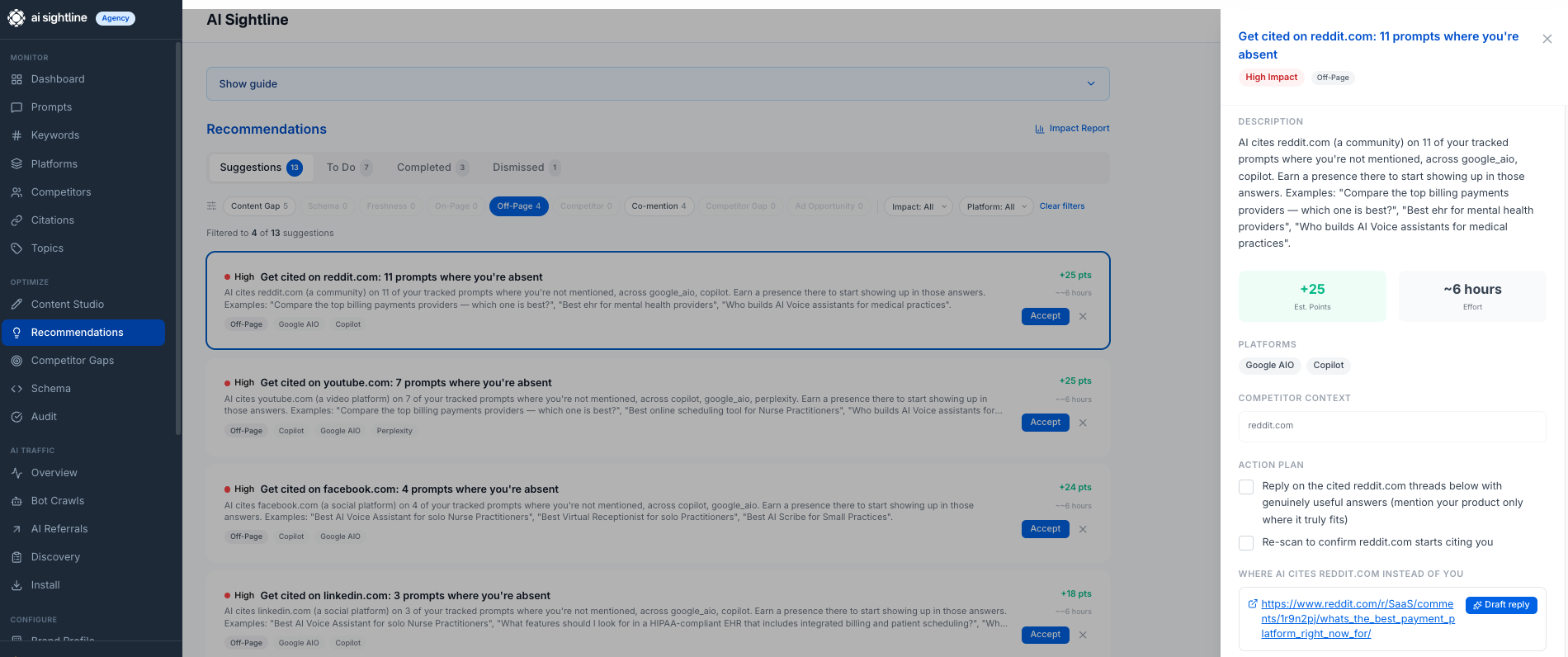
Here is why. In most categories we monitor at AI Sightline, the large majority of AI citations point to third-party sites, the review platforms, Reddit threads, YouTube videos, and directories the model already trusts, rather than to brands' own domains. The answer about your category is being built mostly from sources you do not own and cannot see in Search Console.
Two things stay invisible as a result. You cannot see the competitor citations sitting next to you in the same answers. And you cannot see the third-party domains winning the prompts where your own site never appears at all. Winning those sources back is its own discipline, off-page GEO, and it is invisible to any report tied to your own domain.
There is a fourth Blind Spot, quieter gap worth naming:
Impressions are not clicks. AI answers are designed to resolve the question on the spot, so an impression in an AI Overview may never become a visit. Measuring the appearance is not the same as measuring the traffic it sends.
How to track what Search Console can't
This is where a dedicated AI visibility platform earns its place next to Search Console rather than competing with it. Use the Google report for the Google slice. Use AI Sightline for everything the report leaves dark.
Here is how the blind spots get filled.
See all six platforms in one view
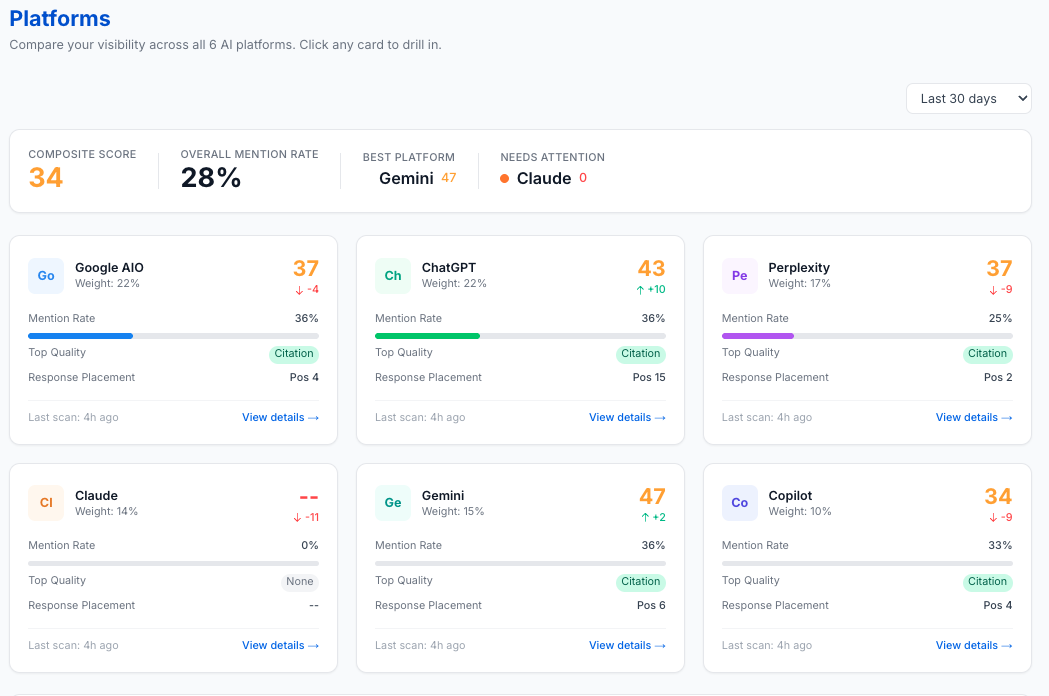
AI Sightline monitors how your brand shows up across six AI platforms: Google's AI Overviews, ChatGPT, Perplexity, Claude, Gemini, and Copilot. That is the difference between watching one surface and watching the market your buyers actually use. Our tagline says it plainly: show up where AI answers, not just where Google reports.
See who really gets cited, prompt by prompt
For every prompt you track, AI Sightline shows the citation leaderboard: who got cited, how often, and on which platforms. Instead of an impression count, you see the competitive shape of the answer, the names sitting next to yours and the ones beating you to the top.
We also score sentiment and share of voice, so you know whether a mention helped you or quietly handed the recommendation to a rival. For a full walkthrough of this workflow, see our guide to AI search competitor analysis.
Know where you are losing and why
The Competitor Gaps view ranks every prompt where you are losing AI visibility by opportunity, then names the competitor beating you and explains why. It turns "we appeared 1,200 times" into "here are the ten prompts to fix first, and who to beat on each."
Then actually close the gap, three ways
Seeing the gap is half the job. AI Sightline is built to close it, and there are only three ways to win a spot in an AI answer:
Earn it on your own pages. Get content and recommendations for the pages that should be cited for a prompt and are not.
Earn it off-page. Get a ranked list of the exact third-party sites the AI keeps citing instead of you, the G2 profiles, Reddit threads, and YouTube videos, with a tailored action plan for each.
Buy it. When earning a spot is too slow for a high-value prompt, AI Sightline can generate a ready-to-run ChatGPT ad campaign, written from the real prompts where you are missing, that you paste into your own OpenAI Ads account.
No Google report points you to a Reddit thread or drafts you a ChatGPT ad. That is the difference between a scoreboard and a playbook.
Measure the clicks, not just the impressions
Because impressions are not traffic, AI Sightline also tracks AI referral visits, the real sessions that ChatGPT, Perplexity, Google AI, and the rest actually send to your site. You see appearances and outcomes, not appearances alone. We cover how to read those numbers in our guide to AI search analytics.
Search Console AI report vs AI Sightline
Both belong in your stack. They answer different questions. Here is the honest split.
What you want to know | Search Console AI report | |
|---|---|---|
Which AI platforms are covered | Google AI Overviews, AI Mode, Discover | Google AI Overviews, ChatGPT, Perplexity, Claude, Gemini, Copilot |
Core metric | Impressions of your pages | Citations, share of voice, sentiment, and traffic |
Shows competitor visibility | No | Yes, per prompt |
Shows third-party sites winning your answers | No | Yes (review sites, Reddit, YouTube, and more) |
Tells you what to do about a gap | No | On-page, off-page, and paid recommendations |
Tracks real clicks from AI | Not in this report | Yes, AI referral visits by platform |
Availability | Rolling out to a subset of sites | Available now, free plan included |
API and MCP access for your own tools | No | Yes |
Read the table the right way. Search Console is the authoritative source for how Google's own AI features treat your pages, and you should use it for that. AI Sightline is how you see the other five platforms, the competitive context, and the action plan.
What this means for your GEO strategy
Google's announcement is permission, not a finish line. It confirms that AI visibility is a number worth tracking. It does not hand you the full number.
Three takeaways to act on this week:
Turn on the Search Console AI report if your property has it, and start watching your AI impression trend on Google. It is free and it is real data.
Stop treating Google as the whole of AI search. The platform with 900 million weekly users is not in that report. Neither are the four others your buyers use.
Move from measuring to acting. Impressions tell you that something happened. Citations, competitors, and recommendations tell you what to do next.
The teams that win AI search in 2026 will not be the ones with the most impressions on one platform. They will be the ones who can see every platform, read the actual answers, and close the gaps faster than their competitors.
Frequently asked questions
Does the Search Console AI report track ChatGPT or Perplexity?
No. The Search Console AI performance report covers Google surfaces only: AI Overviews, AI Mode, and generative features in Discover. It does not track ChatGPT, Perplexity, Claude, Copilot, or the Gemini app. To monitor those, you need a dedicated AI visibility platform that scans them directly.
What does the Search Console AI performance report measure?
It measures impressions of your pages inside Google's generative AI features, broken down by pages, countries, devices, and dates with hourly to monthly granularity. It reports how often your URLs appeared, not what the AI said about you or which competitors it cited.
Is the new Search Console AI report available to everyone?
Not yet. Google is rolling it out to a subset of websites first to test the reports and gather feedback before making them widely available. If you do not see it in your Search Console, you are likely outside the initial rollout group.
Do AI Overview impressions equal website traffic?
No. An impression means your page appeared in an AI feature, but generative answers often resolve the question on the page, so an impression may never become a click. Measuring impressions is not the same as measuring the visits AI sends to your site.
How do I track my AI visibility beyond Google?
Use a platform that monitors multiple AI engines directly. AI Sightline tracks brand visibility across six platforms, including ChatGPT, Perplexity, Claude, Gemini, and Copilot alongside Google's AI Overviews, and shows citations, competitors, sentiment, and real referral traffic that Search Console cannot.
See your real AI visibility
Google just showed you one platform. See the other five.
Start free, no credit card required, and get your brand's visibility across every major AI platform in a few minutes. Then compare it to what Search Console shows you, and decide for yourself how much of the picture you were missing.
Show up where AI answers. For a wider look at the category, see our guide to the best AI visibility tools.
Get your free AI visibility score.
See how ChatGPT, Claude, Perplexity, Gemini, Google AIO, and Copilot talk about your brand.
Start freeSolo founder building AI visibility monitoring. Ships weekly. No venture capital, a lot of opinions about where AI search is going.