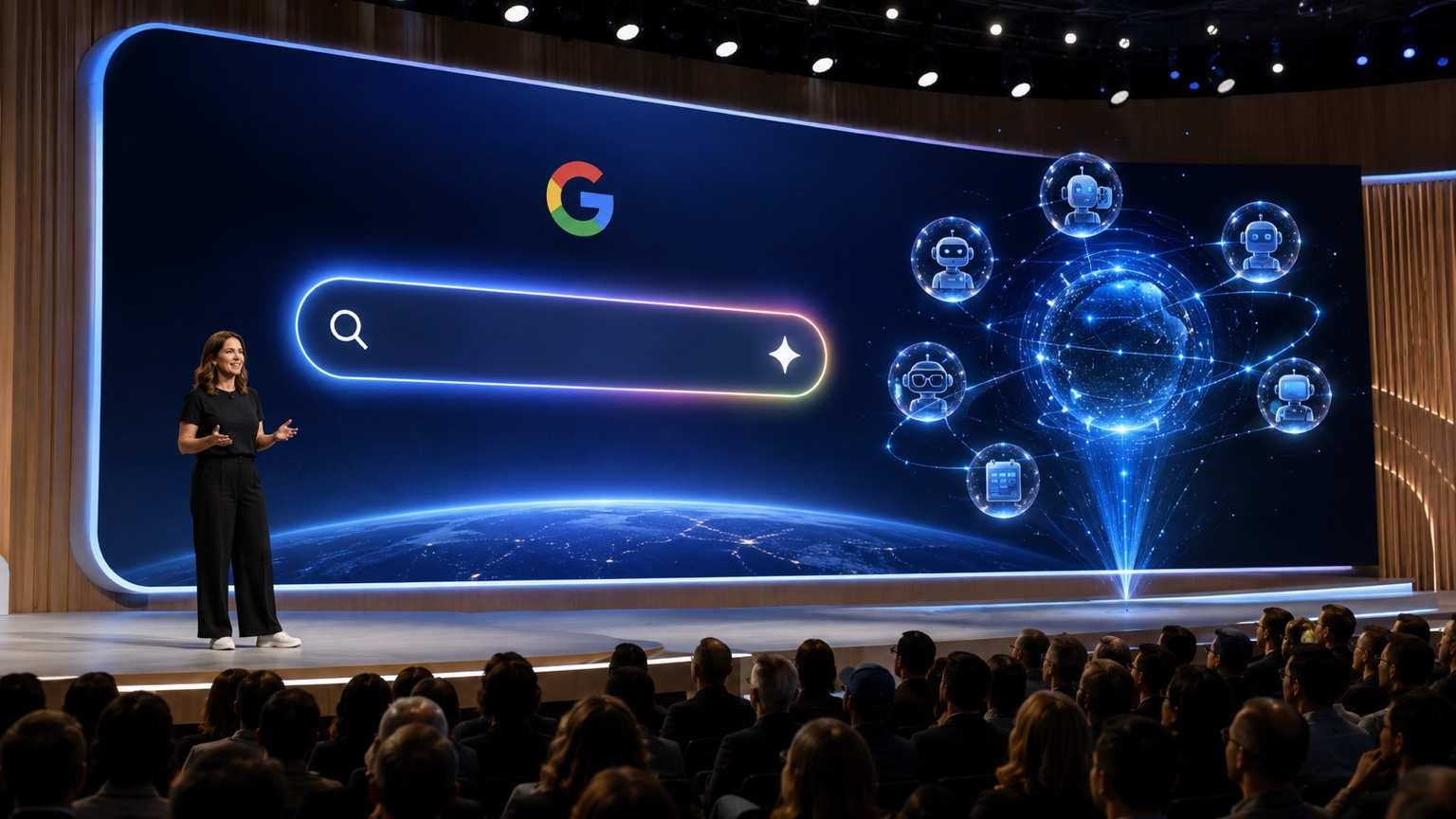
On May 19, 2026, Google VP of Search Liz Reid stood on the I/O stage and announced what is the biggest upgrade to Search in over 25 years. AI Mode is no longer an experiment. It is now the default surface for one billion monthly users, powered by Gemini 3.5 Flash, with a brand new AI search box and a fleet of always-on information agents that work for users 24 hours a day. [^1]
If you sell anything to anyone who uses Google, your visibility strategy just changed. Not in six months. Today.
This post breaks down exactly what Google announced and gives you a clear playbook for what to do about it.
TL;DR
AI Mode is now the default. Gemini 3.5 Flash powers it globally, AI Mode has crossed one billion monthly active users, and queries have more than doubled every quarter since launch. [^1]
The search box is dead. Google replaced its 25-year-old keyword box with an "intelligent" multimodal box that accepts text, images, files, videos, and Chrome tabs as input. [^1]
Information agents arrive this summer. Always-on agents will scan the web for users in the background and notify them when something matches their criteria. This is recurring, automated brand discovery happening without a single live search. [^1]
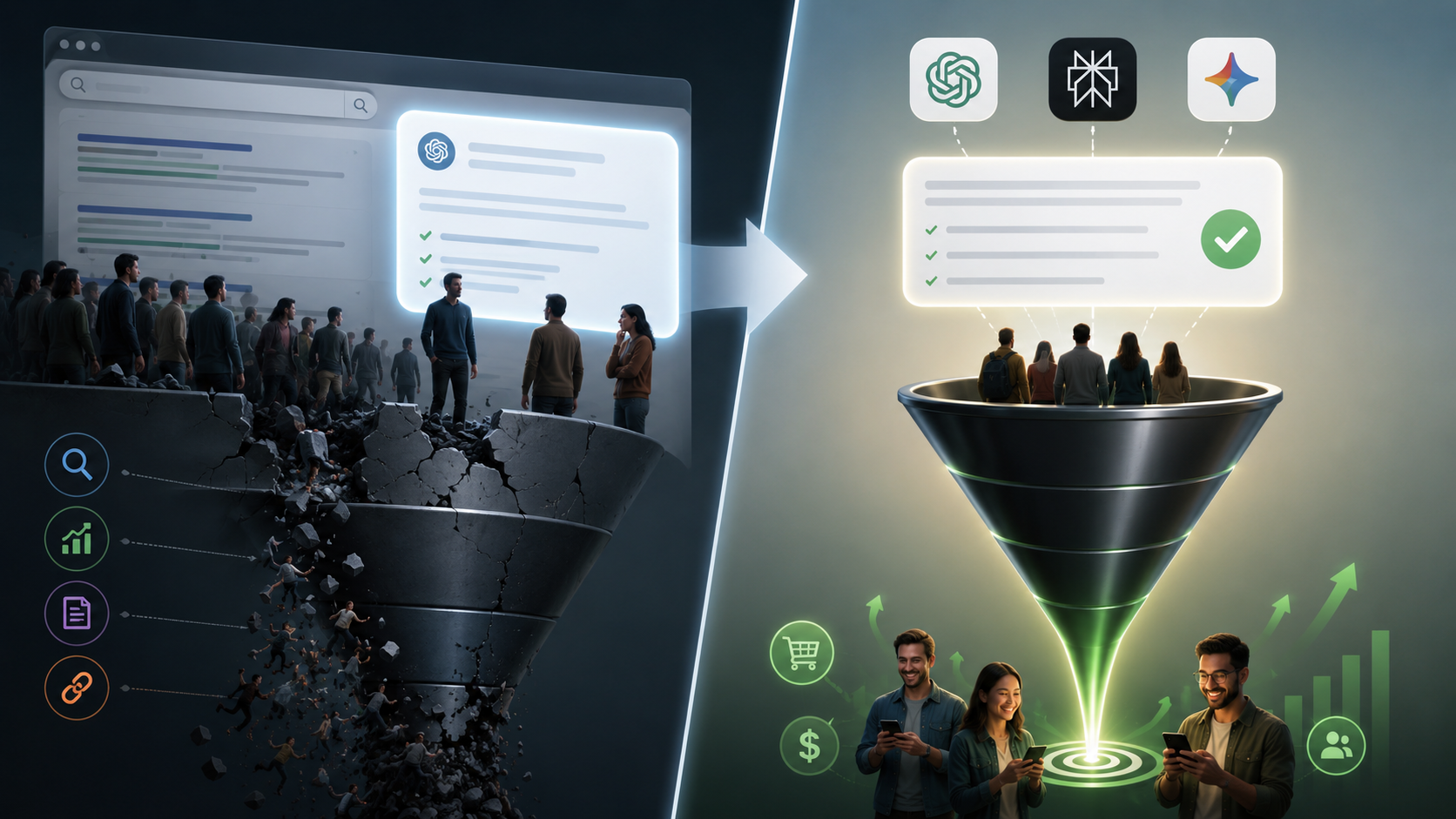
Zero-click is now the norm. Wall Street analysts now cite figures showing 93% of AI Mode searches end without an external click, and AI Overview click-through rates are already down roughly 15%. [^2]
The lesson: Brand visibility now lives inside AI answers, not blue links. If you are not measuring how often the AI sees you, names you, and recommends you, you are flying blind.
What Google Actually Announced
The blog post from Liz Reid (Google VP, Search) covered four buckets. Each one has a real implication for marketing, sales, and product teams.
1. Gemini 3.5 Flash is the default AI Mode model, globally
Google upgraded AI Mode to run on Gemini 3.5 Flash, its newest Flash model, available worldwide and free of charge. Liz Reid called this the next chapter of Google Search. [^1]
This matters because Flash is fast, cheap, and good enough at reasoning to handle multi-step queries. That economics shift is what makes the rest of the announcements possible. Google can now afford to answer a billion conversational questions per day without lighting money on fire.
2. The Search box got rebuilt for the first time in 25 years
The new "intelligent" search box is multimodal by default. You can drop in a picture, a PDF, a video, or even an open Chrome tab and ask a question about it. The box expands dynamically and offers AI-powered suggestions that go beyond autocomplete. [^1]
The strategic read is that Google is no longer optimizing for keyword queries. It is optimizing for intent. Your brand needs to be discoverable in natural language and in multimodal contexts, not just for the head terms in your keyword spreadsheet.
3. Information agents will work for users 24/7
The biggest reveal was information agents. Users can spin up an agent, describe what they want to monitor, and the agent runs in the background continuously. It synthesizes updates from blogs, news, social posts, finance data, shopping data, and sports data, then notifies the user with the option to take action. [^1]
Translation: A user is no longer going to Google to find you. The user is going to Google once to set up an agent that finds you for them, repeatedly, while they sleep. Your customers are now indirect. Your visibility window is every scan that agent runs, forever.
Information agents launch first for Google AI Pro and Ultra subscribers this summer. [^1]
4. Agentic coding and Personal Intelligence
Two more pieces round out the picture. Google brought Antigravity, its agentic development platform, into Search so it can build custom generative UI on the fly, including dashboards, trackers, and "mini apps" for ongoing tasks. And Personal Intelligence is now available in nearly 200 countries with no subscription required, letting Search securely connect to Gmail, Photos, and soon Calendar. [^1]
Both of these deepen Google's grip on the user's full task, not just the lookup. Search is becoming a workspace, not a directory.
The Implications for Google Search Itself
Step back. What Google announced is not four features. It is four moves toward the same destination: Search as an agent, not a list.
The four shifts that follow from the announcement:
Search becomes a destination, not a starting point. Users no longer pass through Search on their way to your site. AI Mode answers the question, and the agent monitors the topic. Source attribution still happens, but the traffic does not.
Discovery becomes asynchronous. Information agents flip discovery from a real-time event to a background process. Your brand has to be visible whenever the agent runs, not just when the user is shopping.
Personalization replaces ranking. Personal Intelligence pulls Gmail and Photos into Search. Two users asking the same question now get different answers tuned to their own context. There is no longer one SERP to rank on.
The interface fragments. Generative UI means Search renders the answer in whatever format fits, including custom dashboards built on the fly. There is no "position one." There is whatever the model decided to show.
The TIME magazine headline summed it up bluntly: "Google Shifts to AI Search, Heralding Major Change in How People Use the Internet." [^3] TechCrunch went even further with "Google Search as you know it is over." [^4]
What the Experts are Saying
The reactions came fast. Here are some of the strongest reads from named voices in SEO, GEO, and Wall Street that were published within 24 hours of the keynote.
Mizuho analyst Lloyd Walmsley: "AI Loser to AI Winner"
Wall Street moved first. Mizuho's Lloyd Walmsley raised his Alphabet price target to $460 and wrote that Alphabet has shifted "from AI Loser to AI Winner and deserves a premium." Loop Capital lifted its target to $490 from $355. Oppenheimer raised theirs to $445 from $425. [^2]
The interesting note buried in the upgrades was a warning: Mizuho flagged that 93% of AI Mode searches currently end without an external click, and AI Overview click-through rates are already down roughly 15%. The bull case for Google's stock is the bear case for publisher traffic. [^2]
Rand Fishkin (SparkToro): Zero-click is a structural reality
Rand Fishkin has been calling the zero-click trend for years, and his read on the I/O announcements was that the shift is no longer debatable. In his recent analysis, Fishkin argued that brand visibility in AI surfaces is now a stronger predictor of revenue than organic rank, because the click cost is going to zero whether SEOs like it or not. [^5]
His framing is what we at AI Sightline have been saying since day one. Track where you show up in the answer, not where you rank in the list.
Aleyda Solís: The query fan-out is the new game
Aleyda Solís, founder of Orainti and one of the most-followed voices in international SEO, dug into how AI Mode actually works under the hood. Her LinkedIn post broke down the "query fan-out technique," where AI Mode silently issues dozens of sub-queries behind a single user question, retrieves passages from each, and synthesizes the answer. [^6]
The implication: your brand has to win not just on the user's original question, but on every related sub-query the model dispatches in the background. Topical authority is the new ranking factor.
Cyrus Shepard (Zyppy): Survivors share five traits
Cyrus Shepard, founder of Zyppy and former Head of SEO at Moz, published an analysis of 400 sites that did not collapse during what Fishkin called "the great traffic apocalypse of 2024-2026." His five strategic features included strong brand search demand, owned audience channels, multi-platform content distribution, original first-party data, and recurring revenue models. [^5]
Notice what is not on that list: keyword rankings.
Ahrefs research: The citation engines do not agree
Ahrefs published research analyzing 730,000 query pairs and found that AI Mode and AI Overviews reach semantically similar conclusions 86% of the time, but cite the same specific URLs only 13.7% of the time. [^7]
That is the hidden cost of the new world. Even within Google's own surfaces, citation is fragmented. You can be cited in AI Overviews and completely absent from AI Mode for the same query. The implication is that brand-citation tracking has to happen per surface, not in aggregate.
Search Engine Land: Google says GEO is just SEO
On May 15, Google published its first consolidated guide on optimizing for generative AI features. The guide explicitly retired GEO and AEO as separate disciplines, stating that "optimizing for generative AI search is optimizing for the search experience, and thus still SEO." [^8]
We disagree with the framing. AI search is a fundamentally different surface, with different inputs, different ranking signals, different output formats, and different measurement requirements. Calling it "still SEO" is comforting for agency clients, but it understates the change. You can do every SEO best practice perfectly and still be invisible to AI Mode if you have not built topical authority across the dozens of sub-queries the model dispatches.
What This Means for AI Sightline Customers
If you are an AI Sightline customer, this is what you should change Monday morning.
Your prompt list is the new keyword list
Stop thinking about your prompts as "queries we want to monitor." Start thinking about them as "the universe of questions where our brand needs to win." AI Mode is now answering more than two billion questions a quarter, and each one is a sub-query fan-out. Your prompt set should sample the head, the middle, and the long tail.
The free tier gives you 3 prompts to test the methodology. Starter at $29.95 gives you 20, which is enough to cover a tight ICP. Pro at $149.95 gives you 75, which is the volume most growth-stage SaaS brands need to track multi-segment messaging. Business at $289.95 unlocks 200 prompts and all six platforms, which is the right tier if you sell into multiple buyer personas. Agency at $549.95 gives you 400 prompts and 750 keywords for multi-brand portfolios.
Track citations per surface, not per query
The Ahrefs finding above is the operational implication. If your dashboard shows aggregate "AI visibility," you are missing the picture. Every surface has its own citation engine. ChatGPT cites differently than Perplexity. AI Mode cites differently than AI Overviews. Google Gemini cites differently than Microsoft Copilot.
AI Sightline tracks six platforms separately and reports per-surface citation counts, share of voice, and sentiment. That separation is no longer a nice-to-have. It is how you find the gap that is costing you visibility.
Watch sentiment, not just frequency
Information agents synthesize across blogs, news, social, and real-time data. That means an agent monitoring a competitive category will catch positive press, negative press, and neutral mentions, and the model will weight all of them when it generates the recurring update to the user.
Your visibility score is no longer the count of mentions. It is the count of mentions weighted by tone. The Brand Sentiment Index we shipped in April measures exactly that, and it is more important after I/O 2026 than it was the day we launched it.
Build for the query fan-out, not the original prompt
Aleyda Solís nailed the operational shift. Track the sub-queries, not just the head term. The topic authority surface in AI Sightline maps the cluster of related questions where your brand needs to appear. After I/O, that cluster is the unit of optimization, not the individual prompt.
Measure recurring discovery, not one-time clicks
When an information agent runs for a user, it is doing weekly or daily checks for your category. The brand that wins the citation in those recurring runs compounds visibility while the brand that wins one-off clicks loses ground. Set your scanning cadence accordingly. Pro, Business, and Agency tiers all scan daily, which matches the cadence at which agents will be running on the other side of the screen.
How AI Sightline Is Responding
We will not pre-announce features or dates. What we will commit to publicly is a set of directional priorities that follow directly from the announcements above.
Per-surface clarity stays our north star. AI Mode and AI Overviews are different citation engines. ChatGPT, Perplexity, Gemini, and Copilot are different engines. Anyone who hands you a single number for "AI visibility" is hiding the gaps. We will keep widening the per-surface lens, not narrowing it.
Multimodal-query monitoring is on the roadmap. The new search box accepts images, video, files, and tabs. Brand visibility inside multimodal answers is a new measurement surface and we are exploring how to instrument it.
Information-agent monitoring is the deepest implication. If users are setting up always-on agents, brands need to know how often those agents see and recommend them across the topics that matter. We are designing the right model for measuring recurring agent discovery, not just one-off queries.
Sub-query fan-out coverage is a topical authority problem. Our Topic Authority feature was already designed for exactly this. Expect us to deepen it, including coverage of the long-tail variant queries the model dispatches behind every user prompt.
Real-time tracking matters more, not less. When Google ships agents that run every hour, monthly scan cadences are blind. Daily is the floor. Hourly scans for high-priority prompts are the next conversation. We are looking hard at sub-daily cadences for the right use cases.
The MCP server is a strategic advantage. AI agents are the user. Agents query data through MCP. AI Sightline already publishes a full MCP server with 30+ tools so that AI agents can pull your brand's visibility data directly. After I/O, that bet looks more right, not less.
We are not promising dates. We are telling you the direction. The product moves where AI Search moves, and AI Search just moved a lot.
The Action Checklist
If you want a five-minute version of what to do this week:
Audit your prompt coverage. Does your monitored prompt set cover head, middle, and long-tail questions across your category? If you are on Free with 3 prompts, you are testing. Move up when you are ready to operate.
Add the missing platforms. If you are not tracking all six AI surfaces, you have blind spots. Business and Agency tiers unlock the full set.
Look at sentiment, not just frequency. Pull the sentiment trend for your brand and your top three competitors. If sentiment is flat or negative, that is the priority before adding more prompts.
Map the sub-queries. Use the Topic Authority view to see which related questions your brand is winning and which it is missing. That gap is what the agent will surface to users this summer.
Set scanning cadence to match. Free is weekly. Starter is every three days. Pro and above are daily. If your category moves fast, you need daily.
Closing
Liz Reid wrote that this is "the next chapter of Google Search." She is right, but she undersold it. This is the chapter where Search stops being a place users visit and becomes a process that runs on their behalf. The brands that show up where AI answers will compound visibility while the brands that did not adapt will discover that being invisible is now a permanent state, not a temporary one.
Show up where AI answers. That is the entire job from here.
Start a free AI Sightline account, add three prompts, and see whether the AI knows you exist. If the answer surprises you, you now have a 90-day head start on the people who waited.
See your visibility score in under 30 seconds. No credit card required.
Footnotes
[^1]: Reid, Elizabeth. "A new era for AI Search." Google Blog (The Keyword), May 19, 2026. https://blog.google/products-and-platforms/products/search/search-io-2026/
[^2]: "Google Stock Price Target: Wall Street Reacts to I/O 2026 Event." Watcher Guru, May 20, 2026. https://watcher.guru/news/google-stock-price-target-wall-street-reacts-to-i-o-2026-event
[^3]: "Google Shifts to AI Search, Heralding Major Change in How People Use the Internet." TIME, May 20, 2026. https://time.com/article/2026/05/20/google-search-ai-internet/
[^4]: "Google Search as you know it is over." TechCrunch, May 19, 2026. https://techcrunch.com/2026/05/19/google-search-as-you-know-it-is-over/
[^5]: Fishkin, Rand. "5 Strategic Features that Predict Survival in the Zero-Click Era." SparkToro, April 20, 2026 (data drawn from Cyrus Shepard's 400-site analysis at Zyppy). Discussion summarized in Near Media episode 244: https://www.nearmedia.co/ep-244-ai-visibility-vs-google-rankings-rand-fishkin-on-the-future-of-search-zero-click-brand-measurement/
[^6]: Solís, Aleyda. "Google AI Mode's Query Fan-Out Technique." LinkedIn, 2026. https://www.linkedin.com/posts/aleyda_google-ai-modes-query-fan-out-technique-activity-7332444787607769088-mRBz
[^7]: Ahrefs Research, cited in industry coverage of AI Mode versus AI Overviews citation divergence (730,000 query pair analysis, 13.7% URL overlap). Summary: https://www.systematicinfotech.com/google-ai-mode-seo-2026/
[^8]: "Google's New AI Search Guide Calls AEO And GEO 'Still SEO'." Search Engine Journal, May 2026. https://www.searchenginejournal.com/googles-new-ai-search-guide-calls-aeo-and-geo-still-seo/575026/
Get your free AI visibility score.
See how ChatGPT, Claude, Perplexity, Gemini, Google AIO, and Copilot talk about your brand.
Start freeSolo founder building AI visibility monitoring. Ships weekly. No venture capital, a lot of opinions about where AI search is going.