
To show up in AI search, you need to optimize your content for the way AI models find, evaluate, and cite sources...not just for how Google ranks web pages. This means structuring your content with clear, direct answers, building topical authority through depth, adding schema markup, and monitoring your visibility across platforms like ChatGPT, Perplexity, Google AI Overviews, Claude, Gemini, and Copilot.
That's the short answer. The long answer is the rest of this post: 15 questions we hear constantly from brands trying to figure out AI search visibility, answered with specific tactics you can act on today.
1. What is AI search and how is it different from Google?
AI search refers to AI-powered platforms that generate direct answers to user questions instead of returning a list of links. ChatGPT, Perplexity, Google AI Overviews (formerly SGE), Claude, Gemini, and Microsoft Copilot all work this way. The user asks a question, the AI synthesizes information from multiple sources, and produces a written response -- sometimes with citations, sometimes without.
The difference from traditional Google search is fundamental. In Google, you compete for 10 blue links. In AI search, you compete to be one of the 2-3 sources the AI model chooses to cite in its answer. There's no "page 2" in AI search. You're either mentioned or you're invisible.
According to data tracked by AI Sightline across thousands of scans, only about 12% of brands that rank on Google's page 1 for a keyword are also cited by ChatGPT for the equivalent query. Traditional SEO rankings do not guarantee AI search visibility.
2. Why should I care about showing up in AI search results?
Because your customers are already using it. AI search referral traffic grew over 3,500% in 2025, and roughly 25% of Google searches now trigger AI Overviews at the top of the results page. When a potential customer asks ChatGPT "what's the best [your category] tool?" and your brand isn't in the response, you just lost a lead you never knew existed.
The shift is accelerating. Perplexity alone processes millions of queries daily. Google AI Overviews appear on a quarter of all searches. Every month, a larger share of purchase research starts in an AI chat window instead of a search bar. Brands that show up in AI search results now are building an advantage that compounds over time. AI models learn to associate your brand with your category.
3. How do AI models decide which brands to mention?
AI models cite brands and sources based on a mix of signals that differ from traditional SEO ranking factors. Based on patterns observed across AI Sightline's monitoring data, the main factors include:
Topical authority. AI models favor sources that demonstrate deep, consistent expertise on a topic. A brand with 30 detailed articles about project management will get cited more than one with 3 generic posts.
Content structure. AI models extract information more easily from content with clear headings, direct answers, structured data (schema markup), and well-organized sections. Messy, wall-of-text pages get skipped.
Recency and freshness. AI platforms that use real-time retrieval (like Perplexity and Google AI Overviews) favor recently updated content. Stale pages from 2021 lose ground to fresh 2026 content.
Third-party validation. Mentions in authoritative publications, industry directories, and review sites act as credibility signals. If Forbes, G2, and three industry blogs all mention your brand, AI models treat that as evidence of relevance.
Direct answers. Content that starts a section with a clear, quotable answer to a specific question is more likely to be extracted as a citation. AI models pattern-match user queries to content headings and lead paragraphs.
4. What is GEO and how is it different from SEO?
Generative Engine Optimization (GEO) is the practice of optimizing your brand's content and online presence to increase visibility, citations, and favorable mentions in AI-powered search engines. Think of it as SEO's younger sibling built specifically for ChatGPT, Perplexity, Google AI Overviews, and other generative AI platforms.
SEO optimizes for Google's ranking algorithm -- keywords, backlinks, page speed, meta tags. GEO optimizes for how AI models select, synthesize, and cite information. There's overlap (structured content helps both), but the tactics diverge in important ways:
| SEO | GEO | |
|---|---|---|
| Goal | Rank on page 1 | Get cited in AI responses |
| Competition | 10 blue links | 2-3 cited sources |
| Key signals | Backlinks, keywords, authority | Topical depth, structure, freshness |
| Measurement | Rankings, organic traffic | Citation rate, visibility score |
| Tools | Semrush, Ahrefs, Moz | AI Sightline, Otterly, Peec |
You need both. SEO drives traffic from people who search traditionally. GEO drives visibility with people who ask AI for answers. Ignoring either one leaves money on the table.
5. How do I check if my brand shows up in AI search right now?
The manual way: open ChatGPT, Perplexity, Claude, Gemini, and Google, type in queries your customers would ask, and see if your brand appears. This takes about 30 minutes per keyword per platform, and you'd need to repeat it regularly because AI responses change constantly.
The automated way: use an AI visibility monitoring tool. AI Sightline scans up to 6 AI platforms automatically on a rolling cycle, daily for Pro plans and above, across all your target prompts. You set up your brand name, your keywords, and your competitors, and it tracks every mention, citation, and visibility shift over time.
The free plan covers 3 prompts across 2 platforms. Enough to see whether AI search is mentioning you at all and start understanding the landscape.
6. What are the best AI search platforms to monitor?
The six platforms that matter most for brand visibility in AI search right now are:
Google AI Overviews - the AI-generated summary that appears at the top of Google search results. This is the highest-volume AI search surface because it sits on top of the search engine 90% of the world already uses.
ChatGPT - the most recognized AI assistant. When people "ask AI" about a product or service, this is usually where they go first. ChatGPT now includes web browsing and citations.
Perplexity - built specifically as an AI search engine with inline citations. Perplexity always links to its sources, making it the most transparent AI search platform for tracking brand mentions.
Claude - Anthropic's AI assistant. Growing rapidly, especially among technical and professional users. Claude's web search feature means your brand can appear in its responses.
Gemini - Google's AI assistant, integrated across Google Workspace. A growing source of AI-generated brand mentions, especially for B2B queries.
Microsoft Copilot - integrated into Bing, Edge, Windows, and Microsoft 365. Copilot pulls from Bing's index and generates AI responses with citations.
Monitoring just one or two platforms gives you an incomplete picture. AI Sightline's Pro plan at $149.95/mo covers 5 of these platforms with 75 prompts scanned daily. The Business plan at $289.95/mo covers all 6.
7. How do I optimize my content to get cited by ChatGPT?
ChatGPT cites content that directly answers questions with specificity and authority. Here are the tactics that work to get you cited by ChatGPT:
Lead every section with the answer. Don't build up to your point, state it first, then explain. ChatGPT extracts the first 1-2 sentences under a heading as potential citations.
Use specific numbers instead of vague claims. "Our platform tracks 6 AI search engines and costs $29.95/mo" is citable. "We offer an affordable, multi-platform solution" is not.
Add structured data to your pages. JSON-LD schema markup. Especially Organization, Product, FAQ, and HowTo schemas -- makes your content machine-readable. AI models that use retrieval-augmented generation pull structured data more reliably.
Publish frequently on your core topics. ChatGPT's training data and browsing both favor brands that demonstrate consistent expertise. One blog post won't do it. Twenty posts on the same topic cluster will.
Get mentioned by third-party sources. Citations in industry publications, review sites, and news outlets signal credibility to ChatGPT's retrieval system. Earned media still matters in AI search.
8. How do I show up in Google AI Overviews?
Google AI Overviews pull from pages that are already ranking well in traditional Google search, but they apply additional criteria when selecting which sources to cite in the AI-generated summary.
To optimize for Google AI Overviews:
Rank on page 1 first. AI Overviews almost exclusively pull from top-10 organic results. Your SEO fundamentals have to be solid before AIO optimization matters.
Structure content for extraction. Use clear H2/H3 headings phrased as questions. Write 40-60 word "Position Zero" paragraphs directly under each heading that answer the question concisely. Google's AI pulls these almost verbatim.
Use comparison tables. AI Overviews frequently extract tabular data. If your post compares tools, features, or approaches, put the comparison in a proper table.
Add FAQ schema. Pages with FAQ structured data are disproportionately represented in AI Overviews. Mark up your FAQ sections with the appropriate JSON-LD.
Keep content fresh. AI Overviews favor recently updated content, especially for queries where information changes (pricing, features, rankings). Update your key pages quarterly at minimum.
9. How do I get my brand mentioned by Perplexity?
Perplexity is the most citation-friendly AI search platform. It always shows its sources with inline links. This makes it the most transparent and the most actionable platform for GEO.
Perplexity pulls from its own real-time web index. To show up:
Publish content that directly answers specific questions. Perplexity matches user queries to web content almost like a traditional search engine but with AI synthesis. Content formatted as Q&A performs well.
Be the definitive source on your topics. Perplexity prioritizes authoritative, in-depth content. Thin pages with 300 words don't get cited. Deep guides with data, examples, and original analysis do.
Update regularly. Perplexity's index is near-real-time. Fresh content gets picked up fast. If your competitor publishes a new comparison page and you haven't updated yours in 6 months, guess who gets cited.
Monitor your Perplexity citations with AI Sightline. The platform tracks exactly which of your pages Perplexity cites, in response to which queries, and how often. You can see whether your optimization efforts are working within days, not months.
10. What is an AI visibility score and how is it calculated?
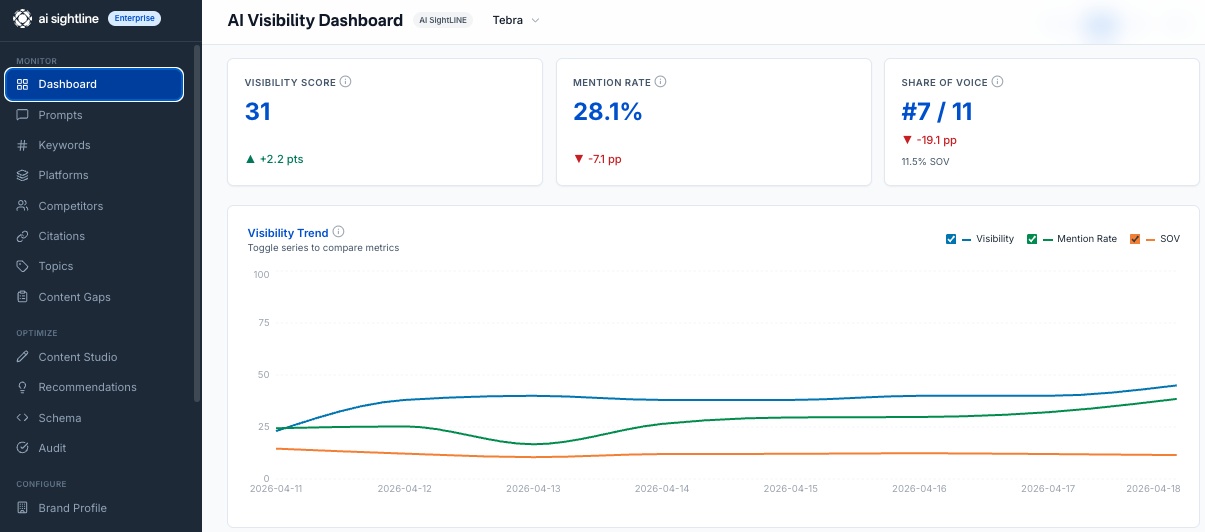
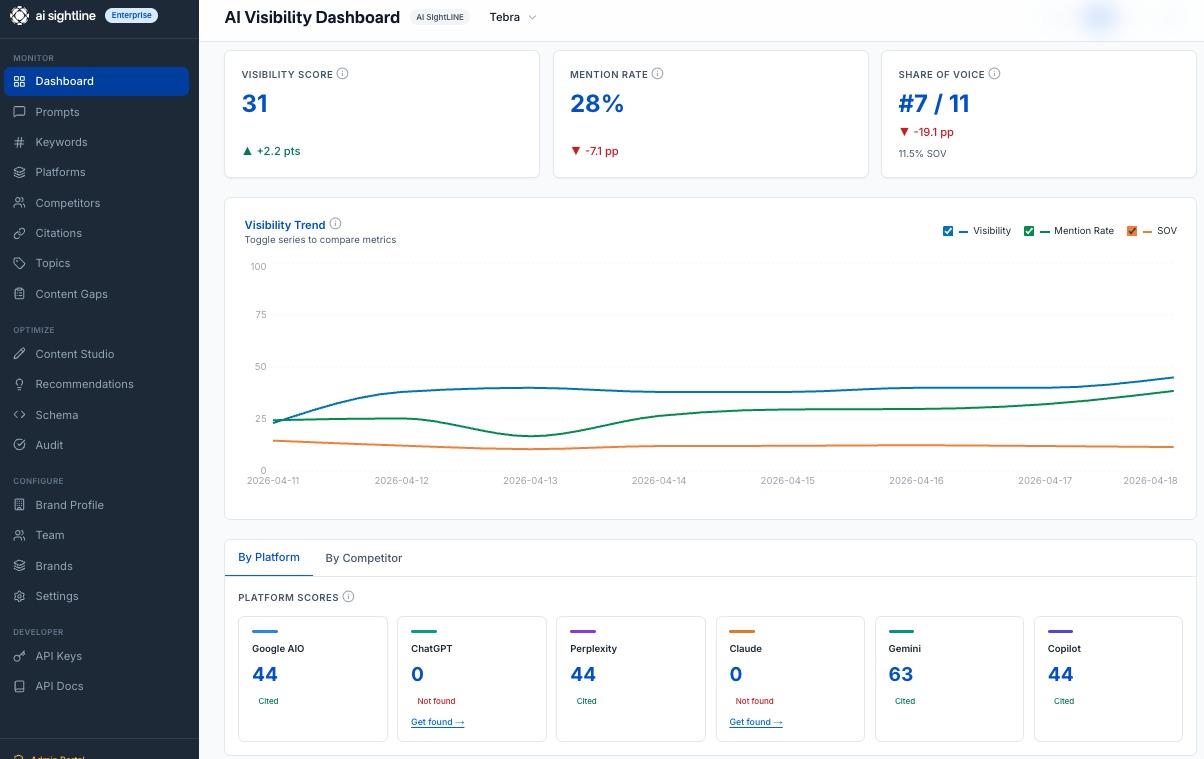
An AI visibility score is a composite metric that measures how often and how prominently your brand appears in AI-generated search responses across multiple platforms. It's the AI search equivalent of your Google search rankings -- a single number that tells you whether your brand is being found by AI.
AI Sightline calculates visibility scores by scanning your target prompts across each AI platform on a rolling cycle, then measuring mention frequency, citation placement, sentiment context, and co-mention patterns with competitors. The score normalizes these signals into a 0-100 scale per platform, with a composite score across all monitored platforms.
A brand scoring 70+ on a platform is showing up in the majority of relevant AI responses. A brand scoring under 20 has a serious AI visibility gap that needs attention. Most brands we see fall somewhere in the 15-45 range -- visible on some queries but invisible on most.
11. What are the biggest mistakes brands make with AI search visibility?
Five mistakes we see constantly:
Ignoring AI search entirely. The most common mistake. Brands that invest heavily in traditional SEO but never check whether AI platforms mention them. By the time they notice, competitors have built a citation advantage that's hard to close.
Optimizing for one platform only. Showing up in ChatGPT but invisible on Perplexity and Google AI Overviews means you're missing 60%+ of AI search traffic. Each platform has different behaviors and different source preferences.
Writing for search engines instead of for answers. AI search rewards content that directly answers questions with clear, specific, structured responses. Content stuffed with keywords but thin on substance gets ignored by AI models even if it ranks well on Google.
Never monitoring or measuring. You can't optimize what you don't measure. Without AI visibility monitoring, you're making changes and hoping they work. Tools like AI Sightline give you the feedback loop.
Treating it as a one-time project. AI search results change constantly. A brand cited by ChatGPT this week might be absent next week. AI visibility requires ongoing monitoring and continuous optimization -- not a single audit.
12. How long does it take to start showing up in AI search?
It depends on your starting position, but most brands see measurable changes within 2-6 weeks of consistent optimization.
Content structure improvements (headings, schema markup, direct answers) can show results on platforms with real-time retrieval -- like Perplexity and Google AI Overviews -- within days. ChatGPT and Claude, which blend training data with browsing, take longer to reflect changes.
The fastest wins typically come from:
Adding FAQ schema to existing high-performing pages (1-2 weeks to see AIO impact). Restructuring blog posts with question-based headings and direct answer leads (2-3 weeks). Publishing new, in-depth content on topics where AI platforms currently cite competitors but not you (3-6 weeks).
AI Sightline's recommendation engine identifies these quick wins automatically. The Pro plan at $149.95/mo generates up to 75 recommendations per month based on your actual scan data, prioritized by estimated impact.
13. Can I track whether my AI search optimization is working?
Yes. This is exactly what AI visibility monitoring tools are built for.
AI Sightline tracks your visibility score, citation count, mention frequency, and competitor comparisons across up to 6 AI platforms on a daily scan cycle. When you make changes to your content, schema, or publishing strategy, you can see the impact reflected in your next scan results.
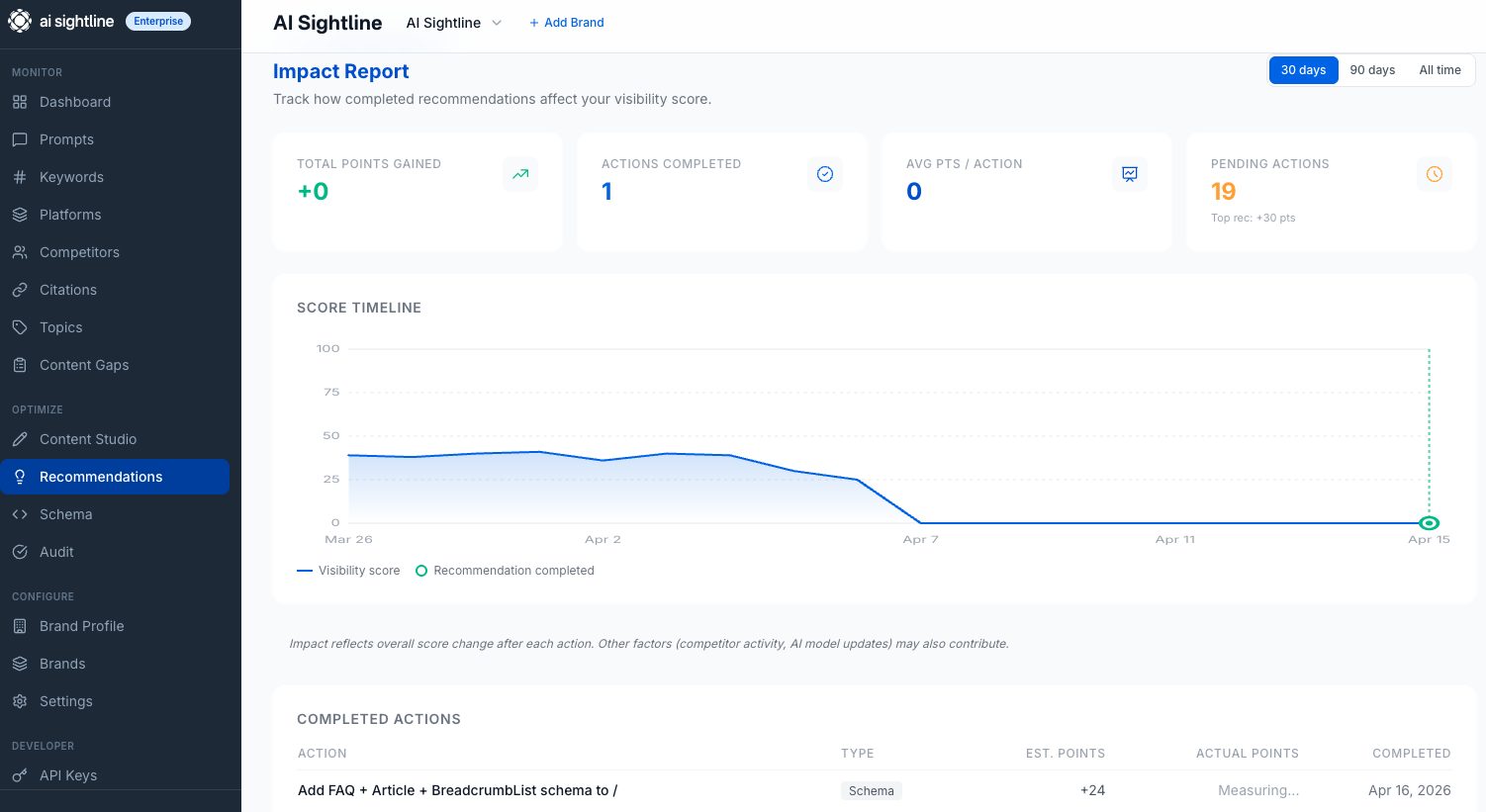
The Impact Report feature goes further: when you follow a recommendation from the engine and mark it complete, the system snapshots your metrics and measures the actual change over subsequent scans. Estimated impact vs. real results, side by side.
This feedback loop is what separates optimization from guessing. You make a change, you see the result, you learn what works for your brand on your platforms, and you do more of it.
14. How much does AI search monitoring cost?
AI visibility monitoring ranges from free to several hundred dollars per month depending on how many AI platforms, keywords, and prompts you need to track. Here's how AI Sightline's pricing compares:
| Plan | Price | Prompts | Platforms | Key Features |
|---|---|---|---|---|
| Free | $0/mo | 3 | 2 | Basic visibility monitoring, 2 recommendations/mo |
| Starter | $29.95/mo | 20 | 4 | Google AI Mode, API access, 10 recommendations/mo |
| Pro | $149.95/mo | 75 | 5 | Daily scans, full MCP access, 75 recommendations/mo, topic authority |
| Business | $289.95/mo | 200 | 6 | Content generation, auto-schema, 300 recommendations/mo |
| Agency | $549.95/mo | 400 | 6 | Full scale, 750 recommendations/mo, dedicated support |
For comparison, Otterly charges around $150/mo for a comparable prompt count to our Pro plan. Scrunch starts at $200/mo for 3 platforms. Profound runs $500+/mo. Semrush's AI tracking is an add-on to their existing $139.95/mo Pro plan and only covers 1 AI platform.
AI Sightline's Pro plan at $149.95/mo is the best value-per-platform in the category for brands serious about AI search visibility: 75 prompts, 5 platforms, daily scans, full API and MCP server access, and a recommendation engine that tells you what to fix.
See all plan details and start free.
15. What should I do right now to improve my AI search visibility?
Here's a prioritized action plan you can start today:
This week: Check your current AI search visibility. Sign up for a free AI Sightline account and run your first scan across 2 platforms. See where you stand. This takes about 30 seconds and requires no credit card.
This month: Audit your top 10 performing pages. Add FAQ schema markup. Restructure headings as questions. Make sure every section leads with a direct, quotable answer. These structural changes are the fastest path to AI search visibility improvement.
This quarter: Build a publishing cadence targeting the prompts where competitors get cited but you don't. AI Sightline's content gap recommendations identify these opportunities automatically on the Pro plan. Publish 2-4 in-depth pieces per month on your core topics.
Ongoing: Monitor your AI visibility scores weekly. Track which optimizations moved the needle using the Impact Report. Double down on what works. Cut what doesn't.
The brands that will dominate AI search in 2026 and beyond are the ones that start measuring and optimizing now -- while most competitors are still pretending AI search doesn't matter.
Start monitoring your AI search visibility -- free, 30 seconds, no credit card.
Get your free AI visibility score.
See how ChatGPT, Claude, Perplexity, Gemini, Google AIO, and Copilot talk about your brand.
Start freeSolo founder building AI visibility monitoring. Ships weekly. No venture capital, a lot of opinions about where AI search is going.