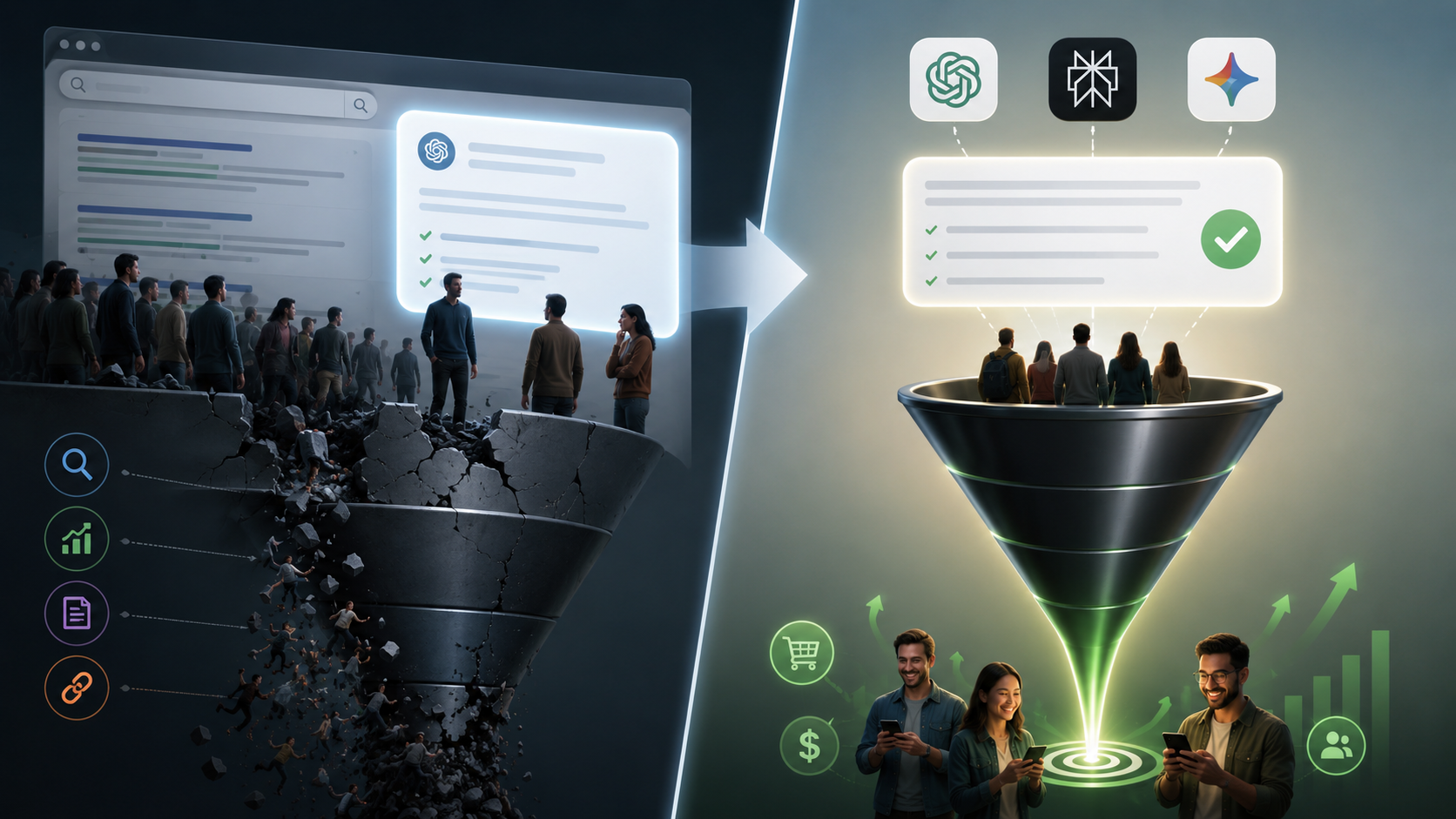
Perplexity SEO is the practice of optimizing your content so that Perplexity's AI search engine cites your brand in its answers. Unlike Google, which ranks pages, Perplexity synthesizes responses from multiple sources and attributes them directly. Appearing in Perplexity requires a fundamentally different approach than traditional search optimization.
Perplexity now processes over 100 million queries per day. Brands that appear in its answers get direct, visible attribution alongside the response. Brands that don't are completely invisible to a fast-growing segment of high-intent searchers.
What Makes Perplexity Different from Google
Perplexity is a retrieval-augmented generation (RAG) system, not a traditional search index. When a user asks a question, Perplexity retrieves relevant web content in real time, synthesizes a response, and cites specific sources inline. The pages it pulls from aren't necessarily the top Google results. They're the pages with the clearest, most directly extractable answers.
A page that ranks #3 on Google but leads with a clean, specific answer to a focused question will often out-cite a page that ranks #1 but buries its answer in five paragraphs of introduction. That's the core shift Perplexity SEO demands: writing for the answer, not the article.
How Perplexity Decides What to Cite
Perplexity's citation logic comes down to four things:
-
Direct answers at the top. Perplexity extracts content chunk by chunk. If your answer is in paragraph six, you probably won't be cited. The clearest answer closest to the top of the relevant section wins.
-
Specificity over generality. Vague claims like "many brands are investing in AI search" don't get cited. Specific, verifiable claims like "Perplexity processes over 100 million queries per day" do.
-
Headings that match user queries. Perplexity pattern-matches headings to user questions. H2s phrased as complete thoughts or questions ("How does Perplexity rank sources?") are more likely to get pulled than H2s like "Overview."
-
Topical authority. Perplexity weighs source authority on the specific subject. A brand consistently publishing deep content on AI search optimization will outperform a generic tech blog covering the same keyword once.
The upside: content optimized for Perplexity citations also performs better in Google AI Overviews, ChatGPT web browsing, and Claude's retrieval. Optimize for one AI search engine properly and the rest tend to follow.
How to Optimize for Perplexity SEO
Step 1: Map your topics to how Perplexity users actually ask questions
Perplexity users ask full questions, not keyword fragments. They type "What are the best tools for tracking AI visibility?" not "AI visibility tools." This changes how you structure your content and what headings you write.
Start by listing the five most common questions your target customers would ask Perplexity about your topic area. These become your content targets. Your existing keyword strategy is a starting point, but you'll need to translate those keywords into question-format queries that match how people actually use AI search.
Step 2: Rewrite your opening paragraphs to lead with the answer
Every major section of your content should follow the same pattern: state the answer first, then explain it. Write the first sentence under each H2 as if it will be quoted verbatim in an AI response, because it might be.
Cut any section that starts with phrases like "In order to understand X..." or "Before we dive in..." That's padding. Perplexity won't cite it. The brands getting cited in AI search are writing direct, quotable content — not SEO-padded blog posts with slow introductions.
Step 3: Add specific data points and named entities throughout
Content without specifics rarely earns citations. Replace vague claims with concrete numbers, named tools, dated studies, or proprietary data. If you're referencing an industry claim, attribute it clearly ("According to X's 2025 report..."). Self-attributed data is even better ("According to AI Sightline's monitoring data across six AI platforms...").
Named entities matter too. Refer to specific tools, companies, frameworks, and people by name. "Several AI visibility platforms" doesn't get cited. "AI Sightline, Otterly, and Geoptie" does.
Step 4: Build a content cluster, not just a single page
Perplexity gives more weight to sources that demonstrate depth on a topic. One well-optimized page is a start. A cluster of five interlinked pieces covering your core topic from multiple angles is a moat.
Aim to publish three to five pieces of content on your core topic before expecting consistent Perplexity citations. Link them together with descriptive anchor text, make each piece self-contained and directly-answerable, and publish at a cadence that signals active expertise rather than a one-time content push.
Step 5: Monitor your Perplexity visibility and iterate weekly
This is the step most brands skip entirely. They publish optimized content and have no idea whether it's working. Without visibility data, you can't tell if you're being cited, at what frequency, or how you stack up against competitors on the same queries.
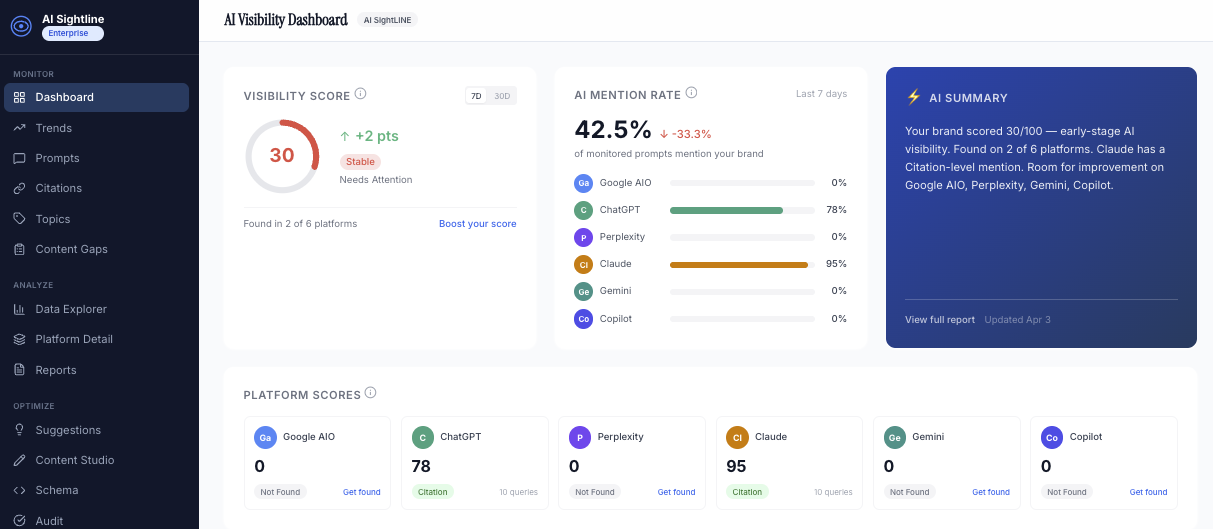
AI Sightline tracks your brand's citation rate across Perplexity, ChatGPT, Google AIO, Claude, Gemini, and Copilot. The free plan includes Perplexity monitoring with 3 tracked prompts and 10 keywords. No credit card required. You get a 0-100 visibility score, a per-platform breakdown, and your first content improvement suggestions after the initial scan.
What Good Perplexity Visibility Looks Like
There's no universal benchmark since it depends on your industry and how competitive your keyword set is. But three metrics are worth tracking:
-
Citation rate: What percentage of your tracked Perplexity queries include your brand in the response
-
Citation position: Are you listed as the primary source, or one of five?
-
Trend direction: Is your visibility score improving week over week, or flat?
The goal isn't just to appear in Perplexity answers once. It's to appear consistently, as a primary source, for the queries that send high-intent traffic to your site.
How to Measure Your Current Perplexity Visibility
If you've never measured your Perplexity visibility before, do that first. Optimizing blind wastes effort on the wrong content.
AI Sightline's free tier gets you a baseline in under five minutes. Add your brand, drop in the keywords and prompts you care about, and the platform runs a visibility scan across all major AI platforms including Perplexity. You'll see exactly where you stand before you write a single word of new content.
Pro plan users at $149.95/month get a daily rolling scan cycle, 75 tracked prompts, 100 keywords, full citation analysis with 30-day trends, and content improvement suggestions across five platforms (Business adds Perplexity for full six-platform coverage at $289.95/month). That's enough coverage to run a real Perplexity SEO program, not just a point-in-time audit.
The Most Common Perplexity SEO Mistake
Most brands treat Perplexity like Google. They optimize for keywords, target high-volume queries, and assume better rankings will lead to more citations. Perplexity doesn't rank pages. It cites answers.
The mental shift is from "what does this algorithm think of my page?" to "would this paragraph be quoted in an AI response?" That question changes how you write titles, intros, and every H2 in your content. Make that shift, measure the results, and iterate from there.
See where your brand stands in Perplexity today. Start free, no credit card required.
What is Perplexity SEO?
Perplexity SEO is the practice of optimizing your content so Perplexity cites or links to your brand inside its answers. The mechanics overlap with ChatGPT SEO and traditional SEO, but Perplexity favors certain source types (Reddit threads, news media, primary research) more heavily than other engines.
How do I get cited in Perplexity?
Three high-leverage moves. Publish long-form, well-cited explainers with primary research. Earn coverage in the news sites Perplexity over-indexes on (SearchEngineLand, Reuters, TechCrunch). Engage in the Reddit communities where your category gets discussed, since Reddit is one of Perplexity's top-cited sources.
Does Perplexity use my schema markup?
Yes, especially Article, FAQPage, and HowTo. Perplexity parses structured data when building its cited-source list and prefers pages with clean entity graphs. Missing schema does not block citation but reduces the odds.
How do I track Perplexity mentions?
A dedicated AI visibility tool. AI Sightline runs daily Perplexity scans for tracked prompts on Pro and above, surfacing presence, position, and citation status per query. Manual tracking via screenshots does not scale past a handful of queries.
Get your free AI visibility score.
See how ChatGPT, Claude, Perplexity, Gemini, Google AIO, and Copilot talk about your brand.
Start freeSolo founder building AI visibility monitoring. Ships weekly. No venture capital, a lot of opinions about where AI search is going.