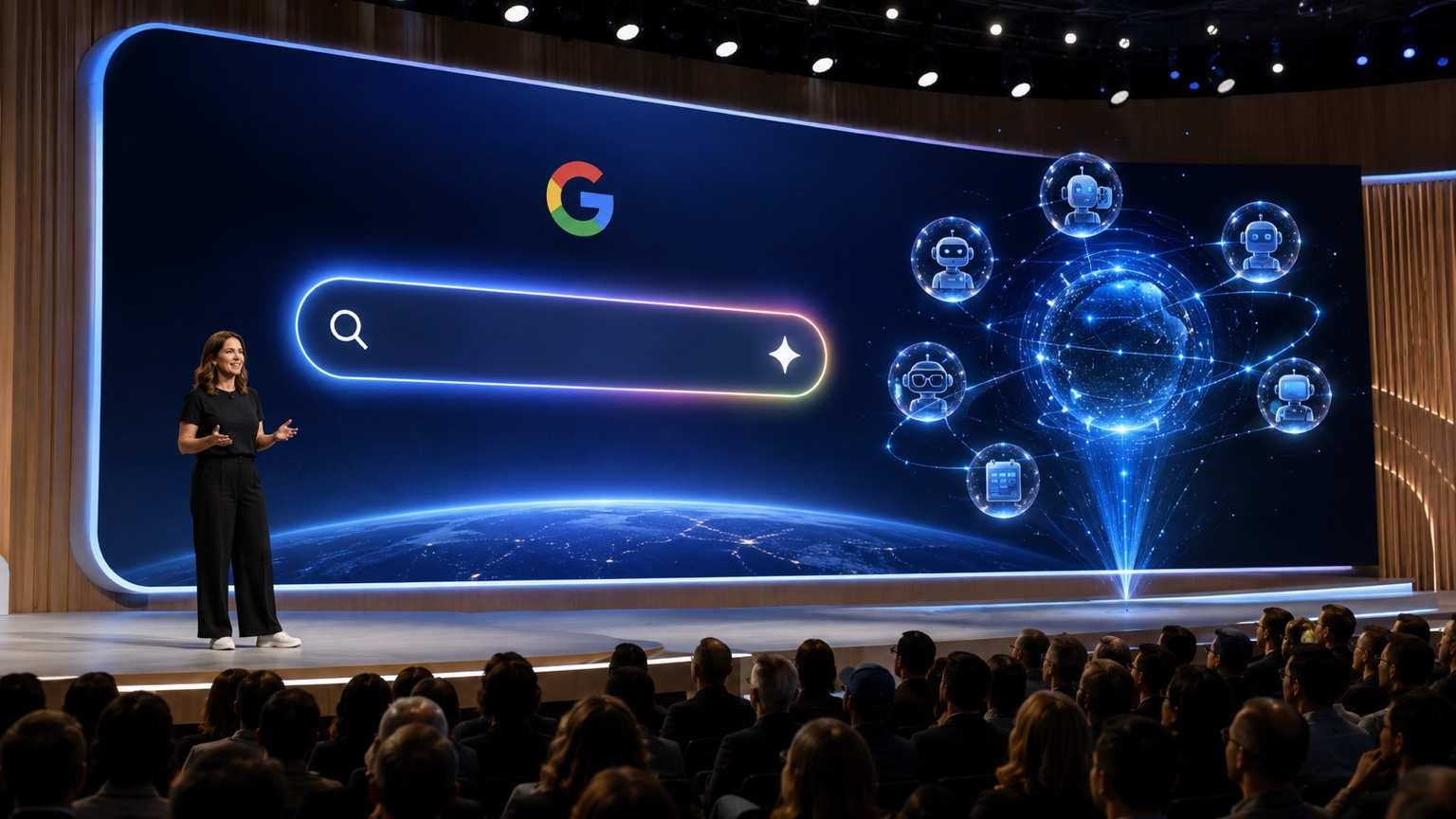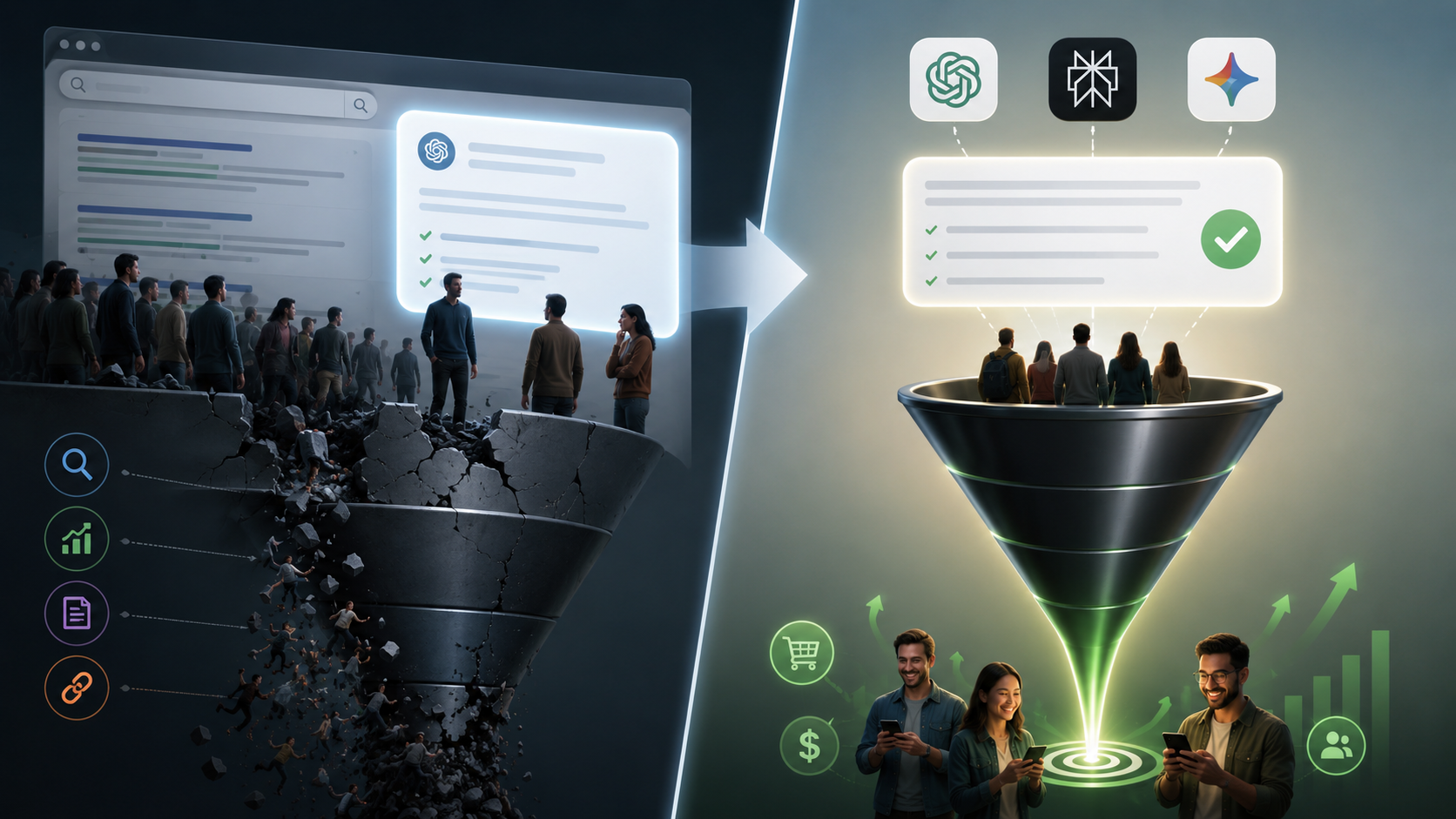
AI search is disrupting digital marketing by replacing the click with the answer. When ChatGPT, Perplexity, or Google's AI Overviews resolve a question right on the results page, people stop visiting websites. The funnel that paid search, SEO, content, and affiliate marketing all depend on starts to break at the very first step.
That is the threat. The opportunity is hiding inside it: the traffic AI search does send is smaller, but it converts several times better than ordinary organic visits. This guide covers both, with the data, and the playbook to adapt.
TL;DR
Roughly 60% of US Google searches now end without a click to any website, according to Semrush's zero-click study.
When an AI Overview appears, the top organic result loses about 58% of its clicks, Ahrefs found across 300,000 keywords, up from a 34.5% drop measured a year earlier.
One major publisher saw its click-through rate fall from 25.2% to 2.8% on searches with an AI Overview, an 89% collapse.
The plot twist: AI-referred visitors convert at roughly 4.4 times the rate of organic search, and far higher in B2B.
The new job for marketers is visibility, not just ranking. You have to show up inside the answer, then measure it.
What "AI search" actually means for marketers
AI search is any query answered by a generative engine instead of a list of blue links. That includes standalone tools like ChatGPT, Perplexity, Gemini, Claude, and Copilot, plus Google's AI Overviews and AI Mode that sit on top of traditional results.
The mechanic that matters is simple. These systems read the web, synthesize an answer, and hand it to the user directly. Sometimes they cite a source, often they do not, and either way the user rarely needs to click.
For two decades, digital marketing has been a machine for manufacturing clicks. Rank a page, win the click. Buy an ad, buy the click. Publish a review, earn the affiliate click. AI search removes the click as the unit of value, and that changes almost everything downstream.
The old model is breaking: what the data shows
The click-based economy is contracting in plain sight. Here are the numbers reshaping every channel at once.
Zero-click is now the default. About 60% of US searches conclude without a single click to an external site, per Semrush. On phones the share is even higher. The search result has become the destination.
AI Overviews gut the clicks that remain. Ahrefs' analysis of 300,000 keywords found the top-ranked page loses roughly 58% of its clicks when an AI Overview is present. That figure nearly doubled in a single year, which tells you the trend is accelerating, not stabilizing.
Publishers are the canary. DMG Media reported its click-through rate dropping from 25.2% to 2.8% when an AI Overview shows, an 89% decline. A study covered by The Guardian found sites pushed below an AI summary can lose as much as 79% of their traffic. Some have called it a traffic apocalypse.
The ad engine feels it too. Google's advertising revenue is still growing, reaching about $264.6 billion in 2024, but the growth rate is slowing. Search ads are priced on clicks, and a search that ends in an answer produces no click to sell. The business model and the product are now pulling in opposite directions.
Why this hits digital marketing specifically
Every major channel was tuned for a world where attention flows through a website visit. Take the visit away and each channel springs a different leak.
Channel | What AI search changes |
|---|---|
SEO and content | Ranking page one no longer guarantees traffic. The answer box absorbs the click before your page is seen. |
Paid search | Fewer searches end in clicks, so the same budget reaches fewer real visitors and CPCs face pressure. |
Affiliate | AI answers rarely include affiliate links, so the recommendation happens without your tracked click. |
Display and video | Fewer site visits mean fewer impressions, softer CPMs, and shrinking video inventory. |
PR and earned media | Coverage still shapes perception, but attribution gets harder as AI surfaces your story without a referral. |
The deeper problem is measurement. When influence moves into an answer you cannot see, your analytics show a flat or falling line even when your brand is shaping the decision. Marketers risk cutting the exact activities that are working, because the dashboard was built to count clicks that no longer happen.
The plot twist: AI traffic is smaller but far more valuable
Here is the part the doom headlines miss. The clicks AI search does pass through are among the best traffic on the internet.
AI referral volume is still small in absolute terms, around 1% of total traffic for most sites, but it is growing fast. Adobe found generative AI referrals to US sites grew more than tenfold in seven months, and Similarweb clocked AI platforms driving over 1.1 billion referral visits in June 2025, up 357% year over year. More than 800 million people now use ChatGPT every week, so the channel is compounding from a real base.
And it converts. Multiple 2026 analyses put AI-referred conversion at four to twenty times the rate of standard organic search, with one B2B dataset showing AI visitors converting at 14.2% against 2.8% for Google organic. The reason is intuitive: an AI visitor arrives pre-qualified, because a system they trust already recommended you inside the answer. They are acting on advice, not browsing a list.
So the strategic picture is not "traffic is dead." It is a trade: fewer visits, much higher intent. The marketers who win the next era will optimize for the answer, not the link.
The playbook: how to adapt digital marketing to AI search
You do not need to abandon SEO or paid search. You need to add a new layer on top of them, aimed at getting cited, recommended, and measured inside AI answers. Here is the order of operations.
1. Treat visibility as the new ranking
In AI search, the question is not "where do I rank," it is "do I appear in the answer at all, and how am I described." Start by measuring your presence across every major engine for the questions your buyers actually ask. You cannot improve a surface you cannot see, and most brands have never looked. AI Sightline tracks exactly this across ChatGPT, Perplexity, Gemini, Claude, Copilot, and Google AI Overviews.
2. Write for citation, not just for clicks
AI models cite content that answers a question cleanly and stands on its own. Lead each section with a direct, self-contained answer. Use specific numbers, dates, and named entities, because precise, verifiable statements are easier for a model to lift and attribute. Bury the answer under throat-clearing and you get skipped.
3. Build brand and entity authority
In AI search, brand authority is starting to beat raw topical authority. Models favor entities they can recognize and trust, so consistency matters: the same brand name, claims, and facts repeated across your site, third-party reviews, Wikipedia-grade references, and structured data. Being a well-defined entity is now a ranking factor of its own.
4. Diversify beyond the blue link
If a single algorithm can erase 79% of your traffic, that traffic was never really yours. Reinvest in channels you own and influence directly: email, community, first-party data, original research, and partnerships. The goal is to stay visible and valuable even when the referral never arrives.
5. Re-instrument measurement for a zero-click world
Sessions and keyword rankings no longer tell the whole story. Add the metrics that map to AI search: share of voice in AI answers, citation rate by platform, sentiment of how you are described, and the conversion rate of AI referral traffic specifically. Measure influence, not just clicks.
6. Monitor continuously, because answers change
AI responses are not static rankings you check once a quarter. The same prompt can return different brands week to week as models update and content shifts. Treat AI visibility like uptime: something you watch on an ongoing basis, with alerts when you appear or disappear.
How to measure AI visibility
A workable AI visibility program tracks four things, on a regular cadence, across each engine that matters to your market.
Presence and share of voice. How often you appear in answers for your priority prompts, versus competitors.
Citations. Which of your pages, and which third-party sources, the engines pull from when they mention your category.
Sentiment. Whether the way AI describes you helps or hurts the sale.
AI referral outcomes. The traffic and, more importantly, the conversions that AI engines actually send.
This is the gap AI Sightline is built to close. You add your brand and the prompts your buyers ask, and you get a visibility score, competitor share of voice, citation sources, and AI referral analytics in one place, with an API and MCP server so the data flows into the tools you already use.
Common mistakes to avoid
Ignoring AI because the traffic looks tiny. One percent of visits at four-times-plus conversion is not a rounding error, it is your highest-intent channel forming in real time.
Optimizing only for Google. ChatGPT and Perplexity answer hundreds of millions of queries that never touch a traditional search box. Tracking one engine gives you a blind spot, not a strategy.
Chasing clicks you can no longer get. Doubling down on thin, keyword-stuffed pages to claw back rankings is fighting the last war. More content is no longer a reliable way to grow.
Flying without instruments. If you are not measuring AI visibility, you are guessing about the channel reshaping every other channel.
What's next for AI search and marketing
Expect the search and AI platforms to rebuild their economics around answers rather than clicks. Sponsored placements inside AI responses and AI-native ad formats are the obvious next step, since the old pay-per-click model cannot survive a click-free results page.
For marketers, the throughline is a shift from traffic to influence. The brands that get recommended inside the answer, and that can prove it with data, will own the next decade of demand the way page-one rankings owned the last one. The tactics will keep changing. The principle will not: show up where AI answers.
Frequently asked questions
Is AI search killing SEO?
No, but it is changing the job. SEO is moving from "rank a page to win a click" toward "structure content and authority to get cited in answers." The fundamentals of quality, structure, and trust still apply, they just serve a new reader: the model.
How is AI search different from traditional search?
Traditional search returns a list of links and sends you clicks. AI search returns a synthesized answer and usually keeps the user on the page. That makes citations and brand mentions, rather than rankings and sessions, the thing to optimize and measure.
Why does AI referral traffic convert so much better?
Because the visitor arrives on a recommendation. A system they trust has already vetted and named your brand inside its answer, so the person who clicks through is closer to a decision than a typical searcher scanning ten options.
How do I track whether my brand shows up in AI answers?
Use a tool that runs your priority prompts across the major engines on a schedule and records when and how your brand appears. AI Sightline does this across ChatGPT, Perplexity, Gemini, Claude, Copilot, and Google AI Overviews, with share of voice, citations, sentiment, and AI referral analytics.
See where you stand
AI search is already deciding which brands get recommended in your category. The only question is whether you can see it.
Start free, no credit card required, and get your AI visibility score in about a minute. Create your account and find out where you show up, where your competitors beat you, and what to fix first. See plans and pricing when you are ready to scale. Show up where AI answers.
Sources and further reading
Semrush, zero-click and AI Overviews study: semrush.com
Ahrefs, AI Overviews reduce clicks by 58%: ahrefs.com
Digiday, DMG Media click-through collapse: digiday.com
The Guardian, AI summaries and news traffic: theguardian.com
Forbes, zero-click and the "traffic apocalypse": forbes.com
Statista, Google advertising revenue: statista.com
Adobe, the rise of generative AI referral traffic: business.adobe.com
Similarweb, AI referral traffic winners: similarweb.com
Emarketed, AI referral conversion value: emarketed.com
Backlinko, ChatGPT user statistics: backlinko.com
Get your free AI visibility score.
See how ChatGPT, Claude, Perplexity, Gemini, Google AIO, and Copilot talk about your brand.
Start freeSolo founder building AI visibility monitoring. Ships weekly. No venture capital, a lot of opinions about where AI search is going.