
ChatGPT does not have a search results page. There is no position #1, no page 2, and no blue links to click. When someone asks ChatGPT a question, it generates an answer, and it either mentions your brand in that answer or it doesn't. That binary outcome is what ChatGPT SEO is about.
The stakes are real. ChatGPT has over 200 million weekly active users, and a growing share of them use it to research products, compare tools, and get recommendations before making purchase decisions. If your brand doesn't appear in those answers, you're invisible to a channel that's growing faster than any other in digital marketing.
This guide covers exactly how ChatGPT decides what to cite, what you can do to increase your citation rate, and how to measure whether it's working.
TL;DR: ChatGPT SEO in 5 Points
-
ChatGPT citations are driven by content quality, specificity, structure, and authority signals, not by keyword density or backlinks alone
-
Only 12% of brands ranking on Google's first page for a keyword are also cited by ChatGPT for equivalent queries (AI Sightline data)
-
The most impactful single change you can make: rewrite your content so each section opens with a direct, quotable answer to the question the heading implies
-
ChatGPT with search enabled pulls from live web content; ChatGPT without search relies on training data. Your strategy must account for both
-
Measuring ChatGPT visibility requires a dedicated tool like AI Sightline; Google Search Console cannot show you whether you're being cited in ChatGPT
What "ChatGPT SEO" Actually Means
ChatGPT SEO is the practice of optimizing your brand's web content, online presence, and authority signals to increase the likelihood that ChatGPT cites, recommends, or mentions your brand when users ask relevant questions.
It is a subset of GEO (Generative Engine Optimization), which covers all AI-powered search engines. But ChatGPT deserves specific attention because it is the most widely used AI assistant by a significant margin and because it has two distinct operating modes that require slightly different optimization approaches.
ChatGPT with search vs. without search
Understanding how ChatGPT retrieves information is essential before you optimize for it.
ChatGPT with search enabled (available on paid plans) performs a real-time web retrieval step before generating its answer. It searches the web, retrieves relevant content from indexed pages, and uses that content as source material. In this mode, ChatGPT behaves more like Perplexity: your content needs to be indexed, accessible, and structured in a way that makes it easy to extract.
ChatGPT without search relies entirely on its training data. The model learned from a massive corpus of web content up to a certain cutoff date, and its answers draw from patterns learned during that training. In this mode, the only way to influence what ChatGPT says about your brand is to have been well-represented in high-quality, widely-cited web content before the model's training cutoff.
For most brands, the practical implication is this: create high-quality, well-structured content now, get it indexed and cited broadly, and it will feed both modes. Content that gets real-time retrieval citations today will eventually make it into future training runs.
How ChatGPT Decides What to Cite
ChatGPT doesn't follow a published ranking algorithm the way Google does. But based on AI Sightline's analysis of citation patterns across tens of thousands of AI responses, several consistent signals drive whether a brand or piece of content appears in ChatGPT answers.
Specificity of claims
ChatGPT prefers content with verifiable, specific claims over vague generalizations. A page that says "AI search is growing and important for marketers" gets ignored. A page that says "AI-powered search referral traffic grew 3,500% in 2025, and ChatGPT now has over 200 million weekly active users" gives the model something concrete to extract and quote.
Specificity signals expertise. It tells the model that a human with real knowledge wrote the content, rather than generic filler. Every vague qualifier in your content ("many," "significantly," "rapidly") is an opportunity to replace it with a number.
Structural clarity
ChatGPT extracts content much more reliably when it's logically organized. Clear headings, opening sentences that state the section's main point directly, and content that makes sense out of context all improve citation rates.
The first 1 to 2 sentences under each H2 heading are the highest-priority citation targets. These are the sentences most likely to be pulled into an AI-generated answer. If those sentences bury the point or lead with context-setting rather than the answer itself, the model will often skip past them.
Named entities and brand mentions
AI models respond to named entities: specific companies, tools, people, frameworks, and metrics. Content that names ChatGPT, Perplexity, Claude, and specific competitors is more useful to an AI generating an answer about AI tools than content that refers to "various AI platforms." Name things specifically.
For your own brand: make sure your brand name, product name, category, and core use cases appear together clearly and consistently across your content. If ChatGPT can't confidently identify what your brand is and who it's for, it won't cite it.
Domain authority and citation network
ChatGPT training data overrepresents content from high-authority domains: major publications, widely-cited research, established industry blogs. Backlinks from these domains signal to both Google and to the AI training corpus that your content is authoritative.
This is one place where traditional SEO and ChatGPT SEO directly overlap. Building backlinks from credible, high-authority sources helps your Google rankings and improves your representation in AI training data simultaneously.
Recency and freshness
For ChatGPT with search enabled, recent content has an advantage because it's more likely to appear in real-time retrieval results. For training-data-based answers, recency matters less, but updating and republishing older content with new data and better structure can improve its representation in future model versions.
8 ChatGPT SEO Tactics That Work
These tactics are ordered by impact and ease of implementation. Start with the first three before working down the list.
1. Rewrite your section openings as direct answers
This is the single most impactful change you can make today. Go through your most important pages and rewrite the first sentence under each H2 heading so it directly answers the question the heading implies.
Before: "When it comes to improving visibility in AI search, there are quite a few things to consider and it's worth taking a methodical approach to the problem."
After: "Improving visibility in AI search requires four changes to your content: more specific data, direct answers at the opening of each section, structured definitions for key terms, and consistent named entity usage."
The second version is immediately quotable. The first is not. ChatGPT will use the second version and skip the first.
2. Add a definitions section to every pillar page
When ChatGPT users ask "what is [term]?", the model looks for clear, standalone definitions it can quote. If your content defines key terms precisely and early, you become the citation source for those definition queries.
Write each definition as a single sentence under 40 words that could be quoted out of context and still make complete sense. The formula: [Term] is [what it is] that [what it does], [key distinguishing characteristic].
Example: ChatGPT SEO is the practice of optimizing your brand's web presence to increase the likelihood that ChatGPT cites or recommends your brand in response to relevant user queries, as distinct from traditional SEO which targets Google's link-based ranking algorithm.
3. Replace vague claims with specific numbers
Audit your most important pages for vague qualifiers and replace every one you find with a specific number, percentage, date, or named source. This signals research-backed authority and gives ChatGPT concrete data to extract.
Some patterns to target:
-
"Growing rapidly" becomes "grew 3,500% in 2025"
-
"Many marketers" becomes "67% of enterprise marketing teams"
-
"Significantly improves results" becomes "increases citation rate by 2.4x"
-
"A leading platform" becomes "ChatGPT, with 200M+ weekly active users"
If you don't have original data for every claim, cite credible third-party sources and attribute explicitly: "According to [source]..." This attribution pattern also appears in AI-generated answers, which amplifies your source credibility.
4. Implement complete schema markup
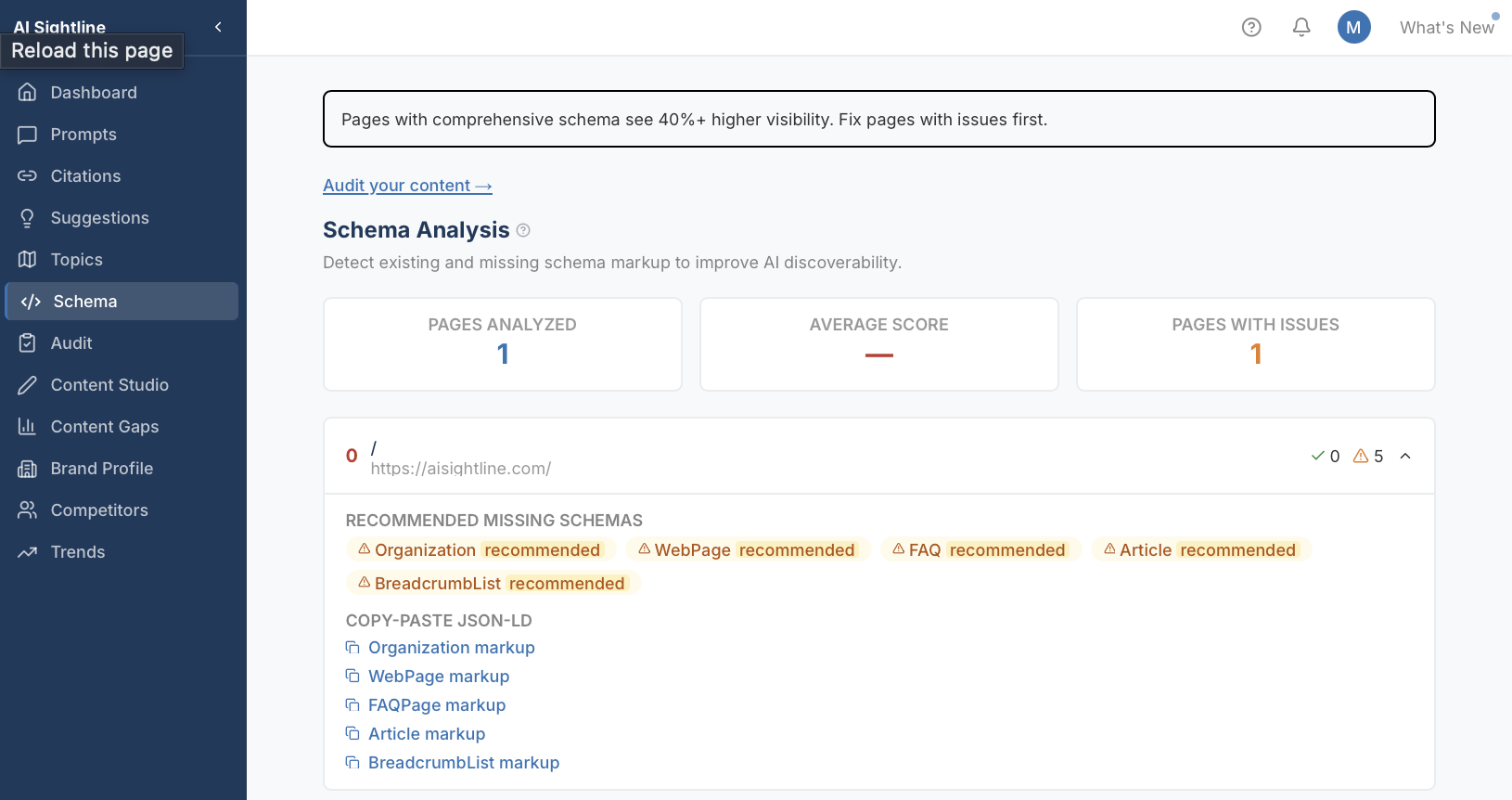
JSON-LD schema markup is the most direct technical signal you can send to AI retrieval systems. Article schema communicates the author, publication date, and topic. FAQPage schema gives ChatGPT a structured list of question-and-answer pairs it can extract directly. HowTo schema maps step-by-step processes that appear frequently in AI-generated instructional answers.
AI Sightline's content audit tool checks your schema implementation and flags gaps. Based on our monitoring data, pages with complete, validated schema markup have meaningfully higher citation rates in ChatGPT's search mode compared to pages with no structured data.
5. Build topical depth through content clusters
A single well-optimized page is a good start. A site with 10 to 15 interlinked pages covering every angle of a topic is what gets you treated as an authoritative source.
ChatGPT's training data reflects topical authority: domains that covered a subject deeply and consistently appear as credible sources. If AI Sightline has 12 articles about GEO and ChatGPT SEO, and a competitor has 2, the domain with 12 will be cited more frequently even if the individual articles are similar in quality.
Pick your top 3 topic clusters. Map every variation of the topic, publish supporting content for each, and interlink them aggressively with your pillar pages.
6. Earn high-authority mentions and backlinks
Mentions from high-authority sources feed both the Google ranking algorithm and the AI training corpus. A citation from Search Engine Journal, HubSpot, Moz, or a major industry publication carries disproportionate weight.
Guest posting on established SEO and marketing blogs, pitching data-driven original research to journalists, and getting featured in roundup articles are the fastest ways to build this signal. One link from a domain with 90+ domain authority is worth more for ChatGPT SEO than 50 links from unknown blogs.
7. Optimize for ChatGPT's "Explore" and shopping queries
ChatGPT's search mode is used heavily for product research and tool comparisons. Queries like "best tools for AI visibility monitoring" and "compare ChatGPT SEO platforms" are high-value commercial queries where brand citations translate directly to purchase intent.
To capture these: create dedicated comparison pages that name your top competitors and explain the difference objectively. Honest comparisons ("AI Sightline vs Otterly: which is better for agencies?") are highly credible to AI models because they signal confidence rather than avoidance. These pages also tend to rank well in Google for comparison searches.
8. Monitor your ChatGPT citation rate and iterate
ChatGPT SEO without measurement is guesswork. You need to know your current citation rate, which prompts you appear in, which prompts you don't appear in, and how your performance compares to competitors.
AI Sightline runs automated scans across 6 AI platforms including ChatGPT, tracks your citation rate per prompt, and surfaces the specific queries where competitors appear but you don't. The Starter plan at $29.95/month covers 20 prompts and 4 AI platforms, which is enough to establish a baseline and start identifying gaps.
What Not to Do: Common ChatGPT SEO Mistakes
Keyword-stuffing content for ChatGPT
Traditional SEO taught many marketers to optimize keyword density. ChatGPT does not respond to keyword density. Repeating "ChatGPT SEO" 25 times in a 1,000-word article makes your content worse, not better. Write for clarity and specificity. The keyword appears naturally when you're actually covering the topic well.
Assuming Google rankings are enough
This is the most common and costly mistake. A first-page Google ranking does not mean ChatGPT knows your brand exists. Only 12% of page-1 Google rankings translate to ChatGPT citations for equivalent queries. You need a separate optimization strategy for AI search.
Publishing thin content to "cover" topics
ChatGPT extracts from content that demonstrates expertise. A 300-word page that skims the surface of a topic will never be cited. Pillar pages that cover a subject with genuine depth: specific data, clear definitions, real examples, and structured step-by-step explanations. Those are the ones that get cited repeatedly.
Ignoring older content
Many brands focus all their optimization effort on new content while letting older pages decay. High-performing old pages that rank well in Google are often under-optimized for AI citation. Retrofitting them with GEO tactics (better definitions, more data, cleaner structure, complete schema) is often the fastest path to improved ChatGPT visibility.
Not distinguishing between citation and recommendation
Being cited by ChatGPT is not the same as being recommended. A citation might say "AI Sightline is one option, though some users report limited platform coverage." That's a citation, but it's not a positive one. AI Sightline tracks citation quality, distinguishing between Citations (direct recommendation), References (neutral comparison), and Mentions (named in passing). Knowing your citation quality tells you whether you need more visibility or better positioning.
How to Measure ChatGPT SEO Performance
Standard analytics tools cannot measure ChatGPT visibility. Google Search Console shows you Google traffic. It says nothing about whether ChatGPT users are seeing your brand.
What to track
Citation rate: The percentage of your target prompts where your brand appears in ChatGPT's response. This is your headline metric.
Share of voice: How often your brand appears versus competitors for the same set of prompts. A 30% citation rate is excellent if competitors average 10%. It's a problem if they average 70%.
Prompt coverage: Which specific prompts trigger a citation and which don't. Gaps indicate content opportunities: topics you need to cover more thoroughly.
Citation sentiment: Whether the citations are positive (recommended), neutral (mentioned), or negative (compared unfavorably). Sentiment trends over time tell you whether your brand positioning is landing.
How to track it
AI Sightline automates all of this. Set up your brand, add your target prompts (the queries your potential customers are typing into ChatGPT), and connect your competitor brands. The platform runs scans on a 7-day cycle for free and Starter plans, and 3-day cycles for Pro and above, then delivers a visibility dashboard showing citation rate, share of voice, and specific prompt-level data for each AI platform.
The free plan includes 3 AI platforms, 10 keywords, and 3 competitor comparisons, enough to see where you currently stand in ChatGPT and identify your biggest gaps.
Getting Started: Your First 30 Days of ChatGPT SEO
If you're starting from zero, here's a focused sequence that produces results within 30 days.
Week 1: Baseline and audit
Create a free AI Sightline account and run an initial scan of ChatGPT using 10 to 15 prompts that represent the questions your customers are actually asking. This gives you a baseline citation rate and identifies which prompts already return your brand.
Simultaneously, audit your 5 best-performing content pages for GEO readiness: are the section openings direct answers? Are key terms defined clearly? Are specific numbers present?
Week 2: Fix your existing content
Retrofit your 5 audit pages with ChatGPT SEO improvements. Rewrite section openings, add definitions, replace vague claims with numbers, and verify schema markup. These changes cost no content budget and often produce visible citation improvements within 2 to 3 weeks as ChatGPT's search index updates.
Week 3: Fill your biggest content gaps
Look at the prompts in your baseline scan where competitors appear but you don't. These are your priority content gaps. Pick the 2 to 3 gaps with the highest commercial intent and plan content specifically designed to close them.
Week 4: Build your first content cluster
Identify your highest-value topic cluster (likely whatever your core product solves) and map every supporting article you need to establish topical authority. Publish the first 2 supporting articles and interlink them with your pillar page.
By the end of 30 days you'll have a baseline, improved existing content, new content targeting specific gaps, and a clear roadmap for the next 60 days.
The Bottom Line on ChatGPT SEO
ChatGPT SEO is not a replacement for traditional SEO. It is an additional channel that requires different tactics, different content structure, and different measurement tools. Brands that treat it seriously today will have a compounding advantage as AI search continues to grow.
The core principle is simple: make your content easy for AI models to extract, quote, and synthesize. Direct answers, specific data, clear definitions, and structured content. That's the foundation. Everything else (schema markup, topical authority, backlink building, content clusters) amplifies the signal.
Start with your best existing content, retrofit it for AI citation, measure the results, and iterate. The brands gaining the most ChatGPT visibility right now are not starting from scratch. They're taking content that already has domain authority and making it AI-ready.
Start your free AI Sightline scan to see your current ChatGPT citation rate. No credit card required.
Related reading: GEO vs SEO: The Complete Guide, How to Measure and Benchmark Your AI Visibility Score , and How to Get Your Brand Cited by AI Search Engines: Platform-by-Platform Guide
What is ChatGPT SEO?
ChatGPT SEO is the practice of optimizing your content so that ChatGPT cites or mentions your brand inside its answers. It overlaps with traditional SEO (schema, structured data, topical authority) but adds prompt-level optimization that traditional SEO ignores. The deliverable is presence inside an AI response, not a SERP rank.
How do I get cited by ChatGPT?
Three levers. First, build topical authority through long-form content clusters around the prompts your buyers ask. Second, add FAQ and HowTo schema so ChatGPT has a clean entity graph to cite. Third, earn high-trust backlinks from domains ChatGPT already cites (Reddit, SearchEngineLand, Wikipedia, ahrefs.com, semrush.com). All three compound.
Does ChatGPT use Google search results?
When grounding is enabled (default for most ChatGPT.com queries since late 2024), yes. ChatGPT calls OpenAI search and Bing under the hood for fresh information. Without grounding it relies on its training cutoff, which means recently published content will not appear until the next major model update.
How fast does ChatGPT pick up new content?
Grounded queries can surface content within hours of publication if the page is indexed in Bing or OpenAI search and well-linked. Untraining-data citations (the kind that show up without grounding) only refresh when OpenAI ships a new model, which has historically been once or twice a year.
Get your free AI visibility score.
See how ChatGPT, Claude, Perplexity, Gemini, Google AIO, and Copilot talk about your brand.
Start freeSolo founder building AI visibility monitoring. Ships weekly. No venture capital, a lot of opinions about where AI search is going.