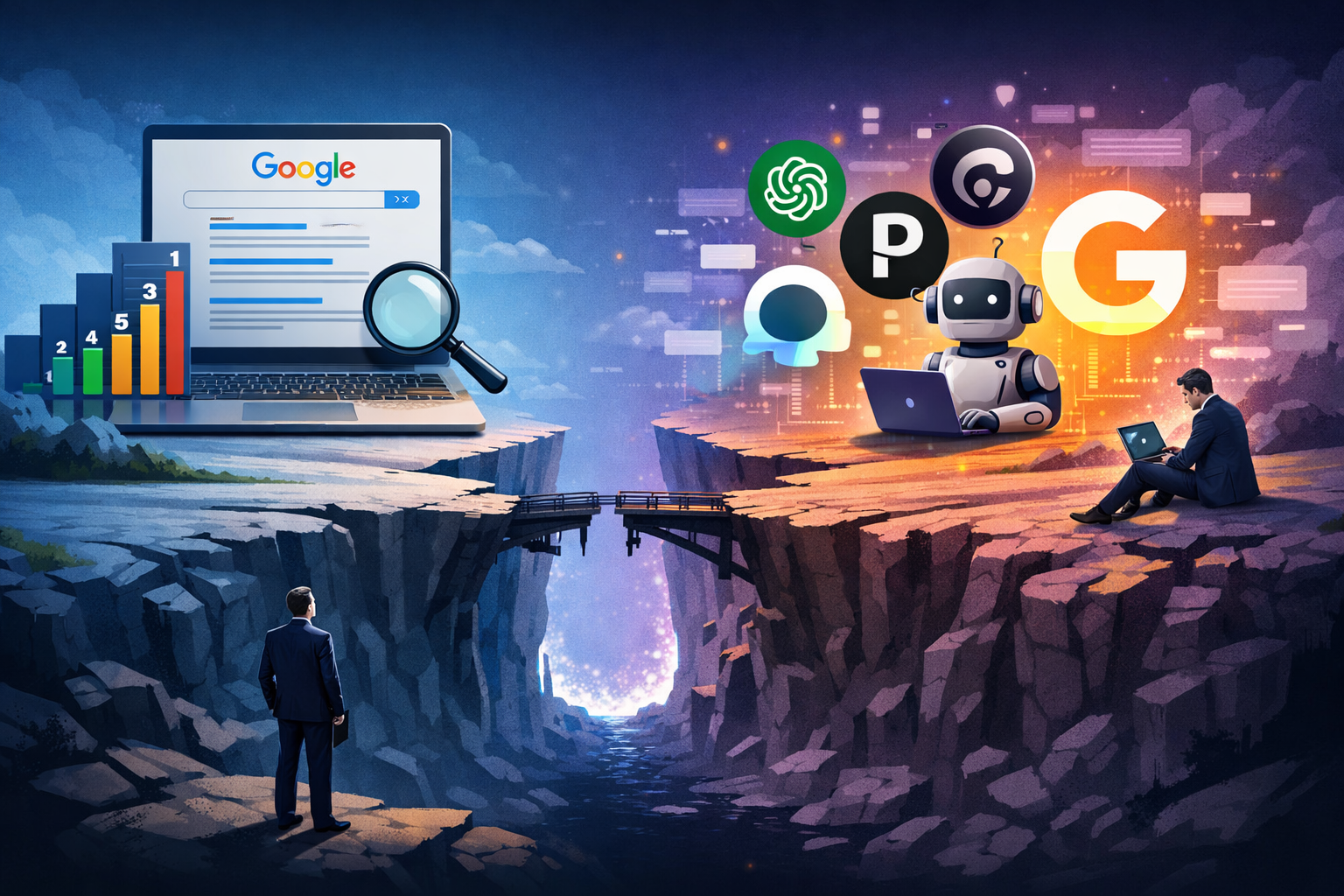
SEO and GEO are not the same thing. SEO (Search Engine Optimization) gets your content ranking in Google's blue links. GEO (Generative Engine Optimization) gets your brand cited in AI-generated answers from ChatGPT, Perplexity, Claude, and Google's AI Overviews. In 2026, you need both, but most marketers are only doing one of them.
The gap between SEO performance and AI visibility is wider than most brands realize. According to AI Sightline's analysis, only 12% of brands ranking on Google's first page for a given keyword are also cited by ChatGPT for equivalent queries. Ranking #1 in Google does not mean AI models know you exist.
This guide covers everything: what GEO is, how it differs from SEO, where they overlap, and exactly what to do to win in both channels. If you came here because you keep hearing about "GEO" and want to understand what it actually means for your business, you're in the right place.
TL;DR: GEO vs SEO at a Glance
-
SEO optimizes content for traditional search engine rankings. It targets Google's algorithmic ranking signals: backlinks, page authority, keyword placement, technical health, and user engagement.
-
GEO optimizes content for AI citation. It targets the patterns that cause ChatGPT, Perplexity, Claude, Gemini, and Google's AI Overviews to reference your brand, quote your content, and recommend your products.
-
AI search referral traffic grew 3,500% in 2025. Twenty-five percent of Google searches now trigger an AI Overview before the organic results.
-
Only 12% of page-1 Google rankings translate to AI citations for the same query (AI Sightline data).
-
Brands visible across 3 or more AI platforms have 2.4x higher composite visibility scores than those visible on just 1 to 2.
-
The tactics are different. The measurement is different. But the goal is the same: get found by the people looking for what you offer.
What is SEO?
Search Engine Optimization (SEO) is the practice of improving your website's visibility in traditional search engine results pages, primarily Google. SEO encompasses three main disciplines: technical SEO (site speed, crawlability, structured data), on-page SEO (keyword targeting, content quality, meta tags), and off-page SEO (backlinks, domain authority, brand mentions).
SEO has been the dominant digital marketing channel for over two decades. Google processes roughly 8.5 billion searches per day, and organic search drives more traffic than any other single channel for most websites. A first-page ranking for a high-volume keyword can generate thousands of visitors per month.
The core mechanics of SEO are well understood. Google's algorithm evaluates hundreds of signals to determine which pages best answer a given query, then ranks them accordingly. Publishers have spent years reverse-engineering those signals to build content that ranks.
What SEO is good at
SEO is excellent at capturing high-intent, search-driven demand. When someone searches "best project management software," they want a recommendation, and a well-optimized comparison page can capture that intent at scale.
SEO is also predictable. Rankings are visible, traffic is measurable, and the feedback loops are relatively tight. You can see which keywords drive clicks, which pages convert, and where to invest more content effort.
The limitation: SEO tells you how visible you are to humans clicking on links. It says nothing about how visible you are to AI models generating answers.
What is GEO?
Generative Engine Optimization (GEO) is the practice of optimizing your brand's content and online presence to increase visibility, citations, and favorable mentions in AI-powered search engines including ChatGPT, Perplexity, Google's AI Overviews, Claude, Gemini, and Microsoft Copilot.
GEO is a newer discipline, emerging as AI search tools became mainstream in 2023 and 2024. When someone asks ChatGPT "what's the best AI visibility tool?", GEO is what determines whether your brand appears in that answer, how prominently it's featured, and whether it's framed positively or neutrally.
Unlike traditional SEO, GEO is not about ranking in a list of blue links. It's about being woven into the fabric of AI-generated responses. The output is not a rank position. It is a citation, a recommendation, or a brand mention inside a paragraph that an AI model produces on the fly.
Why GEO is different from SEO
AI models don't crawl your site the way Google does. They were trained on large corpora of text, they pull from indexed web content in real time (in the case of tools like Perplexity), and they synthesize answers based on what appears most authoritative, specific, and factual. The signals they respond to are fundamentally different from Google's ranking algorithm.
To be cited by an AI model, your content needs to be structured in a way that's easy to extract, quote, and synthesize. Vague claims, marketing language, and content that buries the answer three paragraphs down performs poorly in AI search. Direct answers, specific data, and clearly structured definitions perform well.
GEO vs SEO: Core Differences
The table below captures the key differences between GEO and SEO across the dimensions that matter most:
| Dimension | SEO | GEO |
|---|---|---|
| Target system | Google (primarily), Bing | ChatGPT, Perplexity, Claude, Gemini, Google AIO, Copilot |
| Output | Ranked list of links | AI-generated answer with embedded citations |
| Success metric | Rank position, organic traffic | Citation rate, brand mention frequency, share of voice |
| Key signals | Backlinks, page authority, keyword density, technical health | Content specificity, direct answers, named entities, data density, structured definitions |
| Content style | Optimized for scanners + algorithms | Optimized for extraction and synthesis by AI |
| Measurement tool | Google Search Console, Ahrefs, SEMrush | AI visibility platforms (AI Sightline, Otterly, Perplexity monitoring) |
| Feedback loop | Days to weeks | Varies by AI model's indexing and training cycle |
| Primary benefit | Clicks and traffic | Brand authority, trust signals, purchase intent influence |
| Established since | Late 1990s | 2023 to present |
The most important difference: SEO is about where you rank in a list. GEO is about whether you're mentioned at all, and how.
Where GEO and SEO Overlap
GEO and SEO are not opposing disciplines. They're complementary, and the best content strategy serves both simultaneously.
Several factors that help SEO also help GEO. High-quality backlinks signal authority to both Google and to AI models that pull from indexed web content. Structured data (schema markup) helps Google understand your content and also makes it more extractable by AI models. Technical page health (fast load times, clean HTML, proper canonicalization) helps Google crawl your content efficiently and also helps AI tools index it.
Content that directly answers questions is good for both channels. Google's AI Overviews reward the same direct, structured answers that ChatGPT and Perplexity favor. If you write your H2 headings as full questions ("How do AI models decide what to cite?") and open each section with a clear, concise answer, you're optimizing for featured snippets, AI Overviews, and third-party AI citations simultaneously.
The key overlap principle: content optimized for AI citation is also excellent for traditional SEO, but the reverse is not always true. SEO content can be bloated, keyword-stuffed, and buried under promotional language. That content will struggle in AI search even if it ranks well in organic. The cleaner, more direct, more data-rich approach that GEO requires tends to improve SEO performance as a side effect.
Why GEO Matters Right Now
The numbers make a compelling case for prioritizing GEO in your 2026 content strategy.
AI search adoption is accelerating. Referral traffic from AI-powered search tools grew 3,500% in 2025. This is not a rounding error. Perplexity alone surpassed 15 million daily active users in late 2024. ChatGPT's search feature is now used by a significant portion of its 200 million weekly active users.
Google's AI Overviews are displacing traditional organic rankings. Twenty-five percent of Google searches now trigger an AI Overview at the top of the results page. For informational queries, exactly the type of content most brands publish, that number is higher. When an AI Overview appears, it significantly reduces clicks to organic results below it. If your brand is not in the AI Overview, you're invisible for that query even if you rank #1 organically.
The citation gap is real and measurable. AI Sightline's monitoring data shows that only 12% of brands ranking on Google's first page for a keyword are also cited by ChatGPT for equivalent queries. This means 88% of brands with strong SEO have essentially zero AI search visibility. That's a wide-open opportunity for brands willing to invest in GEO now.
The market is still early. The GEO tools market was valued at approximately $1.1 billion in 2026 and is projected to reach $17.1 billion by 2034, a compound annual growth rate of 40.6%. The brands building GEO competency today will have a significant first-mover advantage as AI search becomes the dominant discovery channel.
How AI Models Decide What to Cite
Understanding how AI search works at a mechanical level is essential for GEO. The citation patterns are not random.
Training data and indexed content
AI models are trained on large text corpora: books, articles, websites, and structured databases. The content that made it into training data carries more inherent weight. However, tools like Perplexity and ChatGPT with search enabled also pull from live web content at query time, running a retrieval step before generating an answer.
For real-time AI search, what matters is whether your content appears in the retrieval results and whether it's structured in a way that makes it easy to quote. This is very similar to how Google decides whether to pull content into a featured snippet.
Specificity and data density
AI models strongly prefer content with specific, verifiable claims over vague generalizations. Content that says "AI search is growing rapidly" is skipped in favor of content that says "AI-powered search referral traffic grew 3,500% in 2025." The second version gives the AI model something concrete to quote.
Named entities also matter. Content that mentions specific tools (ChatGPT, Perplexity, Claude), specific companies, specific people, and specific metrics is more likely to be cited because it's more useful in an AI-generated answer.
Structural signals
AI models extract content much more easily when it's logically structured. Clear H2 and H3 headings act as topic signals. The first 1 to 2 sentences under a heading are the most likely to be cited, because they tend to contain the section's key claim. A section titled "What is GEO?" that opens with a precise, standalone definition is an ideal citation target.
Lists and tables are highly extractable. When an AI model needs to compare features, explain a process, or enumerate options, it pulls from structured list and table content.
Authority signals
AI models favor content that appears authoritative. This includes original research and data, clear attribution ("According to AI Sightline's analysis of 50,000 scans..."), expert authorship signals, and content from domains with strong backlink profiles. Your existing SEO authority helps your GEO visibility, but it's not sufficient on its own.
7 GEO Tactics That Work
These are the highest-impact actions you can take to improve your GEO performance today. Each one is rooted in how AI models actually process and cite content.
1. Lead every section with a direct, quotable answer
The first 1 to 2 sentences under each H2 heading are your best shot at getting cited. Write them as standalone, complete thoughts that directly answer the question implied by the heading. Don't build up to the answer. Give it immediately, then support it.
Bad: "There are many factors to consider when thinking about AI search optimization, and it's important to understand them all before diving in."
Good: "GEO requires four core changes to your content strategy: more specific data, direct answers, structured definitions, and named entity density."
2. Include specific numbers in every major claim
Numbers signal that your content is based on real research rather than opinion. AI models treat data-backed claims as more citable than assertions. Replace every vague qualifier ("many," "rapidly," "significant") with a specific number wherever you can.
If you don't have original research data, cite credible third-party sources. Original data from your own platform or research is best. It gives AI models something unique to reference.
3. Write citation-ready definitions
For every key term you introduce, write a single, self-contained definition sentence that could be quoted out of context and still make sense. This is what AI models look for when a user asks "what is [term]?"
The structure: [Term] is [category] that [function/purpose], [key distinguishing characteristic]. Keep it under 40 words. Make it precise enough to be useful and general enough to be quoted across different contexts.
4. Use structured data (schema markup)
Schema markup is the most direct technical signal you can send to both Google and AI systems. JSON-LD schema for Article, FAQPage, and HowTo content types explicitly tells search systems what your content is about, who wrote it, and what questions it answers.
AI Sightline's content audit tool analyzes your schema implementation and identifies gaps. Brands with complete schema markup see measurably higher citation rates in AI search compared to those with no structured data.
5. Build topical authority through content clusters
AI models don't just evaluate individual pages. They infer authority from the breadth and depth of your coverage of a topic. A single good article about GEO is not enough. A site with 15 articles covering GEO from every angle (definition, tools, tactics, measurement, platform-specific guides) signals genuine expertise.
Build a content cluster: one comprehensive pillar page supported by multiple supporting articles that link back to it. Interlink aggressively. Cover the topic exhaustively. This is how you get AI models to treat your domain as a credible source on a subject.
6. Monitor your AI visibility, not just your Google rankings
You cannot improve what you cannot measure. Traditional SEO tools (Google Search Console, Ahrefs, SEMrush) track Google rankings. They tell you nothing about your visibility in ChatGPT, Perplexity, Claude, Gemini, or Google's AI Overviews.
To run a GEO strategy effectively, you need a dedicated AI visibility monitoring tool. AI Sightline tracks your brand citations across 6 AI platforms, shows you your share of voice versus competitors, identifies which prompts you appear in (and which you don't), and surfaces actionable recommendations for improving your citation rate. The free plan at AI Sightline gets you started with 3 platforms and 10 keywords at no cost.
7. Earn mentions from high-authority sources
AI models pay attention to who else mentions you. If Search Engine Journal, Moz, HubSpot, or other high-authority domain names reference your brand, that signal carries weight in AI training data and real-time retrieval. Guest posting, PR coverage, and podcast appearances on well-indexed platforms all contribute to GEO visibility.
This is the GEO equivalent of link building in SEO. The mechanism is different (it's mentions, not links) but the principle is the same: third-party authority signals amplify your own.
GEO vs SEO: Which Should You Prioritize?
The honest answer is both, but the right sequencing depends on where you are.
If you have no existing SEO presence: Build the SEO foundation first. Keyword-targeted content, technical health, schema markup, and backlinks are prerequisites for ranking in Google and for being indexed by AI retrieval systems. AI models cannot cite content they cannot find.
If you have strong SEO but no GEO program: Start GEO now. Your existing content is likely not structured for AI citation. Most SEO-optimized content is designed for humans skimming results, not for AI extraction. Retrofitting your best-performing pages with GEO tactics (better definitions, more data, cleaner structure) is the highest-value first step.
If you're starting from scratch: Treat GEO and SEO as one integrated discipline, because at this stage the separation is artificial. Write content that directly answers questions. Use specific data. Structure it with clear headings. Publish consistently to build topical authority. You'll be building for both channels simultaneously.
The brands that will own AI search in 3 years are the ones that started treating GEO as a first-class channel in 2025 and 2026. The window for early-mover advantage is open but not unlimited.
How to Measure GEO Performance
SEO measurement is well-established. GEO measurement is newer and requires different tools and mental models.
What to measure in GEO
Citation rate: How often does your brand appear in AI-generated responses for your target prompts? This is the primary GEO metric. If you're not being cited, nothing else matters.
Share of Voice: What percentage of AI citations in your category go to your brand versus competitors? A brand that appears in 40% of responses for "best GEO tools" prompts has a 40% share of voice for that query cluster.
Citation quality: Are you being cited as the recommended choice, as an alternative, or as a cautionary example? AI Sightline classifies citations into three tiers: Citation (direct recommendation), Reference (mentioned as a comparison), and Mention (named in passing). Higher-quality citations drive more conversion.
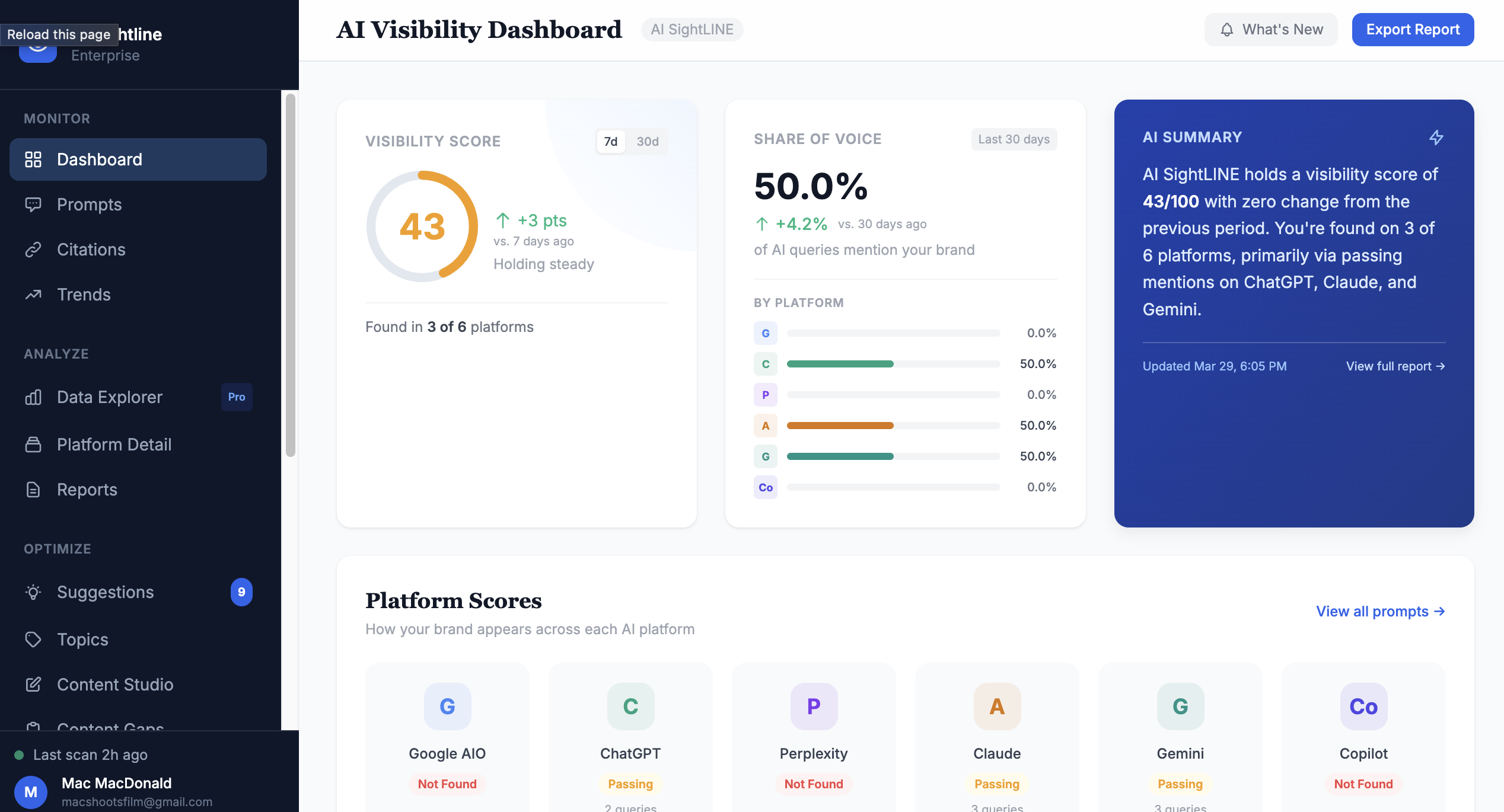
Platform coverage: Are you visible on all 6 major AI platforms (Google AIO, ChatGPT, Perplexity, Claude, Gemini, Copilot), or just one or two? According to AI Sightline's monitoring data, brands visible on 3 or more platforms have 2.4x higher composite visibility scores than those visible on just 1 to 2.
GEO measurement tools
Traditional SEO tools do not measure AI visibility. To track GEO performance, you need a dedicated platform that queries AI search engines with your target prompts and monitors the responses for brand mentions.
AI Sightline tracks citations across 6 AI platforms, generates a visibility score for each platform, shows share of voice versus your defined competitors, and surfaces specific prompts where your brand is absent but should appear. The Pro plan supports 75 prompts and 10 competitors, enough for a serious GEO measurement program at $149.95/month.
Common GEO Mistakes to Avoid
Brands new to GEO tend to make the same handful of mistakes. Each one is fixable once you know what to look for.
Writing for humans, not for extraction
SEO content is often written for a human who will skim headings and read the parts that look relevant. GEO content needs to be structured for an AI that will extract and recombine pieces of your text in a new context. The practical difference: every section needs to make sense in isolation, every definition needs to be self-contained, and every claim needs to be precise enough to stand alone as a quoted sentence.
Ignoring AI platforms outside of Google
Most marketing teams are focused on Google because that's where their existing reporting lives. But ChatGPT, Perplexity, and other non-Google AI tools are where significant portions of your target audience are starting their research. A GEO strategy that only thinks about Google AIO is missing 60 to 70% of the AI search landscape.
Treating GEO as a one-time project
GEO is not a website redesign project that you complete and move on from. AI models are updated, retrained, and their citation patterns shift over time. A brand that's cited prominently today may drop off after a model update. Ongoing monitoring, regular content updates, and continuous optimization are necessary, just like ongoing SEO maintenance.
Not measuring share of voice versus competitors
GEO is a relative game. Whether your citation rate is "good" depends entirely on what your competitors are achieving. A 20% citation rate in a category where every competitor is at 5% is dominant. A 20% rate where your main competitor is at 60% is a problem. AI Sightline's competitor tracking shows exactly where you stand relative to specific competitors across all 6 platforms.
Publishing content that lacks a point of view
AI models tend to cite content that says something specific and defensible. Generic, balanced "on one hand / on the other hand" content is less likely to be cited because it doesn't give the AI model a clear claim to use. Take positions. Use your own data. Publish original analysis. That's the content that gets cited.
Getting Started with GEO Today
If you're new to GEO, here's a practical starting sequence.
Step 1: Audit your current AI visibility
Before changing anything, find out where you stand. Create a free account at AI Sightline and add your brand and 5 to 10 of your target keywords. Run a scan against ChatGPT, Perplexity, and Google's AI Overviews. This gives you a baseline: where are you already cited, and where are you invisible?
Step 2: Identify your highest-value GEO opportunities
Look at the prompts where your competitors appear but you don't. These are your citation gaps. Prioritize the gaps that map to your highest-value keywords, specifically the queries where a citation would translate most directly to awareness and pipeline.
Step 3: Retrofit your best content for GEO
Take your top 5 SEO-performing pages and apply GEO tactics: add a direct, quotable answer to the opening of each major section, add specific data points to replace vague claims, add a structured definition for each key term, and verify your schema markup is complete.
Step 4: Create content specifically for AI citation
Publish one pillar page per month targeting a high-volume GEO keyword (this guide, for example, targets "geo vs seo" at 2,400 monthly searches). Write it using the GEO tactics above: direct answers, data-rich, structured definitions, named entities throughout.
Step 5: Monitor, learn, and iterate
Set up weekly AI visibility monitoring in AI Sightline. Watch your citation rate, share of voice, and platform coverage over time. When you see a citation gap appear or close, investigate why. GEO is a feedback loop. The teams that monitor consistently improve fastest.
The Bottom Line on GEO vs SEO
GEO and SEO are separate disciplines targeting different systems, but they share a common goal: getting your brand in front of the right people at the moment they're looking for what you offer.
SEO is not going away. Google still drives the majority of web traffic and will for years to come. But AI search is growing fast enough and displacing enough traditional organic clicks that brands without a GEO strategy are leaving real visibility on the table.
The brands that will dominate search in 2027 and beyond are the ones building both programs today. GEO is not a replacement for SEO. It's the missing half of a complete search visibility strategy.
If you want to see exactly how visible your brand is in AI search right now, AI Sightline gives you that picture in under 30 seconds. Start your free scan. No credit card required.
Want to go deeper on GEO? Read our guides on how to improve your AI visibility score or our breakdown of the Best GEO Tools in 2026.
What is the difference between GEO and SEO?
SEO optimizes for Google search rankings. GEO optimizes for inclusion inside AI assistant answers from ChatGPT, Perplexity, Google AIO, Gemini, Claude, and Copilot. Same underlying signals (authority, freshness, structured data) but different success metrics and different failure modes.
Does GEO replace SEO?
No. AI assistants pull from indexed web content, so SEO foundations stay load-bearing. GEO is an additional layer that targets prompt-level inclusion on top of search ranking. Brands that drop SEO to chase GEO usually lose both.
Which should I invest in first if I am starting fresh?
SEO foundations first (technical health, schema, content clusters, backlinks) for the first 90 days, then layer GEO measurement and prompt-level optimization on top. The early SEO work directly improves AI visibility too, so the order compounds.
Can the same content work for both?
Mostly yes. Strong SEO content with clear structure, FAQ blocks, and schema markup is also strong GEO content. The two diverge when you need to target conversational prompts that have no keyword equivalent (for example, "what should I buy for X under Y dollars"), which is where prompt-level GEO research adds value.
Get your free AI visibility score.
See how ChatGPT, Claude, Perplexity, Gemini, Google AIO, and Copilot talk about your brand.
Start freeSolo founder building AI visibility monitoring. Ships weekly. No venture capital, a lot of opinions about where AI search is going.