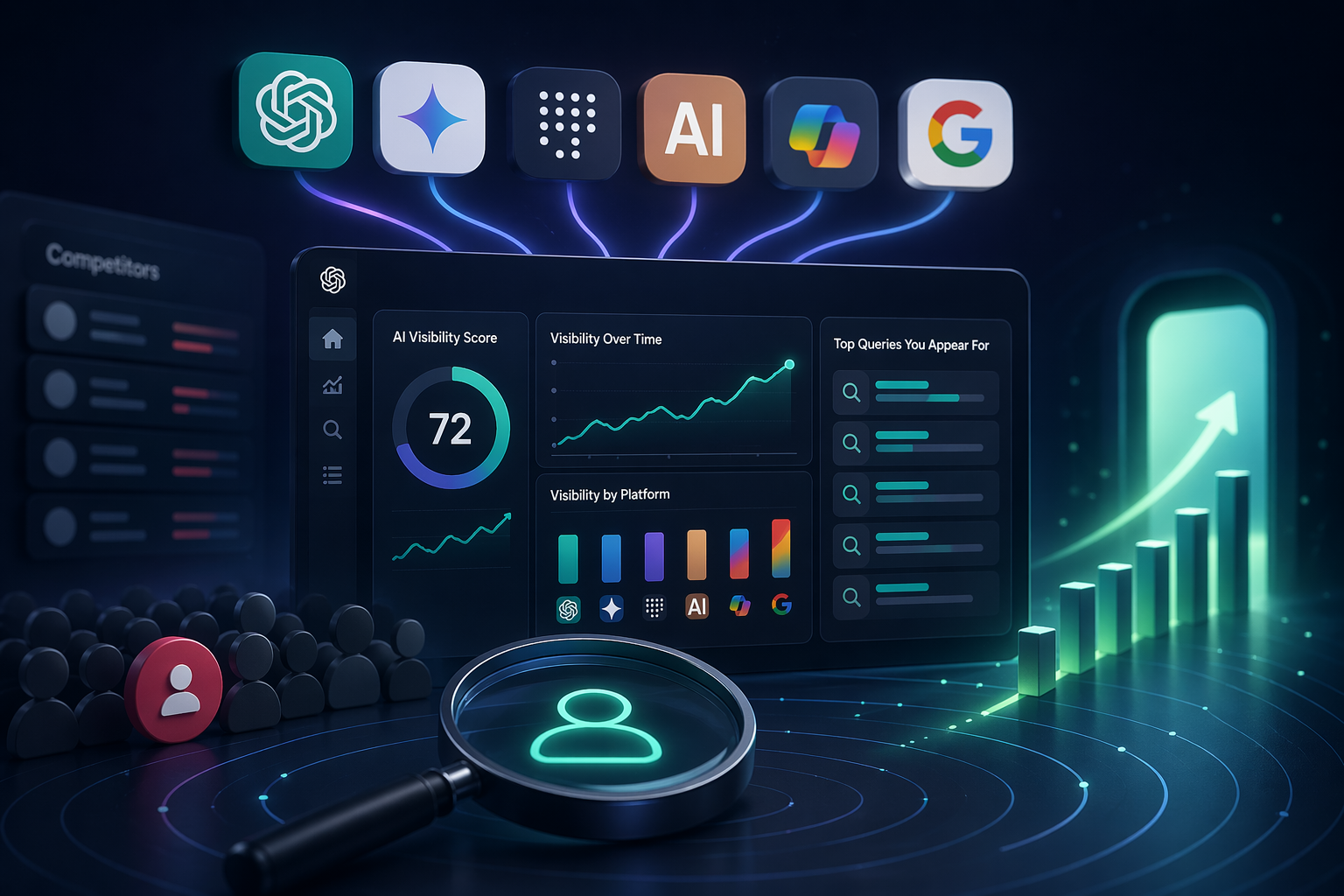
Generative engine optimization (GEO) tools are platforms that monitor and improve your brand's visibility in AI-powered search engines like ChatGPT, Perplexity, Google AI Overviews, and Gemini. With AI referral traffic growing 3,500% since mid-2024 and ChatGPT now controlling 87% of that traffic, GEO tools have moved from nice-to-have to essential infrastructure for any brand that depends on search visibility.
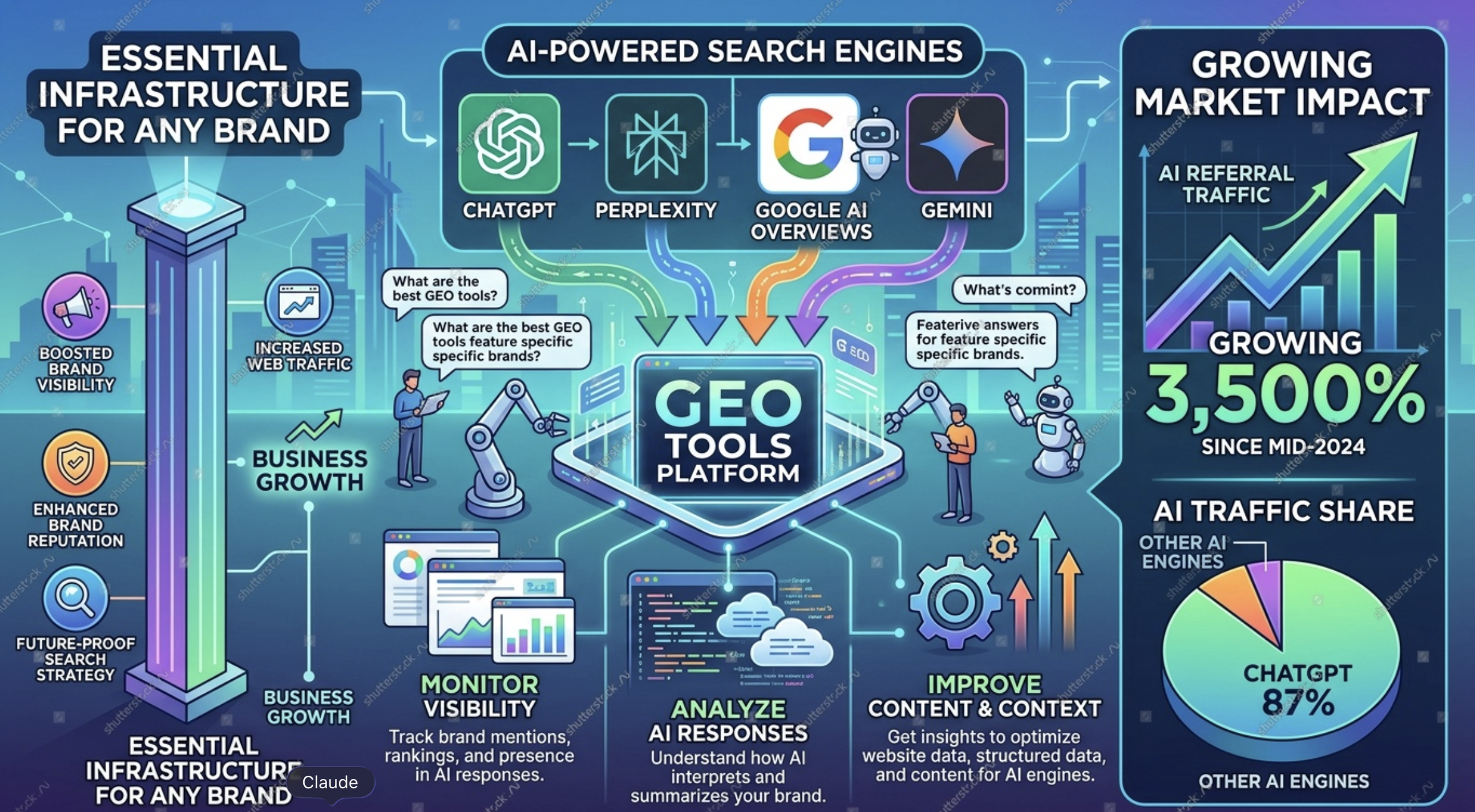
This guide reviews the eight best generative engine optimization tools available in 2026, with honest breakdowns of pricing, features, and who each tool is actually built for.
TL;DR: Best GEO Tools at a Glance
| Tool | Best For | Starting Price | Platforms |
|---|---|---|---|
| AI Sightline | SMBs and developers needing API + MCP | $0/mo | 3–6 |
| Otterly | Teams wanting the market leader | $29/mo | 4 base (add-ons extra) |
| Profound | Enterprise with $500+/mo budget | $399/mo | 10+ |
| Peec | Multi-country, agency workflows | EUR85/mo | 8 |
| LLMrefs | Free utility tools + lightweight monitoring | Free tools | 10 |
| Geoptie | Budget-first teams, free audit tools | $41/mo | 6 |
| Nightwatch | Teams already tracking traditional SEO | $32/mo + add-on | Multiple |
| Scrunch AI | Enterprise AI content delivery optimization | $250/mo | 4–9 |
What Is Generative Engine Optimization?
Generative engine optimization (GEO) is the practice of optimizing your brand's content and online presence to increase visibility, citations, and favorable mentions in AI-powered search engines like ChatGPT, Perplexity, and Google AI Overviews.
GEO is distinct from traditional SEO in a critical way. Traditional SEO gets your page ranked in Google's blue links. GEO gets your brand named, quoted, or cited in the AI-generated answer that now sits above those links. According to recent data, 60% of AI search sessions end without a user clicking any website link at all. If you're not in the AI answer, you're effectively invisible.
The stakes are real. AI search traffic converts at 14.2%, compared to Google organic's 2.8%. That's a 5x conversion premium on every visit. The brands winning in AI search right now are not necessarily the ones who dominated Google, which means GEO is a genuine reset, and generative engine optimization tools are what you use to measure and improve your position.
What to Look for in a GEO Tool
Not all GEO tools are built the same. Before committing to any platform, evaluate it across these five dimensions.
Platform coverage. Your customers use ChatGPT, Perplexity, Google AI Overviews, Gemini, Copilot, and Grok. A tool that only monitors one or two platforms gives you an incomplete picture. Look for coverage of at least 4 to 5 platforms before trusting the data as representative.
Prompt flexibility. The best tools let you define your own custom prompts, not just track branded keywords. If you can't test "best project management tool for remote teams," you can't see how AI responds to the queries your customers actually type.
Monitoring frequency. AI citations rotate fast. According to recent research, 40 to 60% of cited sources change month over month. A tool that only refreshes weekly or monthly will miss those shifts entirely. Look for 3 to 7-day scan cadences at minimum.
API and integrations. If you want to build dashboards, pipe data into your analytics stack, or automate reporting, you need a tool with a real REST API. Many GEO tools are dashboard-only products with no way to get your data out programmatically.
Actionability. A visibility score without a path to improvement is just a grade. The best tools surface specific gaps, suggest content fixes, analyze your schema markup, and point you at the specific pages where changes would have the highest impact.
The 8 Best Generative Engine Optimization Tools
1. AI Sightline
Best for: SMBs, agencies, and developers who want full platform coverage, a real API, and MCP server access without an enterprise price tag.
AI Sightline is purpose-built for AI visibility monitoring across all six major platforms: ChatGPT, Perplexity, Google AI Overviews, Gemini, Copilot, and Grok. It is the only GEO tool on the market that ships with a full MCP (Model Context Protocol) server, meaning AI agents and coding assistants can query your visibility data directly via 15 native MCP tools.
Pricing:
-
Free: $0/mo (3 prompts, 10 keywords, 2 platforms, no credit card required)
-
Starter: $29.95/mo (20 prompts, 25 keywords, 4 platforms, REST API access)
-
Pro: $149.95/mo (75 prompts, 100 keywords, 5 platforms, full API, full MCP, 75 suggestions/mo, 25 content audit pages/mo, topic authority scoring)
-
Business: $289.95/mo (200 prompts, 300 keywords, all 6 platforms, content generation, schema auto-generation)
-
Agency: $549.95/mo (400 prompts, all 6 platforms, 750 keywords, dedicated support)
Platform coverage: 2 on Free, 4 on Starter, 5 on Pro, 6 on Business and Agency (all major platforms included, no add-ons)
What sets it apart:
The MCP server is genuinely unique. No other GEO tool in this category offers one. It enables AI-native workflows where your agent, coding assistant, or internal tooling can pull brand visibility data without a human in the loop.
The REST API is available from the $29.95/mo Starter tier. Most competitors lock API access to their highest plans or don't offer it at all. The automatic rolling scan cadence means your data refreshes on a daily cycle at Pro and above, and a 3-day cycle Starter, with no manual triggering required.
On pricing, AI Sightline Pro at $149.95/mo covers 5 platforms (Business at $289.95 adds the 6th), with full API and MCP access included. Otterly's Standard at $189 covers 4 platforms and requires paid add-ons for Gemini and AI Mode — so AI Sightline gives you broader coverage without per-platform upsells.
Honest limitations: The free tier's 2 prompts is genuinely tight for serious ongoing monitoring. Pro at $149.95 is where the platform really opens up, and it is where most active teams should start.
Bottom line: If you want the widest coverage, the deepest feature set, and a developer-friendly platform at a mid-market price, AI Sightline is the strongest all-around option in this category. See full pricing details.
2. Otterly
Best for: Teams who want the established market leader with a large community and strong educational content.
Otterly is the market reference point for GEO tools, with 20,000+ users and the strongest brand recognition in the category. It covers ChatGPT, Google AI Overviews, Perplexity, and Copilot on base plans, with Gemini and AI Mode available as paid add-ons.
Pricing:
-
Lite: $29/mo (15 prompts)
-
Standard: $189/mo (100 prompts) — listed as "Most Popular"
-
Premium: $489/mo (400 prompts)
-
Annual pricing saves 15%
-
Add-ons: Gemini from $9/mo, AI Mode from $9/mo (exact pricing scales by tier)
Platform coverage: 4 base platforms. Gemini and Google AI Mode cost extra.
What sets it apart:
Otterly has the largest user base in the category and a content-heavy educational library with strong GEO tactics. The prompt research tool helps surface new monitoring opportunities beyond the ones you'd think to add manually. Multi-country tracking covers 50+ countries, and team seats are unlimited on all plans.
Honest limitations: The add-on model is the main friction point. If you need Gemini and AI Mode alongside the four base platforms, you're paying extra on top of an already premium price. Its REST API and MCP server, both added in 2026, are gated to the Standard plan ($189/mo) and above, so on lower tiers your data stays inside their dashboard. At 100 prompts, Otterly Standard costs $189. AI Sightline Pro gives 75 prompts across 5 platforms for $149.95, including Gemini and AI Mode with no add-ons.
Bottom line: Otterly is a solid, polished platform backed by real traction and a strong community. It is the market leader for a reason. Just budget carefully for platform add-ons and plan around the lack of API access if integrations matter to you.
3. Profound
Best for: Enterprise marketing teams with $500+/mo budgets who want the deepest AI search dataset available.
Profound is the most analytically powerful tool in the GEO category. Backed by $35M in Series B funding from Sequoia Capital, its core asset is a proprietary dataset of 400 million real user prompts, giving it pattern-recognition depth that smaller tools simply cannot replicate.
Pricing:
-
Growth: $399/mo (3 platforms, limited prompts)
-
Lite: $499/mo (ChatGPT only, 50 prompts, 1 seat)
-
Enterprise: $2,000 to $5,000+/mo
-
No free tier. No self-serve signup. Sales-led only.
Platform coverage: 10+ AI engines including Grok and DeepSeek
What sets it apart:
The 400M+ prompt dataset is genuinely proprietary. The "Conversation Explorer" surfaces real user queries at scale, showing you what people are actually asking AI systems in your category. Content Agents automate AI-optimized content workflow. A next-aeo npm package gives developers a direct integration path. Shopping Visibility covers eCommerce brands specifically.
Honest limitations: There is no free tier, no self-serve signup, and no trial. You call sales, get a demo, and close a deal. That process is appropriate for a $2,000+/mo tool, but it makes Profound inaccessible for most SMBs and independent marketers. At $499, the Lite plan covers only ChatGPT with 50 prompts, which is limited for the price.
Bottom line: If you're an enterprise marketing team with a serious GEO budget and a need for the deepest analytical capability, Profound earns its price. For everyone else, AI Sightline Pro delivers roughly 80% of the analytical depth at 27% of the cost, with self-serve signup and no sales call required.
4. Peec
Best for: Agencies and multi-country brands who need daily tracking frequency and actionable GEO roadmaps.
Peec differentiates on two things: daily tracking (faster than most competitors) and an "Actions" feature that converts visibility data into a prioritized GEO roadmap with Relative Opportunity Scores attached to each recommendation.
Pricing (EUR-denominated):
-
Starter: EUR85/mo (50 prompts, 3 AI models, 1 project, 1 country)
-
Pro: EUR205/mo (150 prompts, 3 models, 2 projects, multi-country)
-
Advanced: EUR425/mo (unlimited prompts, all models, 5 projects, API, SSO)
-
Agency tiers: EUR205 to EUR675/mo
-
Additional AI model add-ons: EUR30 to EUR140/mo per model
Platform coverage: ChatGPT, Perplexity, Gemini, Grok, AI Mode, Copilot, Claude, and GPT-5 Search (8 platforms). Additional models available as paid add-ons.
What sets it apart:
Daily tracking is genuinely faster than most competitors in this list. The "Actions" feature makes recommendations concrete rather than leaving you with a score and no direction. Team seats are unlimited on all plans, which is a meaningful advantage for agencies adding multiple collaborators. Agency-specific plans are clearly structured.
Honest limitations: EUR pricing creates friction for US-based buyers, particularly as currency rates shift. The add-on model for additional AI platforms mirrors Otterly's approach and can inflate costs if you need full coverage. Its REST API is in beta and limited to Enterprise customers. Peec does ship an MCP server (api.peec.ai/mcp).
Bottom line: Peec is a strong choice for agencies managing multiple brands across multiple countries who need daily data and prioritized next steps. Factor in the EUR currency conversion and add-on model before committing to your budget estimate.
5. LLMrefs
Best for: Teams who want free GEO utility tools and lightweight monitoring at an accessible price point.
LLMrefs leads with a free-tool-first strategy. Their ungated free offering includes an AI crawlability checker, Reddit thread finder, content A/B tester, LLMs.txt generator, and query fan-out generator, all accessible without a signup. The paid tier adds ongoing monitoring and reporting.
Pricing:
-
Free tools: Available without any account
-
Paid: From $79/mo (marketing team tier)
Platform coverage: ChatGPT, Google AI Overviews, AI Mode, Gemini, Perplexity, Claude, Grok, Copilot, Meta AI, DeepSeek (10 platforms stated)
What sets it apart:
LLMrefs has the widest stated platform coverage in this category at 10 platforms. Noise reduction through statistical significance checks filters out data artifacts. Multi-country targeting covers 20+ countries. The free tools solve real GEO problems for teams that aren't ready to commit to a paid platform.
Honest limitations: The free tools are useful for one-time assessments, not ongoing monitoring. The paid tier feature details are less transparent than most competitors in terms of published feature depth. Tracking is keyword-based rather than custom-prompt-based, which limits your ability to test specific scenarios your customers would actually use.
Bottom line: LLMrefs is worth bookmarking for its free tools even if you end up using a different paid platform. The $79/mo paid plan is a reasonable entry point for teams comfortable with keyword-based tracking rather than fully custom prompt testing.
6. Geoptie
Best for: Budget-conscious teams who want the lowest paid entry price and a suite of free audit tools with no signup required.
Geoptie has entered the GEO market aggressively, with the lowest starting price among paid platforms and six free ungated tools: GEO Audit, Rank Tracker, Content Checker, Keyword Finder, Cannibalization Checker, and Backlink Finder.
Pricing:
-
Starter: $41/mo ($490/yr annual, 15 prompts, 2 brands)
-
Professional: $83/mo ($990/yr, 100 prompts, 10 brands) — "Most Popular"
-
Enterprise: $166/mo ($1,990/yr, 400 prompts, 50 brands)
-
Additional users: $20 to $40/mo each depending on tier
Platform coverage: ChatGPT, Google AI/Gemini, Perplexity, Claude, Copilot, Grok (6 platforms)
What sets it apart:
Geoptie has the lowest paid entry point in the category at $41/mo. The six free tools are genuinely accessible and work without creating an account. "Setup in 5 minutes" messaging reflects a straightforward onboarding experience. Their content marketing strategy includes comparison pages against most major competitors, which signals a serious content-led growth motion.
Honest limitations: No published REST API. No MCP server. The free audit tools serve as lead capture for paid conversions, so depth may be limited compared to paid monitoring. Per-user pricing adds up for teams beyond two or three seats.
Bottom line: Geoptie is a credible option for smaller teams who need a low-friction entry point. Its Professional plan at $83/mo competes with AI Sightline's Starter at $29.95/mo on price but offers more prompts, while AI Sightline's Pro at $149.95/mo provides significantly richer features including REST API, MCP server, content generation, and schema analysis. Weigh your need for API access before choosing on price alone.
7. Nightwatch
Best for: Teams already using Nightwatch for traditional SEO who want to add AI visibility monitoring without switching platforms.
Nightwatch is the only platform in this comparison that combines traditional rank tracking and GEO monitoring in one dashboard. If your team runs Nightwatch for SEO already, the AI add-on is a natural expansion rather than a full platform switch.
Pricing:
-
Traditional SEO base: From $32/mo
-
AI monitoring add-on: Approximately $59 to $99/mo additional
-
14-day free trial on all plans
Platform coverage: LLM outputs plus real-time web searches performed by AI systems (dual-layer approach)
What sets it apart:
The dual-layer monitoring is genuinely differentiated. Nightwatch tracks both the LLM responses themselves and the underlying web searches that AI systems perform when generating answers, giving you two signals where most competitors only give one. Location-based rank tracking covers 190,000+ locations for traditional SEO. Sentiment analysis on AI-generated responses is included. Prompt research helps identify new monitoring opportunities.
Honest limitations: GEO is an add-on to a traditional SEO product, not the core focus. Feature depth in AI monitoring lags behind dedicated platforms. If AI visibility is your primary concern rather than a secondary signal alongside traditional SEO, a purpose-built tool will serve you better.
Bottom line: Nightwatch is an efficient choice if traditional SEO is your primary workflow and you want AI visibility as a complementary data source. For teams where GEO is the main priority, a dedicated platform delivers more depth for a comparable or lower price.
8. Scrunch AI
Best for: Enterprise teams who want to optimize how AI systems crawl and render their content, not just monitor citations.
Scrunch approaches GEO from a different angle than the others in this list. Rather than purely monitoring AI citations, its Agent Experience Platform (AXP) aims to serve AI-optimized content directly to LLM crawlers in real time.
Pricing:
-
Core: $250/mo (125 prompts, 4 LLMs, 1 brand, 5 users, 5 site audits/mo)
-
Enterprise: Custom (9 LLMs including Claude, Gemini, Meta AI, Grok; API access, SSO)
-
7-day free trial
-
Additional users: $25/mo each
Platform coverage: 4 platforms on Core, 9 on Enterprise
What sets it apart:
The AXP concept is the most differentiated idea in this category. Serving AI-optimized content to LLM crawlers rather than just measuring citations is a fundamentally different strategic approach. Site audits are included on all plans. The Enterprise tier covers 9 platforms including Claude, Meta AI, and Grok.
Honest limitations: The AXP feature is still in limited pilot as of early 2026, making it more of a near-term roadmap item than a current capability. Core covers only 4 platforms, and full coverage requires Enterprise pricing with a custom sales process. No API access on Core. At $250/mo for 4 platforms, AI Sightline Pro delivers 5 platforms (Business unlocks the 6th), full REST API, and MCP server access for $149.95/mo.
Bottom line: Scrunch's AXP concept is worth watching, and the monitoring capabilities are solid. Right now, the Core plan's limited platform count and pilot-stage differentiator make it a harder value argument for teams focused primarily on visibility monitoring.
Full Comparison: Generative Engine Optimization Tools Side by Side
| Tool | Platforms | Paid From | REST API | MCP Server | Free Option |
|---|---|---|---|---|---|
| AI Sightline | 2–6 | $29.95/mo | Starter+ | Yes (Pro+) | Free tier (no CC) |
| Otterly | 4 base + add-ons | $29/mo | No | No | 14-day trial |
| Profound | 10+ | $399/mo | Enterprise only | No | No |
| Peec | 8 | EUR85/mo | Advanced+ | No | No |
| LLMrefs | 10 | $79/mo | Not published | No | Free tools (no signup) |
| Geoptie | 6 | $41/mo | Not published | No | 6 free tools (no signup) |
| Nightwatch | Multiple | $32/mo + add-on | Yes | No | 14-day trial |
| Scrunch AI | 4 (Core) / 9 (Enterprise) | $250/mo | Enterprise only | No | 7-day trial |
How to Choose the Right GEO Tool
The right tool depends on four factors: your team size, your budget, whether you need API access, and how central AI visibility is to your overall marketing strategy.
If you're an SMB or independent marketer: Start with AI Sightline's free tier or Geoptie's free audit tools to establish a baseline before spending anything. Once you have benchmark data, Pro-tier tools in the $99 to $149.95/mo range give you enough signal to act on with confidence.
If you run an agency with multiple clients: Peec's unlimited-seat model and agency-specific tiers make it a natural fit for client-facing work. Otterly's agency program offers enhanced prompt limits. AI Sightline's Business tier at $289.95/mo tracks up to 25 competitor brands per project, which aligns well with agencies running brand monitoring across multiple accounts.
If you need API access: Your options narrow quickly. AI Sightline provides full REST API access from Starter at $29.95/mo. Nightwatch offers API on paid plans. Most other tools in this list lock API access to their highest tiers or skip it entirely. If you're building internal dashboards, Slack alerting, or automated reporting pipelines, API availability matters more than the headline feature list.
If you're an enterprise with a serious GEO budget: Profound is the analytical depth leader for teams with $500+/mo to allocate and a preference for sales-led onboarding. For teams that want enterprise-grade coverage without Profound's price point, AI Sightline's Business tier at $289.95/mo or Agency at $549.95/mo provides automatic daily scan cadences, full API, MCP server, and schema auto-generation at a fraction of the cost.
What a GEO Tool Should Actually Do for You
The measure of a good GEO tool is not the number of platforms it monitors. It's whether the data tells you something you can act on by Monday morning.
Good generative engine optimization tools answer three questions. First: where does your brand appear in AI responses, and where is it absent? Second: which competitors are being cited instead of you, and for which specific queries? Third: what changes to your content would shift those citations in your direction?
The Princeton GEO research paper (ACM SIGKDD 2024) found that specific content tactics, including explicit source citations, expert quotations, structured data markup, and Wikipedia-style definitions placed in the first 60 words, produce 30 to 40% improvements in AI citation rates. A GEO tool worth paying for should surface which of those tactics are missing from your pages and point you at where fixing them would have the highest impact.
According to AI Sightline's monitoring data, brands visible on three or more AI platforms have 2.4x higher composite visibility scores than brands only visible on one or two. Platform breadth is not just a comparison table checkbox. It is a direct indicator of how resilient your AI visibility is when any single platform updates its citation behavior.
Start Monitoring Before You Optimize
You cannot improve what you do not measure. Before choosing tactics, before updating content, before hiring an agency to help with GEO, spend 30 minutes establishing a baseline.
Every tool on this list has a free entry point. Run your brand through a few of them. See which platforms cite you, which competitors appear in your place, and which query types you're absent from entirely. That baseline is what turns GEO from a vague priority into a specific action list.
Start your AI visibility baseline free at AI Sightline — no credit card required, set up in under 5 minutes.
What are the best GEO tools in 2026?
The category has 15-plus entrants. The strongest are AI Sightline, Otterly, Peec, Profound, Nightwatch, and Semrush. They differ on platform coverage, scan frequency, API access, and price. The best tool for you depends on whether you need single-brand monitoring or multi-brand agency reporting, and whether you need an API or just a dashboard.
What should a GEO tool track at minimum?
AI visibility across at least four platforms (ChatGPT, Perplexity, Google AIO, and one of Gemini or Claude), competitive share of voice, citation source breakdown, and recommendations tied to the gaps it finds. Tools that only track Google AI Overviews are not GEO tools, they are AIO tools.
Are free GEO tools good enough?
Free tiers are good enough to baseline and decide whether the problem is worth solving. AI Sightline Free covers two platforms and a starter prompt set. Once you start running content experiments and need daily scans across all six platforms, paid tiers become necessary.
What is the difference between a GEO tool and an AEO tool?
AEO (answer engine optimization) is a narrower term focused on direct-answer formats like featured snippets and AI Overviews. GEO (generative engine optimization) is the broader practice covering full AI assistant conversations across multiple engines. Most modern tools cover both, but the language matters when comparing feature sets.
Get your free AI visibility score.
See how ChatGPT, Claude, Perplexity, Gemini, Google AIO, and Copilot talk about your brand.
Start freeSolo founder building AI visibility monitoring. Ships weekly. No venture capital, a lot of opinions about where AI search is going.