The 8 Best AI Visibility Tools in 2026 (Honest Comparison)
If your customers ask ChatGPT, Gemini, Perplexity, Claude, Copilot, or Google AI Overviews for a recommendation in your category, are they getting your name? Half the time the answer is no. And if you're not measuring it, you can't fix it.
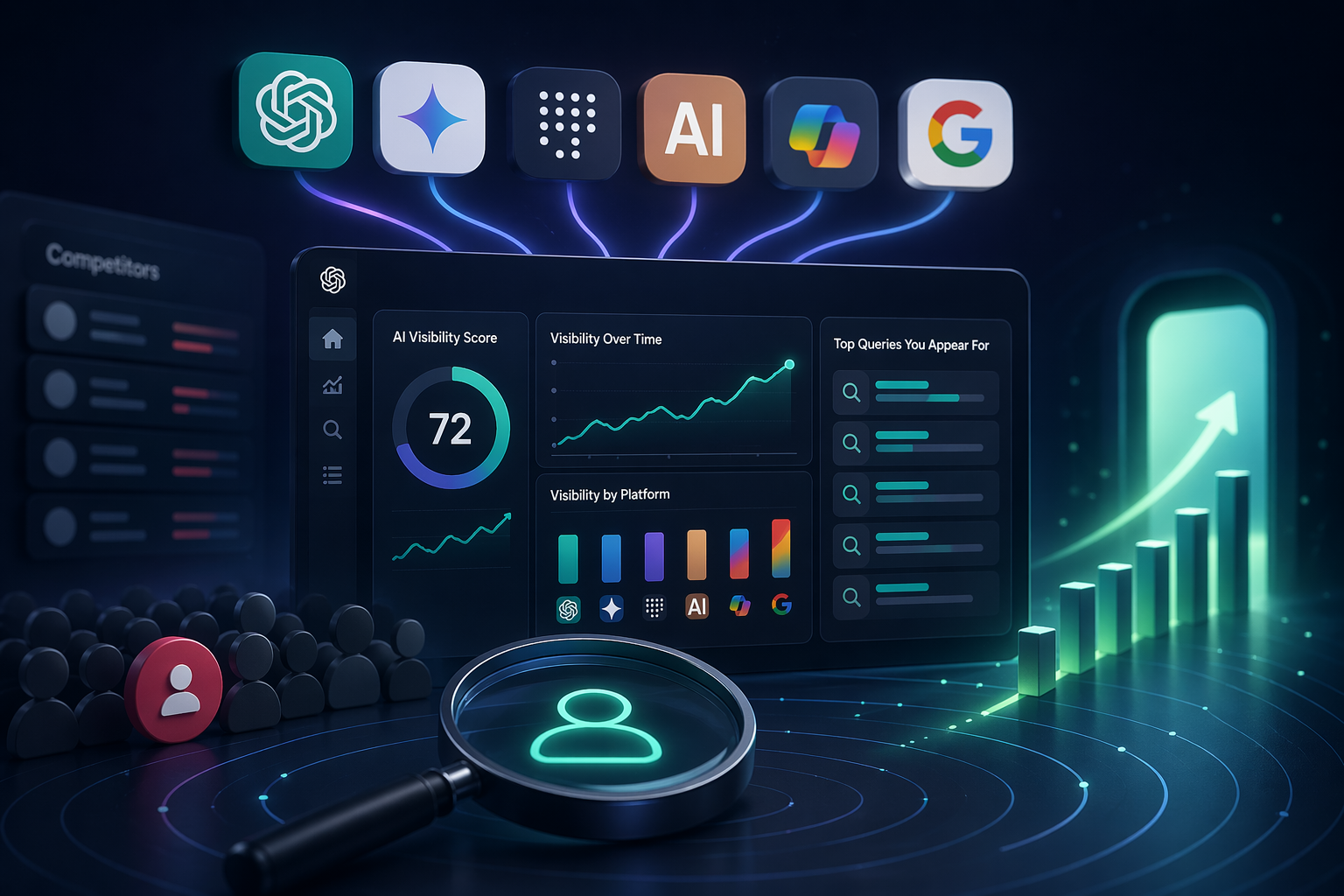
That's what AI visibility tools do. They monitor how AI platforms describe your brand, which queries you show up for, which queries your competitors own, and where the opportunities are. The category is young (most of these tools didn't exist two years ago), moving fast, and already crowded with 20+ platforms making overlapping claims.
This guide compares the eight that actually matter in 2026. We built one of them, and we'll be honest about that up front: AI Sightline is on this list, and we'll also tell you where other tools beat us.
What is an AI visibility tool?
An AI visibility tool monitors how your brand appears (or doesn't) in answers from generative AI platforms: ChatGPT, Gemini, Perplexity, Claude, Copilot, and Google AI Overviews. Instead of tracking where you rank in Google's 10 blue links, it tracks whether an AI names your brand when a user asks a question in your category.
The category goes by a few names. You'll see it called AI visibility monitoring, generative engine optimization (GEO), answer engine optimization (AEO), and AI search optimization (AIO). They're different angles on the same problem: AI is becoming the first place people look, and traditional SEO measurement doesn't cover it.
A decent AI visibility tool will do four things:
Run your target prompts across multiple AI platforms on a regular cadence
Detect whether your brand appears in the responses, and whether the sentiment is positive, neutral, or negative
Track which competitors appear when you don't
Tell you which of your content (and which external sources) are getting cited
The best tools go further: sentiment analysis, recommendations, content audits, and programmatic access via API or MCP.
What to look for in an AI visibility tool
Seven criteria matter more than anything else. Evaluate every tool on this list against them.
Platform coverage. The big six are ChatGPT, Google AI Overviews, Perplexity, Claude, Gemini, and Copilot. Meta AI and emerging entrants matter less for now, but coverage of a new platform is a strong quality signal. A tool that only covers 3-4 is already behind.
Scan frequency. Daily is the new baseline. Weekly was acceptable in 2024. Anything less than weekly today is a signal the vendor hasn't built the infrastructure to compete.
Competitor tracking. Without it, you're measuring yourself in isolation. Every serious tool offers this, but the depth varies widely.
Citation source analysis. When an AI cites a competitor instead of you, which source did it pull from? The best tools surface the exact URLs and domains being cited, which is actionable data you can use for outreach.
Recommendation engine. Measurement without guidance is busywork. The top tools tell you what to do about the data.
Multi-brand support. If you're an agency or a company with multiple brands, how does the tool price that? Per-brand billing gets expensive fast. Pooled quotas are rare but dramatically cheaper.
Pricing floor. Some tools start at $400/mo. Others have free tiers with real functionality. If you're evaluating the category for the first time, a low pricing floor lets you try before you commit.
The 8 best AI visibility tools in 2026
1. AI Sightline - Best overall (value + coverage)
We built AI Sightline, so take this with appropriate salt. Here's what we'll claim and here's where we'll lose.
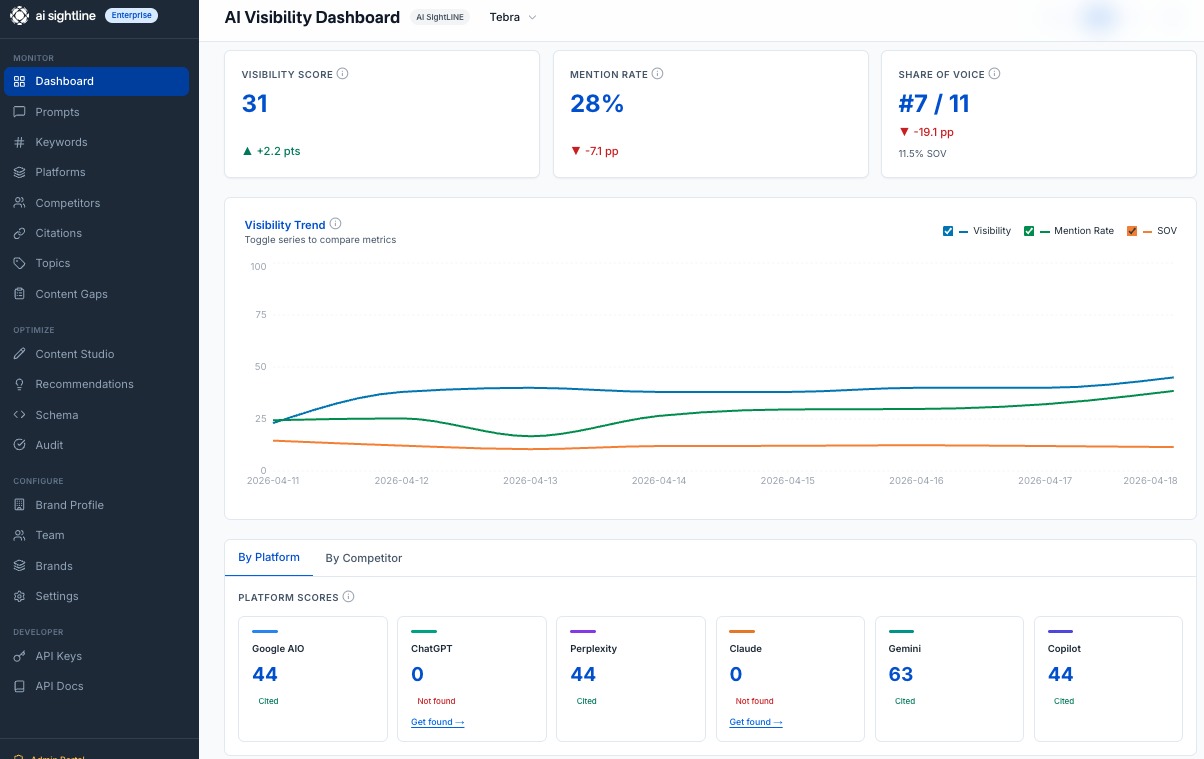
Coverage: All six major platforms (ChatGPT, Google AIO, Perplexity, Claude, Gemini, Copilot).
Scan cadence: Daily.
Competitor tracking: Yes, unlimited competitors.
Citation analysis: Domain leaderboard, category breakdown, per-URL citation counts.
Recommendation engine: Yes. Content gaps, schema suggestions, competitor intel, and impact tracking (Pro tier and above).
Multi-brand: Pooled quotas across 3-50 brands depending on tier. Starter supports 1 brand; Business supports 10.
MCP server: Yes. 30 tools. You can pipe visibility data directly into Claude, Cursor, or any MCP-compatible agent.
Pricing:
Free: $0
Starter: $29.95/mo
Pro: $149.95/mo
Business: $289.95/mo
Agency: $549.95/mo
Best for: SMBs, solo marketers, and agencies who want strong coverage without enterprise pricing. The MCP server makes it the only tool in the category that works natively inside AI coding environments.
Where we lose: Newly launched AI platforms take us a few weeks to add adapters for. If you need literal day-one coverage of a newly released AI engine, Profound's larger engineering team ships faster. Our UI is simpler than Peec's design-led polish.
2. Profound - Best enterprise
Profound sets the benchmark for enterprise AI visibility. Strong data team, deep citation analysis, and the best-in-class adapter coverage when new platforms launch. Their research content (like the "Profound Report") is genuinely useful and often cited by analysts.
Pricing: Lite at $499/mo (ChatGPT only, 50 prompts, single seat). Full 6-platform coverage is gated behind Growth or Enterprise tiers that range from a few hundred to $2,000-$5,000+/mo depending on prompt volume and seats.
Best for: Mid-market to enterprise teams with budget for premium tooling and a need for deep analytical capabilities.
Where Profound loses: Lite at $499/mo for ChatGPT-only puts meaningful coverage out of reach for SMBs and freelancers. Per-brand billing gets expensive fast for agencies. UI is built for analysts, not fast-moving marketing teams.
3. Peec AI - Best for European marketers
Peec has the cleanest UI in the category and strong traction in DACH and Nordic markets. European-focused, GDPR-aware, and fast.
Pricing: Starter $89/mo (25 prompts daily, 3 AI models, 3 countries), Pro $199/mo (100 prompts, 5 countries), Advanced $499/mo (300+ prompts). Extra AI models beyond the included three cost $30-$140/mo each.
Best for: Marketing teams in Europe, or anyone who prioritizes design polish and ease of onboarding. Competent core tracking at a reasonable price.
Where Peec loses: Does not cover Claude, which matters for technical and developer audiences. The "3 models of your choice" design means multi-platform comparison requires paid add-ons. Content recommendations are lighter than Profound or AI Sightline.
4. Otterly - Best simple dashboard
Otterly keeps things simple. If you want a clean "is my brand showing up, yes/no" dashboard without the overhead of learning a more powerful tool, it's a reasonable starting point. Per-prompt pricing model lets you start small.
Best for: Non-technical marketers at small companies who want a basic visibility check without a learning curve.
Where Otterly loses: Per-prompt pricing is hard to defend as your tracking scales past 20-30 prompts. Analytics depth is limited compared to purpose-built competitors. Its REST API and MCP server are gated to the Standard plan ($189/mo) and above.
5. Semrush AI Toolkit - Best if you already pay for Semrush
Semrush added AI visibility tracking as a feature in their broader SEO suite. For existing Semrush customers, it's a reasonable add-on that integrates with traditional SEO workflows.
Best for: Teams already running Semrush for traditional SEO who want to tack on basic AI visibility without adopting a second vendor.
Where Semrush loses: AI visibility is a feature inside a bigger product, not a dedicated tool. Depth is shallower than purpose-built competitors. Content specific to GEO is thinner than Otterly, Peec, or AI Sightline.
6. LLMrefs - Best free option
LLMrefs is the most generous free tier in the category. Narrower platform coverage than paid tools, but a real starting point if you've never measured AI visibility and want to see what the data looks like before committing.
Best for: First-time category evaluators, solo founders, and anyone testing whether AI visibility tracking is worth investing in.
Where LLMrefs loses: Paid tiers exist but feature depth lags the leaders. Citation analysis and recommendations are lighter than Profound, Peec, or AI Sightline.
7. Scrunch - Best agency-focused
Scrunch positions around agency and multi-client workflows. If you're managing visibility for a portfolio of clients, their reporting and client-facing views are worth a look.
Pricing: Core $250/mo (1 brand, 4 LLMs, 125 prompts, 5 seats). Agency Core $500/mo with higher limits. Full 9-LLM coverage (adding Claude, Gemini, Meta AI, Google AI Mode, Grok) and API access are Enterprise custom-priced.
Best for: Agencies running 5+ client brands who want client-ready reports out of the box and don't need Claude or Gemini coverage at entry tier.
Where Scrunch loses: Core tier misses Claude and Gemini at $250/mo. Per-client pricing adds up fast compared to pooled-quota alternatives. No free tier or public self-serve trial.
8. Rankscale - Best cheap entry-tier
Rankscale leans into developer-focused positioning with an analytical UI and broad engine coverage. Cheapest paid entry in the category.
Pricing: Essentials $20/mo (2 brand dashboards, 120 credits, up to 480 AI responses/mo). Pro $99/mo (10 dashboards, 1,200 credits). Enterprise $780/mo (100 dashboards, 12,000 credits, REST API).
Best for: Technical marketers and budget-conscious solo users who want broad engine coverage (8 including Grok, DeepSeek, Mistral) at the lowest paid price point.
Where Rankscale loses: No free tier (14-day trial only). No MCP server. REST API gated behind $780/mo Enterprise. Credit-based model can surprise you on scan volume.
Comparison table
Tool | Paid entry | Free tier | Platforms | Includes Claude | Scan frequency | MCP server | Multi-brand model |
|---|---|---|---|---|---|---|---|
AI Sightline | Yes (real scans) | 6 | Yes | Daily | Yes (26 tools) | Pooled (3-50 brands) | |
Profound | $499/mo (ChatGPT only) | No | 6 (at higher tiers) | Yes (Enterprise) | Daily | No | Per-brand |
Peec AI | $89/mo | 14-day trial | 7 | No | Daily | No | Per-project |
Otterly | ~$29/mo per prompt pack | Trial only | 4-5 | Yes | Weekly | No | Per-brand |
Semrush AI Toolkit | $139.95/mo (bundled) | Via Semrush trial | 4-5 | Yes | Weekly | No | Via Semrush |
LLMrefs | ~$49/mo | Yes | 3-4 | Varies | Weekly | No | Per-brand |
Scrunch | $250/mo (1 brand, 4 LLMs) | No | 4 (Core) / 9 (Ent) | Enterprise only | Daily | No | Per-brand |
Rankscale | $20/mo (2 dashboards) | No (14-day trial) | 8 | Yes | Hourly-monthly | No | Per-dashboard |
Vendors change pricing without notice — spot-check before making a purchase decision.[^pricing-note]
Which tool should you choose?
The honest answer depends on four things: budget, team size, how many brands you need to track, and whether Claude coverage matters to you.
If you want a real free tier before you pay anything: AI Sightline Free or LLMrefs Free. Both run actual scans with no trial timer. AI Sightline covers all 6 platforms in the free tier; LLMrefs is narrower.
If you want the cheapest paid entry: Rankscale Essentials at $20/mo if you only need 2 dashboards and the credit-based model works for your scan volume. AI Sightline Starter at $29.95/mo if you want the free-tier-then-upgrade path, MCP server, and Claude coverage.
If you run an agency with 10+ brands: AI Sightline Business at $289.95/mo with pooled quotas across 25 brands, or Agency at $549.95/mo for up to 50 brands. Rankscale Pro at $99/mo is cheaper nominally but has no free tier and no MCP server; compare credit limits carefully against your prompt volume.
If you're an enterprise with budget and need deep analytical depth: Profound Enterprise ($2K-$5K+) or AI Sightline Agency at $549.95/mo. Profound's data team is deepest in the category; our Agency tier covers 6 platforms with daily scans, MCP server, and pooled quotas at a fraction of the price.
If you need Claude coverage: Skip Peec. AI Sightline, Profound, Otterly, and Rankscale all cover Claude. Claude matters for technical and developer audiences.
If you already pay for Semrush: Try their AI Toolkit first. If it's enough, great. If not, graduate to a purpose-built tool.
Frequently asked questions
What is an AI visibility tool?An AI visibility tool monitors how your brand appears in responses from generative AI platforms like ChatGPT, Gemini, Perplexity, Claude, Copilot, and Google AI Overviews. It tracks whether your brand is mentioned, which competitors appear when you don't, and which sources AI platforms cite.
How does an AI visibility tool work?The tool sends your target prompts to multiple AI platforms at a set cadence (usually daily). It analyzes the responses to detect brand mentions, sentiment, and competitor presence. Better tools also track which URLs and domains the AI cited, so you can see exactly what content is winning.
Which AI platforms should I track?The six that matter right now are ChatGPT, Google AI Overviews, Perplexity, Claude, Gemini, and Copilot. ChatGPT and Google AIO have the broadest reach. Perplexity drives strong referral traffic because it shows sources prominently. If your audience is technical, Claude matters more.
What's the difference between AI visibility and SEO?Traditional SEO tracks your ranking in Google's organic results. AI visibility tracks whether AI platforms mention you in their answers. They're related but not the same: you can rank #1 in Google and still not be cited by ChatGPT. The emerging field that connects them is called generative engine optimization (GEO).
How much do AI visibility tools cost? Free tiers with real scan functionality exist on AI Sightline and LLMrefs. Paid entry ranges from $20/mo (Rankscale Essentials, 2 dashboards) and $29.95/mo (AI Sightline Starter) at the low end, to $89/mo (Peec Starter), $250/mo (Scrunch Core), and $499/mo (Profound Lite) at the premium end. Agency-tier pricing in this category ranges from $549.95/mo (AI Sightline Agency, self-serve) to $5,000+/mo (Profound, Scrunch Enterprise, sales-gated). Per-brand billing on Profound, Peec, and Otterly adds up fast for agencies; pooled-quota pricing (AI Sightline) is usually cheaper past 5 brands.
Can I track competitors with an AI visibility tool?Yes. Every serious tool in this list offers competitor tracking. The depth varies: some tools just show whether a competitor appears, others show domain-level citation analysis so you can see exactly what content they're winning with.
Are there free AI visibility tools?Yes. LLMrefs and AI Sightline both offer free tiers with real scan functionality (not just trials). They're a reasonable way to test the category before paying.
What's the best AI visibility tool for small businesses?AI Sightline Starter ($29.95/mo) is the lowest real entry point. LLMrefs' free tier is a viable pre-paid step. Otterly's per-prompt pricing works if you only need to track a handful of queries.
What's the best AI visibility tool for agencies?AI Sightline Business ($289.95/mo) with pooled quotas across 25 brands. Per-brand pricing on Profound, Peec, and Otterly gets expensive fast past 5 clients. Scrunch is agency-focused but still uses per-client billing.
Do AI visibility tools work for local businesses?Most AI visibility tools are designed for national and global brands. Local-focused tracking (answers for "best pizza in Denver" versus "best pizza") is an emerging use case that most tools handle adequately but none specialize in.
How we picked these tools
We built AI Sightline, so we obviously have skin in the game. Everything in this article is verifiable by signing up for any of these tools or reading their docs.
Criteria we used:
Minimum 4 AI platforms covered
Purpose-built for AI visibility (not a feature inside a broader SEO suite, except where called out like Semrush)
Commercially available (no stealth-mode or closed beta)
English-language UI and documentation
Active development (product updates within the last 90 days)
We excluded tools that haven't shipped updates in over 6 months, tools that are white-label resells of another platform, and tools without verifiable customer traction.
If you think we missed one, email us and we'll look at it for the next update.
Start measuring your AI visibility
You can't fix what you don't measure. Every tool on this list will tell you more than you know today about how AI platforms describe your brand.
If you want to start in the next 60 seconds, AI Sightline's free tier runs a real scan across six AI platforms for the brand or URL you enter. No credit card, no trial timer.
Get your free AI visibility score.
See how ChatGPT, Claude, Perplexity, Gemini, Google AIO, and Copilot talk about your brand.
Start freeSolo founder building AI visibility monitoring. Ships weekly. No venture capital, a lot of opinions about where AI search is going.