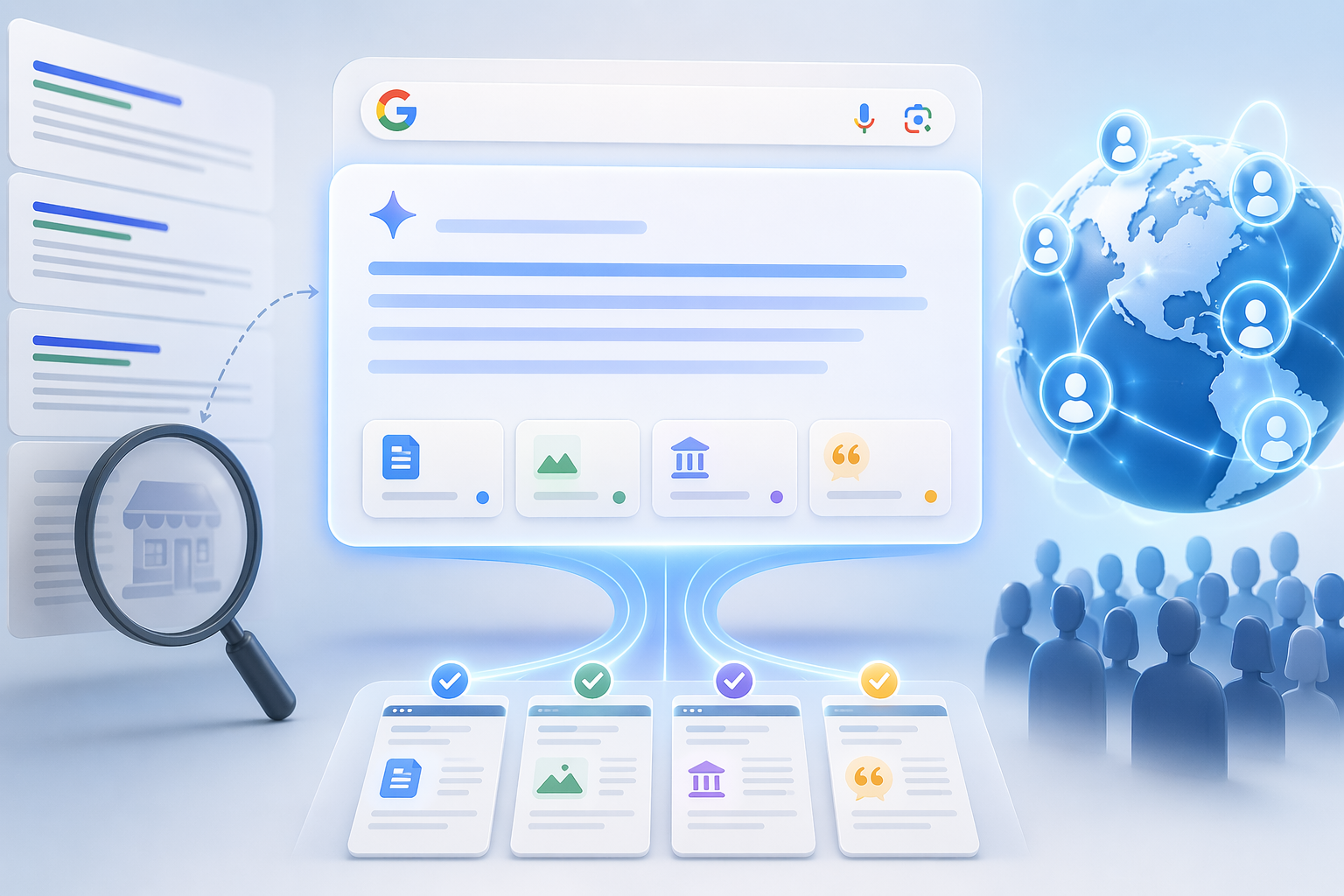
Google AI Overviews are AI-generated summary answers that appear at the top of Google Search results for many informational queries, synthesized by Google's Gemini models from across the web and linked to a handful of cited source pages. They launched at Google I/O in May 2024, replacing the earlier "Search Generative Experience" (SGE) label, and have since expanded to more than 100 countries and 200 million users according to Google's own disclosures.[^1]
If your brand ranks well on Google today but still feels invisible when you actually search for your category, Google AI Overviews are a big part of why. They change where the click goes, which sources get seen, and what "ranking" even means. This guide covers what they are, which queries trigger them, how Google picks sources, and how to get your brand cited.
What are Google AI Overviews?
Google AI Overviews are AI-generated summaries that appear above the traditional organic results for eligible queries on Google Search. Each Overview is produced on the fly by Google's Gemini model, pulls facts and phrasing from multiple indexed web pages, and displays a short list of cited sources the user can click through to verify.[^1]
Three things define them:
They sit in "Position Zero plus." They render above the first organic blue link, the People Also Ask box, and often above paid ads, pushing organic results further down the page.
They're generative, not extractive. Unlike a Featured Snippet, which copies a single passage from one page, an AI Overview synthesizes a new answer from multiple sources.
They attribute sources inline or via a panel. A small set of cited pages, typically 3-8, is shown as links, tiles, or a "Show more" drawer.
That makes them functionally a new surface. Ranking #1 for a keyword no longer guarantees the user ever scrolls to you. What matters is whether Google picked your page as one of the cited sources inside the Overview itself. This is the same category shift we cover in What is Generative Engine Optimization (GEO)?.
How did AI Overviews roll out?
Google's AI answer surface evolved in three phases:
Date | Event | What changed |
|---|---|---|
May 2023 | Search Generative Experience (SGE) announced at I/O 2023 | Opt-in experiment via Search Labs, US-only |
May 2024 | Renamed "AI Overviews," launched broadly in US | Default for many queries, no opt-in required |
Aug 2024 | Expanded to UK, India, Japan, Brazil, Indonesia, Mexico | Localization of AI answer panels |
Oct 2024 | Expanded to 100+ countries, 200M+ monthly users | First large-scale global rollout of AI-generated Search |
Mar 2025 | AI Mode launched as a separate tab | AI Overviews stayed on the default results page |
The short version: Google has made AI Overviews the default experience for a rapidly growing share of informational queries, and it isn't slowing down.[^1][^2]
What triggers a Google AI Overview?
AI Overviews are most often triggered by informational, how-to, explainer, comparison, and conversational queries where Google's systems judge that a synthesized answer is more useful than a list of links. They rarely appear on direct navigational, transactional, or highly commercial queries, and they are suppressed on sensitive topics like medical, legal, and financial advice in many regions.[^3]
Independent studies agree on the shape, even if the exact percentages differ:
Study | Sample | Share of queries triggering AI Overviews |
|---|---|---|
Semrush AI Overview study (Feb 2025) | 10M+ US keywords | ~13% of tracked informational queries[^4] |
Authoritas AI Overview tracker (Q1 2025) | 100K keywords | ~7% of all queries, ~30% of "how to" queries[^5] |
BrightEdge (Jan 2025) | 7 verticals | Healthcare 74%, B2B tech 34%, E-commerce 18%[^6] |
The pattern underneath those numbers:
Informational queries trigger most often. "What is X," "how does Y work," "why does Z happen" are Overview magnets.
"How to" and step-based queries trigger heavily. Anything that can be answered as a numbered list is a strong candidate.
Long-tail and conversational queries trigger more than short head terms. Google's AI is built to handle natural-language phrasing, so longer, question-shaped queries get the generative treatment.
Comparison queries trigger on B2B and SaaS topics. "Otterly vs AI Sightline," "best AI visibility tool," "alternatives to X" frequently produce an Overview.
Topical authority on the result page matters. If Google doesn't already have strong, trustworthy pages ranking for the query, it tends to suppress the Overview rather than hallucinate.
In practice, this means the queries most likely to show an Overview are the same queries content marketers have historically targeted with blog posts, guides, and comparison pages. That's good news and bad news. The content still matters, but the game is now "get cited in the Overview," not "rank #1."
What queries don't trigger AI Overviews?
Google systematically suppresses or avoids AI Overviews on queries where a generative answer could mislead, harm, or simply duplicate existing Google surfaces. That includes most transactional, navigational, and sensitive queries.
The categories where Overviews are rare or absent:
Pure navigational queries: "facebook login," "aisightline.com," "amazon prime." Google already knows exactly what you want.
Transactional queries with strong shopping intent: "buy iphone 16," "nike running shoes size 10." These route to the Shopping carousel and product grids.
Local queries: "coffee near me," "plumber in Austin." The Map Pack handles these.
Sensitive health, medical, and mental-health topics: Many are deliberately excluded to reduce harm.[^3]
Explicit, illegal, or policy-violating topics: Suppressed under Google's Search content policies.
Real-time events and live data: Stock prices, scores, and breaking news rely on existing Knowledge Panel data, not AI Overviews.
If your business lives primarily in local or transactional search, AI Overviews are a smaller part of your world today. If it lives in research and comparison queries, which is where most B2B SaaS and services buying happens, Overviews are already reshaping your funnel.
How does Google choose sources for AI Overviews?
Google's published guidance is that AI Overviews draw from web content surfaced by the same core Search ranking systems that produce traditional results, with additional filtering for authoritativeness, freshness, and direct relevance to the synthesized answer.[^7] In practice, that means being cited in an Overview is a compound of classic SEO signals and AI-specific structural signals.
The signals that appear to matter, based on Google's documentation, patent filings, and observed behavior:
You already rank in the top 10 for the query. Sources cited in AI Overviews are almost always pulled from the first result page. Getting into the top 10 is the price of entry.[^8]
Your content directly answers the question posed. AI Overviews favor pages with a clear, self-contained answer in the opening paragraphs or under a question-shaped heading.
Structured data and clear headings help. Articles with proper H2 hierarchy, FAQPage schema, HowTo schema, and clean structured content are easier for the model to extract from.
Brand entity recognition matters. When Google's Knowledge Graph recognizes you as an entity in the topic, you're more likely to be named in the Overview text, not just in the source list.
Freshness tilts the selection. Pages with recent
dateModifiedtimestamps and up-to-date data are preferred for time-sensitive queries.Topical depth across the domain matters. Sites with a deep cluster of content on the topic outperform one-off pages on the same keyword.
The signals above are the same ones that determine citations across the rest of the AI search ecosystem, which is why a well-optimized GEO strategy tends to lift visibility in ChatGPT, Perplexity, and Google AI Overviews simultaneously. We broke that dual-surface tension down in SEO vs GEO: Why Traditional SEO Isn't Enough Anymore.
How are AI Overviews changing click-through rates?
Every major third-party CTR study published through early 2025 shows double-digit CTR declines on organic results when an AI Overview is present on the query, with the sharpest drops on informational queries.[^9] Ahrefs found a 34.5% drop in CTR for pages ranking in position 1 when an AI Overview appeared above them.[^9] Similarweb and Semrush reported similar directional findings across their samples.[^4]
The mechanism is straightforward:
The Overview answers the user's question on the results page.
The user either clicks a cited source inside the Overview, clicks an unrelated result further down, or leaves Search entirely ("zero-click search").
Pages that used to collect the lion's share of clicks at position 1 now share the top of the page with the AI-generated answer.
For brands, this shifts what "winning" in Search looks like:
Old winning state | New winning state |
|---|---|
Rank #1 organically | Be cited inside the AI Overview |
Own the Featured Snippet | Appear as a named brand inside the Overview text |
Drive traffic from position 1 | Drive qualified traffic from Overview citations + capture branded search downstream |
That last row is the most important. Even when click volume drops, the users who do click tend to be more qualified, because they've already self-filtered on the AI summary.
How to get cited in Google AI Overviews
If you want your brand pulled into an AI Overview, the playbook is: rank in the top 10, answer the question directly, structure for extraction, build topical authority, and make your entity legible to the Knowledge Graph. None of these are new SEO ideas, but the emphasis has shifted.
The concrete tactics:
Write a direct answer in the first 60-80 words. The opening paragraph should be a quotable, self-contained answer to the H1 question. Models extract from the top of the document.
Use question-shaped H2s and H3s. Google's ranking systems pattern-match headings to user queries. "What is X," "How does Y work," "Why does Z matter" outperform cleverly phrased alternatives for Overview inclusion.
Add FAQPage and HowTo schema where appropriate. These make the content machine-readable and are among the strongest signals for extraction into AI surfaces.
Publish data-backed, citable statements. AI Overviews favor content with specific numbers, named entities, and original claims over generic explainers.
Build topical clusters, not one-off posts. A pillar page with 8-12 supporting cluster articles outperforms a single 4,000-word post on the same keyword.
Keep content fresh. Update
dateModifiedwhen you revise, and re-publish updated data quarterly on high-intent pages.Claim and verify your entity. Google Business Profile, consistent NAP data, Wikipedia, Wikidata, and LinkedIn entries all help your brand become a recognized entity.
Monitor citations, not just rankings. A page at position 8 that's cited inside the Overview is more valuable than a page at position 3 that isn't. Rank tracking alone misses this entirely.
That last point is where most SEO stacks break today. Tools built around SERP position don't tell you whether you were cited by the AI Overview, what it said about you, or what source it linked out to instead. That's the gap AI Sightline's monitoring feature was built to fill.
How can you track your Google AI Overview presence?
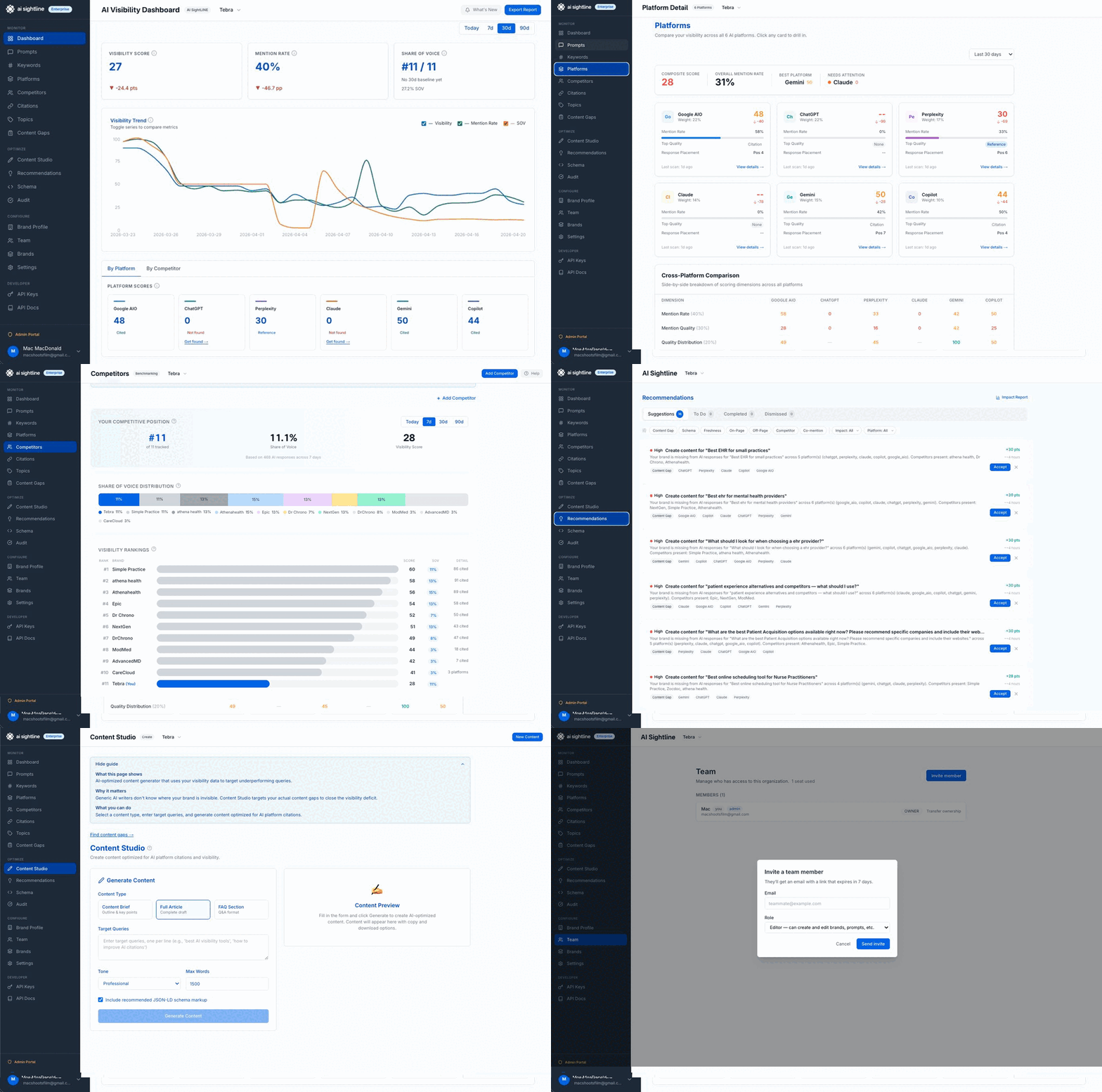
You can track your Google AI Overview presence by monitoring three things at the query level: whether an AI Overview is triggered, whether your brand is cited or mentioned inside it, and which competitors are cited alongside or instead of you. That's the minimum viable measurement setup for the AI Overview era.
A useful AIO tracking stack looks like:
A list of your highest-intent query prompts. Start with 20-75 queries a real buyer would ask about your category. Include branded, competitive, and category queries.
A daily or near-daily scan of those queries against Google AI Overviews (and, ideally, other AI platforms so you're not optimizing for a single surface).
A dashboard that tracks: AI Overview trigger rate, your citation rate, sentiment of mentions, and which competitor domains are cited.
An alerting layer that tells you when a new citation appears, a competitor steals your spot, or your visibility score shifts materially.
This is exactly what AI Sightline does across Google AI Overviews, ChatGPT, Perplexity, Claude, Gemini, and Copilot. You get a single composite AI visibility score and a per-platform breakdown that shows where you're cited and where you aren't. Pricing starts at $29.95/mo on the Starter plan; see the full pricing page for the comparison against per-prompt tools.
Because Overviews aren't the whole story. Your buyers ask the same questions in ChatGPT and Perplexity, and the answers they get there are just as load-bearing. Monitoring only Google AIO is like measuring your web traffic from one browser in 2008.
Are Google AI Overviews the same as Google AI Mode?
No. AI Overviews are the AI-generated summary panel that appears on the standard Google Search results page; AI Mode is a separate, dedicated tab that serves a fully conversational, AI-first search experience. AI Overviews are the default for many informational queries today, while AI Mode is an opt-in destination launched in 2025 that sits alongside All, Images, Videos, News, and other tabs.[^10] They share the same underlying Gemini models but serve different user intents.
Do Google AI Overviews appear on every search?
No. Google deliberately suppresses AI Overviews on transactional, navigational, local, and sensitive queries, and they appear on roughly 7-20% of all queries in most third-party studies, with much higher rates on informational and how-to queries.[^4][^5] Coverage varies significantly by vertical: healthcare and education see Overviews on the majority of informational queries, while e-commerce and local services see them far less often.[^6]
How many sources does Google cite in an AI Overview?
A typical Google AI Overview cites 3 to 8 distinct source pages, shown as links, tiles, or a collapsible "Show more" panel on the right side or below the answer text. The exact number depends on the query complexity and whether the Overview includes a bulleted list, a step-by-step answer, or a comparison table. For longer, multi-part answers, citation counts can reach 10 or more. Citation ordering does not necessarily match the organic ranking of the same URLs; Google's generative system can promote a lower-ranked page into the first citation slot if it answered the question more cleanly.
Can you opt your site out of appearing in Google AI Overviews?
Partially. Google honors the nosnippet and max-snippet:0 robots meta tags to exclude pages from both Featured Snippets and AI Overviews, and recent documentation confirms the newer google-extended user-agent directive in robots.txt controls training and generative use.[^11] However, opting out of Overviews means your content won't be cited in them at all, which for most brands is a larger visibility hit than the traffic loss from zero-click behavior. Before opting out, monitor whether you're being cited first. Most sites should optimize for citation, not against it.
Is traditional SEO still relevant in the AI Overviews era?
Yes, but its role has changed. Traditional SEO signals (topical authority, backlinks, technical excellence, content quality) are still the primary input to AI Overview source selection, so ranking well organically is a prerequisite for being cited. What changed is the success metric: citation rate inside the Overview now matters at least as much as organic position. The brands winning in 2026 are treating SEO and GEO as the same discipline with two surfaces, not as competing strategies.
If you want a deeper breakdown of where the two overlap and where they diverge, see SEO vs GEO and our side-by-side comparisons of the tools built for each, starting with AI Sightline vs Otterly.
Start tracking your Google AI Overview presence
Google AI Overviews aren't a temporary experiment. They're the default experience Google is rolling out globally, and the data suggests informational traffic patterns will keep reshaping around them. Ranking #1 used to be enough. Now, being cited inside the Overview is the only durable signal that your brand is winning the query.
You can't improve what you can't see. Start a free AI Sightline account to monitor your Google AI Overview citations (along with ChatGPT, Perplexity, Claude, Gemini, and Copilot) in one dashboard. Free, no credit card, set up in under two minutes.
[^1]: Google, "Generative AI in Search: Let Google do the searching for you," blog.google, May 14, 2024. https://blog.google/products/search/generative-ai-google-search-may-2024/
[^2]: Google, "AI Overviews are rolling out to more countries and languages," blog.google, August 15, 2024. https://blog.google/products/search/ai-overviews-search-august-2024/
[^3]: Google Search Central, "Generative AI in Search Help documentation." https://support.google.com/websearch/answer/14901683
[^4]: Semrush, "AI Overviews Study: Key Takeaways for SEOs," February 2025. https://www.semrush.com/blog/ai-overviews-study/
[^5]: Authoritas, "Google AI Overviews Tracking Study," Q1 2025. https://www.authoritas.com/blog/google-ai-overviews-analysis
[^6]: BrightEdge, "Generative Parser: AI Overview Coverage by Vertical," January 2025. https://www.brightedge.com/resources/research-reports/generative-ai-search-industry
[^7]: Google Search Central, "How Google uses generative AI in Search." https://developers.google.com/search/docs/appearance/ai-features
[^8]: Search Engine Land, "Study: Most AI Overviews cite top 10 organic results," 2024. https://searchengineland.com/study-ai-overviews-cite-top-10-organic-449107
[^9]: Ahrefs, "How AI Overviews Affect Click-Through Rates," March 2025. https://ahrefs.com/blog/ai-overviews-ctr-study/
[^10]: Google, "Expanding AI Mode in Search," blog.google, March 2025. https://blog.google/products/search/ai-mode-search/
[^11]: Google Search Central, "Overview of Google crawlers and fetchers (user agents): Google-Extended." https://developers.google.com/search/docs/crawling-indexing/overview-google-crawlers#google-extended
Get your free AI visibility score.
See how ChatGPT, Claude, Perplexity, Gemini, Google AIO, and Copilot talk about your brand.
Start freeSolo founder building AI visibility monitoring. Ships weekly. No venture capital, a lot of opinions about where AI search is going.