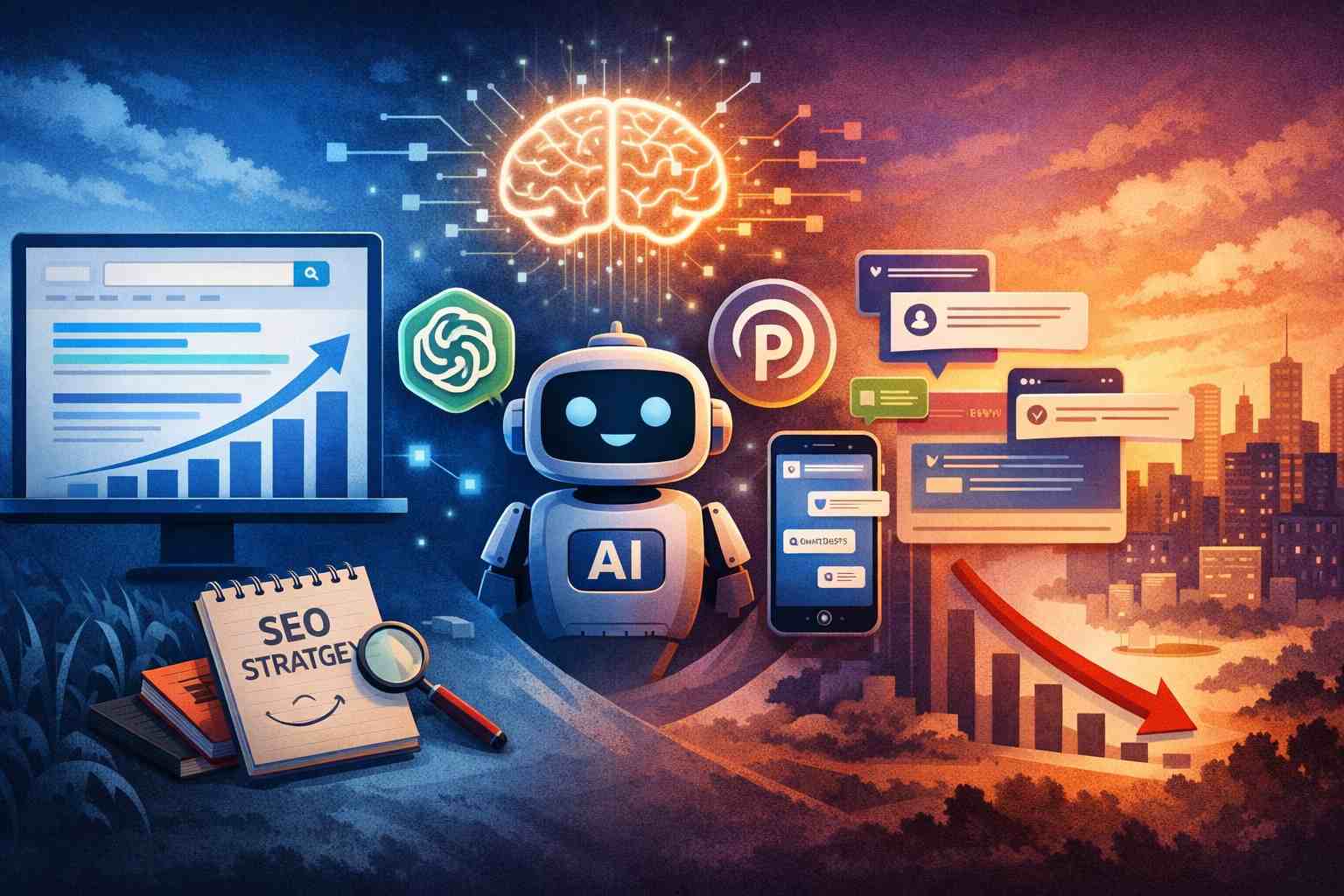
AI is fundamentally changing search marketing. Google AI Overviews now appear on nearly 60% of searches, AI chatbots like ChatGPT and Perplexity handle hundreds of millions of queries per month, and Gartner predicts traditional search volume will drop 25% by 2026. For marketers, this isn't a future trend to watch -- it's a structural shift happening right now that demands a new playbook.
The old model was simple: rank on page one, get clicks. The new model is more complex. Your brand needs to appear in AI-generated answers, get cited by chatbots, and maintain visibility across a fragmented ecosystem of search experiences. This post breaks down exactly what's changing, what the data says, and what smart marketers are doing about it.
The Numbers That Should Get Your Attention
The scale of this shift is hard to overstate. Here are the data points that matter most:
AI Overviews are everywhere. According to BrightEdge data, AI Overviews appeared on 31% of Google searches in February 2025. By February 2026, that number hit 48%. Some industries are even higher -- healthcare triggers AI Overviews on 88% of searches, education on 83%, B2B tech on 82%.
AI chatbot usage is exploding. Perplexity processed 780 million queries in May 2025, up 370% year-over-year. ChatGPT still holds 68% market share among AI chatbots, but that's down from 87% a year earlier as competitors like Gemini, Claude, and Perplexity take share. The pie is growing fast and fragmenting at the same time.
Organic click-through rates are falling. Search Engine Land reports a 61% drop in organic CTR on queries where AI Overviews appear. If your entire strategy depends on Google organic clicks, you're losing ground every month.
Consumers are using AI for purchase decisions. 61% of US consumers now use generative AI tools for online shopping research. 47% use AI specifically to summarize product reviews before buying. This isn't just informational search -- it's commercial intent flowing through AI channels.
What "Search Marketing" Even Means Now
For two decades, search marketing meant two things: SEO (rank organically on Google) and SEM (buy Google Ads). That framework is breaking down.
Today, search marketing includes at least five distinct surfaces where your brand either appears or doesn't:
Google organic results still matter, but they're getting pushed down the page by AI Overviews, featured snippets, and knowledge panels. Position one isn't what it used to be when an AI-generated answer sits above it.
Google AI Overviews are the new position zero. When Google generates a summary answer, the brands cited in that answer get 35% more organic clicks than those that aren't. Getting cited here is becoming more valuable than ranking #1 in traditional results.
AI chatbots (ChatGPT, Perplexity, Claude, Gemini, Copilot) are where a growing share of searches start and end. These platforms don't show ten blue links -- they generate answers and sometimes cite sources. If your brand isn't in those answers, you're invisible to an increasingly large audience.
AI-powered shopping experiences are emerging as 61% of consumers use AI for product research. Google's AI Mode, ChatGPT's browsing, and Perplexity's shopping features are creating entirely new conversion paths.
Voice and agent search is still early but accelerating. AI agents that research, compare, and recommend on behalf of users will make brand visibility in AI systems even more critical.
The marketers who are winning right now aren't choosing between these channels. They're building visibility across all of them.
How AI Search Actually Decides What to Show
Understanding how AI search works is the first step to optimizing for it. And it's fundamentally different from how Google's traditional algorithm works.
Traditional Google: Links and Relevance
Google's organic algorithm evaluates pages based on relevance, authority (backlinks), technical quality, and user signals. You optimize for specific keywords, build links, and improve page experience. The ranking factors are well-documented and the feedback loop (search console data, rank tracking) is mature.
AI Search: Training Data and Authority Signals
AI models like ChatGPT and Claude form their "opinions" about brands during training on massive text datasets. They also pull real-time information through web browsing and retrieval-augmented generation (RAG). What determines whether your brand appears in an AI-generated answer?
Content quality and depth. AI models favor sources that provide thorough, specific, well-structured information. Thin content that might rank for a long-tail keyword on Google won't get cited by an AI chatbot.
Structured data. JSON-LD schema markup, clear heading hierarchies, and well-organized content make it easier for AI systems to extract and cite your information accurately.
Brand authority signals. Mentions across multiple authoritative sources, consistent NAP (name, address, phone) data, Wikipedia presence, and strong E-E-A-T signals all influence whether AI models consider your brand trustworthy enough to recommend.
Direct answers to questions. AI models look for content that directly answers the user's question in a clear, self-contained way. Content that buries the answer under three paragraphs of filler gets skipped.
Freshness and accuracy. AI systems with real-time browsing capabilities (Perplexity, ChatGPT with browsing) prioritize recent, accurate information over outdated content.
Three Shifts Every Search Marketer Needs to Make
The data is clear: 54% of US marketers plan to implement GEO (Generative Engine Optimization) within 3-6 months, and 98% plan to increase AI SEO spend in 2026. Here's what that actually looks like in practice.
Shift 1: From Keywords to Questions
Traditional SEO targets keyword phrases. AI search optimization targets the questions behind those keywords -- and answers them directly.
Instead of optimizing a page for "best CRM software," you need to answer the question an AI model will try to answer: "What is the best CRM software for small businesses with under 50 employees?" The more specific and directly you answer real questions, the more likely AI models are to cite you.
This means restructuring your content around question-and-answer patterns. Use H2 headings that are actual questions. Lead each section with a direct, citation-worthy answer. Then provide the supporting detail.
Shift 2: From One Platform to Many
When Google was the only game in town, you optimized for one algorithm. Now you need visibility across Google (organic + AI Overviews), ChatGPT, Perplexity, Claude, Gemini, and Copilot -- at minimum.
Each platform has different retrieval patterns. Perplexity cites sources aggressively. ChatGPT's citations are less consistent. Google AI Overviews pull from pages already in the search index. Claude draws heavily from training data.
Monitoring your visibility across all of these platforms is the only way to know where you stand. This is exactly why tools like AI Sightline exist -- we track your brand's visibility across 6 AI platforms simultaneously, starting at $29.95/mo for 20 prompts across 4 platforms.
Shift 3: From Ranking to Being Referenced
Here's the mental model shift: in traditional SEO, success means ranking on page one. In AI search, success means being referenced in the answer. These are different things.
A brand can rank #1 on Google for a query and never get mentioned by ChatGPT for the same topic. Conversely, a brand with no Google presence might get cited frequently by Perplexity because it has strong, specific content that answers questions well.
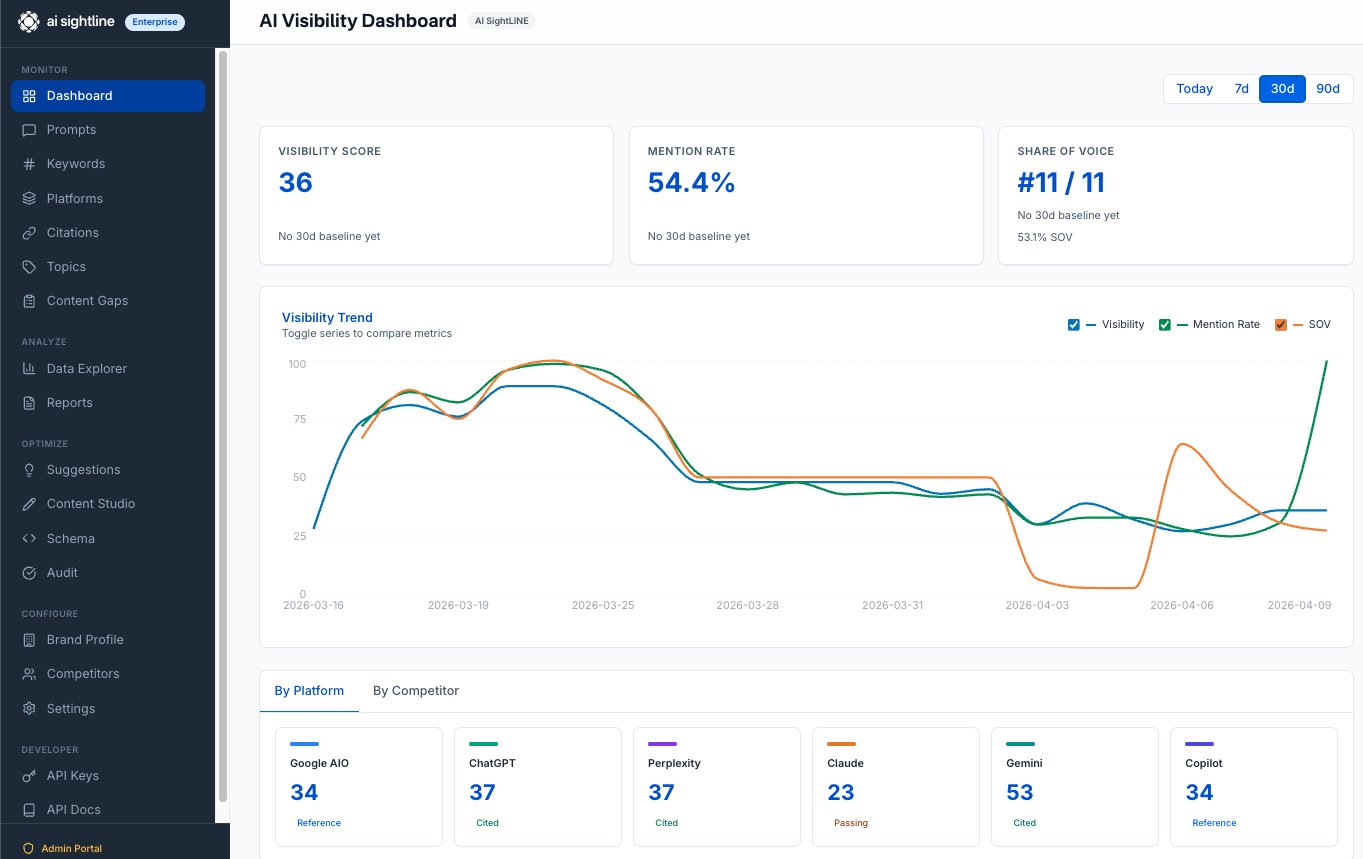
The new metric isn't "what position do I rank?" It's "am I being cited, referenced, or mentioned -- and in what context?" This is what AI visibility monitoring measures: not just whether you appear, but how you appear -- as a citation, a reference, or a passing mention -- across every major AI platform.
What GEO Actually Looks Like (Practical Steps)
GEO -- Generative Engine Optimization -- is the practice of optimizing your brand's content and online presence to increase visibility in AI-powered search. Here's what it looks like day-to-day.
Audit Your Current AI Visibility
Before optimizing anything, you need a baseline. How often does your brand appear in AI-generated answers for your target keywords? On which platforms? In what context?
You can do this manually by searching for your key terms on ChatGPT, Perplexity, Google (with AI Overviews), Claude, Gemini, and Copilot. Or you can use a monitoring tool that automates this across all platforms and tracks changes over time.
Structure Content for AI Extraction
AI models extract information from content that's well-structured. That means:
-
Clear heading hierarchies (H2 for sections, H3 for subsections)
-
Direct answers in the first 1-2 sentences of each section
-
Specific data points (numbers, dates, named entities) rather than vague claims
-
Comparison tables when discussing multiple options
-
JSON-LD schema markup on every page
Build Topical Authority, Not Just Page Authority
AI models don't just evaluate individual pages -- they assess whether a source has comprehensive expertise on a topic. Publishing one blog post about "AI search optimization" won't cut it. You need a cluster of content that covers the topic from multiple angles: what it is, how it works, specific tactics, comparisons, case studies, and data.
This is why topic authority tracking matters. It shows you where you have depth and where you have gaps that competitors are filling.
Monitor and Iterate
AI search results change frequently. A brand that gets cited today might disappear next week if a competitor publishes better content or if an AI model updates its retrieval index.
Weekly monitoring across all platforms gives you the feedback loop you need. AI Sightline's rolling scan system automatically rechecks your visibility every 3-7 days depending on your plan, so you catch changes before they become trends.
The Brands Getting This Right
The brands that are winning in AI search share a few characteristics:
They publish specific, data-backed content. Not generic thought leadership -- actual data, actual numbers, actual analysis. AI models cite specifics, not platitudes.
They maintain structured data. JSON-LD schema, OpenGraph tags, clean sitemaps, and consistent entity information across the web. This makes it easy for AI systems to parse and attribute their content.
They monitor multiple platforms. They don't just check Google rankings. They track their presence across ChatGPT, Perplexity, Claude, Gemini, and Google AI Overviews -- because visibility varies dramatically across platforms.
They treat AI search as a channel, not a gimmick. They have dedicated workflows for GEO just like they have for SEO. They track metrics, run experiments, and iterate based on data.
What Happens If You Do Nothing
Gartner projects a 33% or more share of web content will be optimized for AI search within 18 months. If your competitors are optimizing and you're not, the math isn't complicated.
The 61% CTR drop on AI Overview queries isn't going to reverse. The share of searches handled by AI chatbots isn't going to shrink. The question isn't whether AI is changing search marketing -- it's whether you'll adapt before your competitors do.
Start Measuring What Matters
The first step is knowing where you stand. AI Sightline tracks your brand's visibility across ChatGPT, Google AI Overviews, Perplexity, Claude, Gemini, and Copilot -- with a free plan that covers 3 platforms and 3 prompts, no credit card required.
Because you can't optimize what you can't measure. And in AI search, most brands can't measure anything yet.
Check your AI visibility for free -- it takes 30 seconds.
How is AI changing search marketing in 2026?
Search marketing is splitting in two. Traditional SEO still drives the click-through from a list of blue links, while generative engine optimization (GEO) decides whether your brand even gets named inside a ChatGPT, Perplexity, Claude, Gemini, Copilot, or Google AI Overview answer. The shift matters because roughly half of all branded queries now resolve inside an AI assistant before the user ever sees a SERP.
Should I stop doing SEO?
No. SEO and GEO share the same plumbing: clean technical foundations, useful content, and earned authority. Stopping SEO would also stop most of the signals AI engines rely on to decide who to cite. Treat GEO as a layer that sits on top of SEO, not a replacement for it.
What is the first thing a marketer should change?
Start measuring AI visibility separately from organic rank. Pick a tool that tracks how often your brand appears across ChatGPT, Perplexity, Google AIO, Gemini, Claude, and Copilot for the prompts your buyers actually type. Without that baseline you cannot tell whether anything you do is working.
Does paid search help with AI visibility?
Not directly. Paid placement gets you into Google Ads and Sponsored Bing slots, but AI assistants build answers from organic citations and licensed datasets, not ad inventory. Spend on paid where intent is high; spend on GEO where AI assistants are answering instead.
Get your free AI visibility score.
See how ChatGPT, Claude, Perplexity, Gemini, Google AIO, and Copilot talk about your brand.
Start freeSolo founder building AI visibility monitoring. Ships weekly. No venture capital, a lot of opinions about where AI search is going.