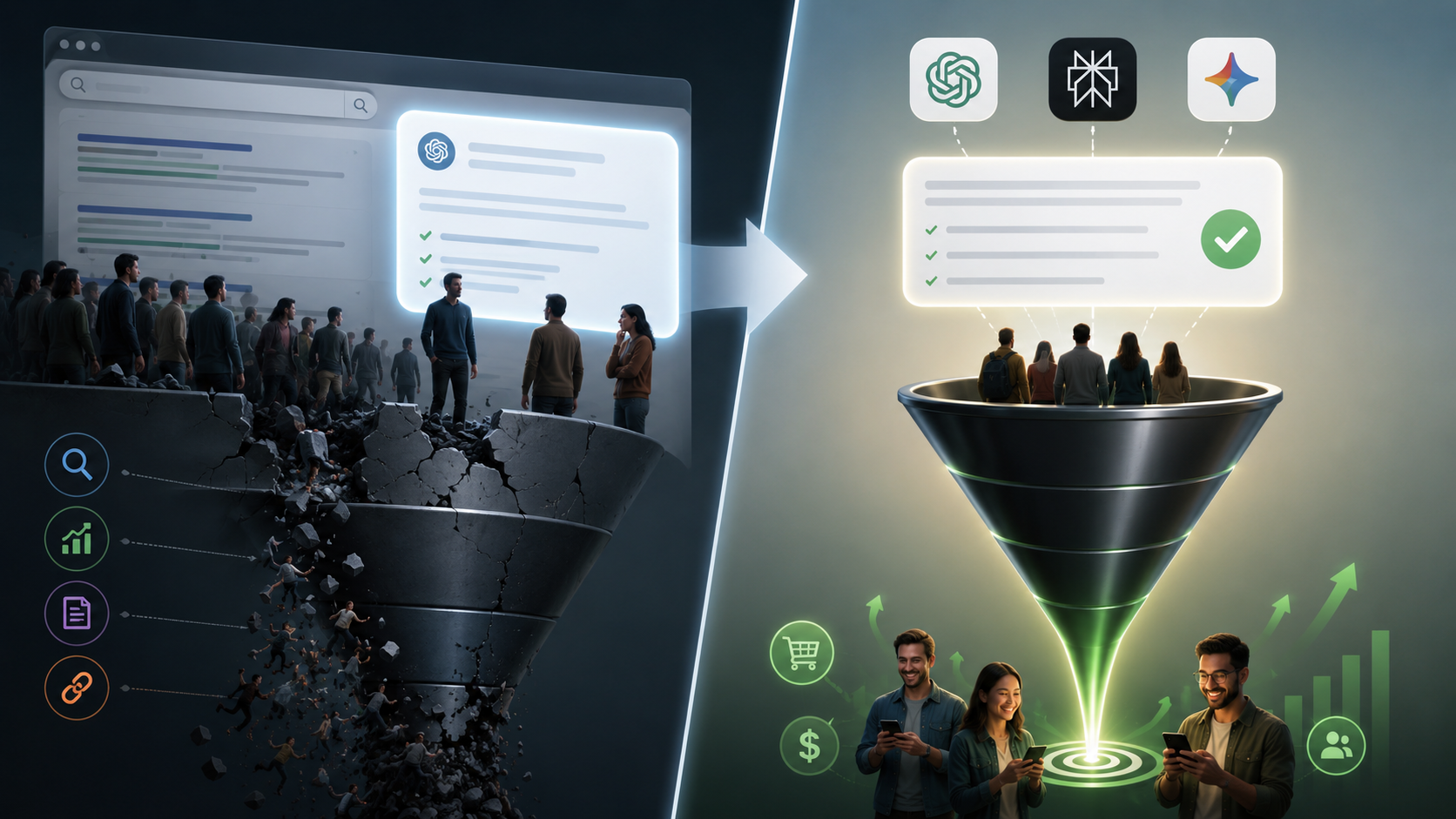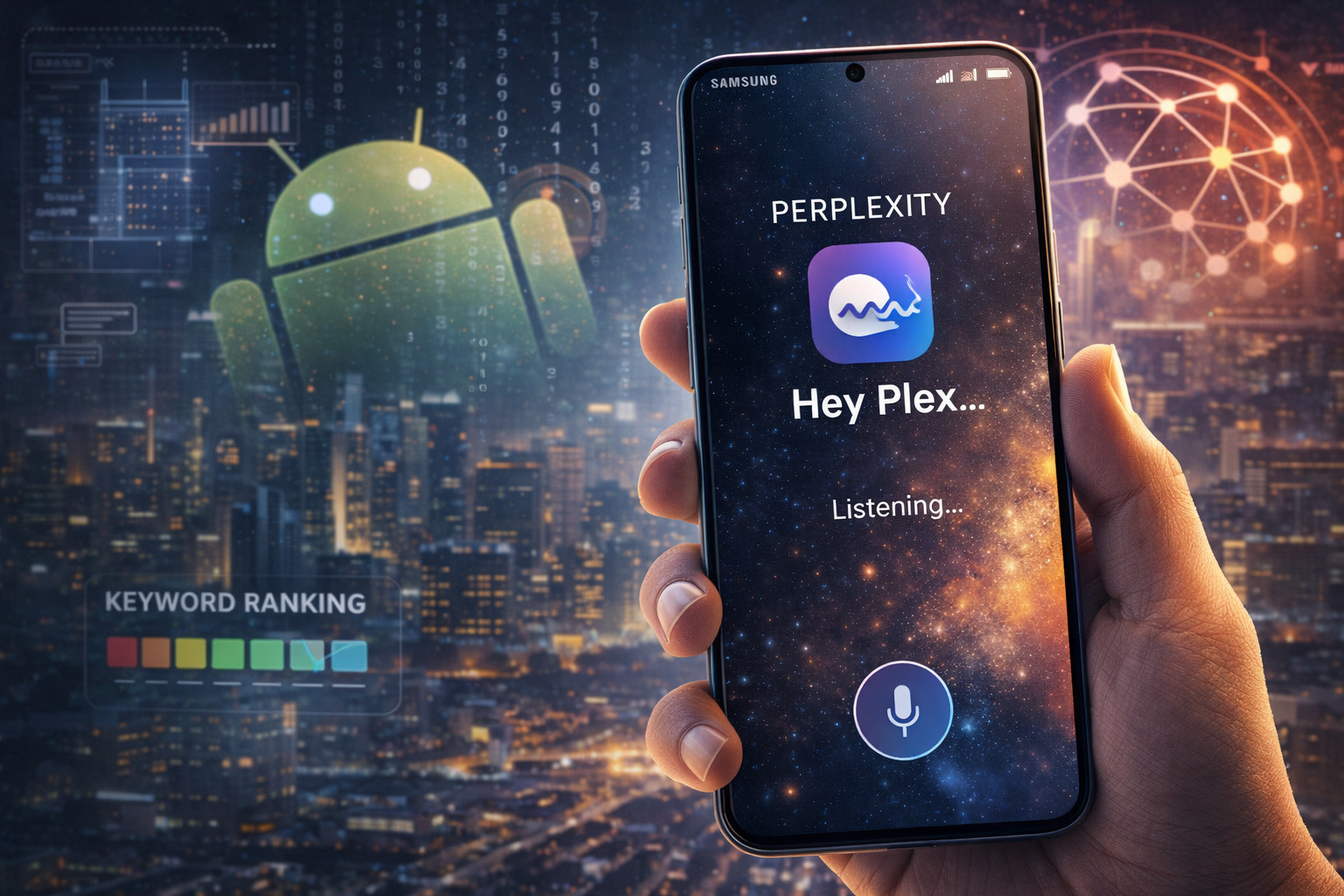
Perplexity is pre-installed on the Samsung Galaxy S26, and "Hey Plex" is now a default voice search option on the most popular Android device on the planet. That single product decision moves AI search from a tab people open to an operating system layer buried under every swipe, every home-screen gesture, and every voice command on a billion-plus phones. If your brand visibility strategy still starts and ends with Google rankings, the ground just shifted underneath it.
This post breaks down what changed, what the data actually says about AI search adoption, why legacy SEO tools were never built to see any of it, and the specific moves marketing leaders should make this quarter to avoid going invisible inside LLM answers.
What actually changed with Perplexity on the Samsung Galaxy S26
The Samsung Galaxy S26 ships with Perplexity pre-installed as a default AI search and voice assistant option, activated through the "Hey Plex" wake word. For the first time, a mainstream flagship smartphone is shipping an LLM-first answer engine alongside and in many default flows, in front of traditional Google Search. Samsung's Galaxy line is the best-selling Android family in the world, so the shipped install base is measured in hundreds of millions of devices within a year.
The practical implication is simple. A buyer who used to tap the Google search bar to research a vendor, a product category, or a competitor now has a one-word voice shortcut that returns a synthesized answer with a handful of citations and often zero clicks out to any website. The search session your marketing team used to own inside Google Analytics never starts.
Why "Hey Plex" is an OS-level event, not a feature launch
AI search has been a browser tab, a sidebar, or a standalone app for most of the last two years. Pre-installation on the Galaxy S26 collapses that distance to zero. "Hey Plex" sits at the same privilege level as "Hey Google" and "Hey Bixby" wake word, system-wide, no app-open required.
When an answer engine becomes an OS-level surface, three things happen at once:
-
Defaults carry disproportionate weight. Research on software defaults consistently shows that the pre-selected option captures the overwhelming majority of usage, regardless of user preference. A default AI assistant on a flagship device compounds across hundreds of millions of users.
-
The discovery funnel shortens. Voice-to-answer removes the SERP, the scroll, and the click. The user hears a synthesized answer and whatever brands it chose to name.
-
The switching cost to "just Google it" rises. Every frictionless answer is a small reason to never open a browser.
This is why treating Perplexity on Samsung Galaxy S26 as "another channel" misreads the shift. It's not a channel. It's infrastructure.
The SEO playbook was built for one question. That question is now partial.
The SEO playbook most marketing teams still run was built around a single question: where does my brand rank on Google? That question still matters traditional search drives the majority of web sessions in 2026 , but it is no longer the whole game.
More and more buyer research now starts and ends inside an LLM answer. There is no click. There is no SERP. There is no session in your analytics. The buyer either hears your brand name in the synthesized response, or they don't and you have no native way to know which happened.
Here is the honest read on the state of brand discovery today:
| Traditional SEO assumes | What AI search actually does |
|---|---|
| The user lands on your site | The user gets an answer without visiting any site |
| You can measure impressions in Google Search Console | LLM citations never appear in Search Console |
| Ranking #1 captures the click | A ranked page may never be cited by ChatGPT or Perplexity |
| Backlinks and content depth drive visibility | Citation-worthiness, structure, and entity clarity drive visibility |
| Google is the gatekeeper | ChatGPT, Perplexity, Gemini, Copilot, and Google's AI Mode each have their own |
None of this means SEO is dead. It means SEO is now one leg of a two-leg stool, and the second leg has no name on most marketing org charts.
What the data says about AI search adoption
You don't need Samsung's decision to tell you the wind shifted the adoption data already did. A few numbers that matter for planning:
-
AI-powered search referral traffic grew by roughly 3,500% year-over-year heading into 2026, according to multiple analytics vendors tracking referral categories.
-
Google itself has rolled out AI Overviews across a majority of informational queries and launched AI Mode as a dedicated answer surface inside the core Google app.
-
ChatGPT, Perplexity, Claude, Gemini, and Copilot each publish citations in their answers which means every one of them is a source of brand mentions your team cannot currently see or attribute.
-
Voice and ambient AI search, historically niche, becomes a material share of sessions the moment a flagship smartphone ships it as default.
The pattern is consistent across every data source. AI answers are where a growing share of consideration-stage research is actually happening, and the tools most teams use to measure discovery were built before any of that existed.
What Google Search Console was never built to see
Google Search Console is a great tool for one specific thing, showing you how your pages perform inside Google's own organic index. It was never built to report on whether ChatGPT named your brand in an answer, whether Perplexity cited your domain in a citation card, whether Gemini included you in a side-by-side comparison, or whether Google's own AI Overview pulled your content or a competitor's.
The AI answer layer is a parallel universe your current stack cannot observe. You can be the #1 organic result on Google and still be the brand that never gets named when "Hey Plex" answers the same question.
That blind spot is the reason a new category exists.
The new category: AI visibility monitoring
AI visibility monitoring is the practice of tracking whether, how, and how often your brand is mentioned or cited inside the answers generated by AI search engines like ChatGPT, Perplexity, Gemini, Copilot, and Google's AI Mode. It sits next to SEO in the marketing stack — it doesn't replace it — and it answers questions Google Search Console was never architected to answer.
A purpose-built AI visibility tool monitors:
-
Whether your brand appears in LLM answers for the prompts your buyers actually type and speak
-
How often competitors are named in those same answers
-
Which platforms cite you, which ignore you, and which describe you inaccurately
-
Which of your own pages, schemas, and topical clusters are driving the citations you do earn
-
How all of the above changes week over week, so you can tie content and PR work to measurable movement
This is exactly the category AI Sightline was built for.
Why AI Sightline is the tool built for this moment
AI Sightline is an AI visibility monitoring platform that tracks your brand across five AI search platforms — ChatGPT, Perplexity, Gemini, Copilot, and Google's AI Mode from a single dashboard, with full API and MCP server access so your team can plug AI visibility data into the same place the rest of your marketing data already lives.
A few things that make AI Sightline the right fit for the Perplexity-on-Samsung reality:
-
Coverage of the platforms that actually matter. The Pro plan monitors five AI platforms at $29.95/month. That's the coverage you need for a market where Perplexity just shipped on the Galaxy S26 and Google AI Mode is rolling into the core Google app.
-
Real scanning volume, not per-prompt billing. The Pro plan includes 75 prompts scanned daily and 100 tracked keywords. You are not nickeled-and-dimed per query.
-
Full REST API from Starter and an MCP server from Pro. Your own agents and dashboards can query visibility data directly — this is the only AI visibility tool with an MCP server, which means any Claude or AI-agent workflow can read your live visibility numbers.
-
Competitor tracking built in. Starter tracks 3 competitors, Pro tracks 10, Business tracks 25. You see who is getting named when you aren't.
-
Schema analysis, topic authority, and content audit on Pro. The recommendations tell you which pages to adjust to increase citation probability, not just which prompts you're losing.
If you want the short version: five platforms, 75 daily prompts, 100 keywords, REST API and MCP, for $29.95 per month on the Pro plan. That is the coverage you need to actually see what Perplexity is saying about your brand when someone holds down the side button on a Galaxy S26 and says "Hey Plex."
How to start monitoring Perplexity and the rest of AI search
The workflow is short. You are not building a new marketing motion — you are adding an observation layer to the one you already have.
-
Create a free AI Sightline account. The Free plan monitors 2 AI platforms and 10 keywords, which is enough to confirm the visibility gap is real for your brand.
-
Add your brand, your top 10-25 buyer-intent prompts, and your 3-5 direct competitors. Think "best [category] for [use case]," "[competitor] vs [competitor]," and "[category] alternatives to [incumbent]." Include voice-style phrasing, because that's how "Hey Plex" queries come in.
-
Run your first scan and read the baseline. You will almost certainly find platforms that name competitors but not you. That list is your first content and PR brief.
-
Upgrade to Pro ($29.95/mo) when you need 5 platforms, 75 prompts, 100 keywords, MCP, and the content audit module. That tier is where most B2B marketing teams should operate.
-
Wire the API or MCP server into your reporting. Treat AI visibility as a weekly metric alongside organic traffic. Track movement, tie it to content and PR work, iterate.
You can see the full plan breakdown on our pricing page and a deeper look at how the monitoring engine works on the features page. If you run an agent stack, the MCP server docs show how to expose visibility data to Claude, ChatGPT, or any MCP-capable client.
The question every marketing leader needs to answer this quarter
If "Hey Plex" is now the default on a flagship phone shipping into hundreds of millions of hands, the question stops being abstract. It becomes very concrete.
Do you know what Perplexity is saying about your brand today? Do you know what ChatGPT, Gemini, Copilot, and Google's AI Mode are saying? If the answer is "not exactly," your buyers are about to find out before you do — and every one of those answers will shape pipeline you never see land in your CRM.
The teams that win the next 18 months will be the ones that treat AI visibility the same way they treated search visibility in 2010 — as a discipline with its own metrics, its own tooling, and its own owner on the marketing team. The teams that keep measuring only Google rankings will quietly lose share to competitors who figured out how to show up inside the answer.
You can close the visibility gap this week. Start monitoring your AI visibility for free — no credit card required, five minutes to your first scan, and a real answer to the question your CEO is already asking.
What does Perplexity on Samsung Galaxy S26 mean for brands?
Perplexity is now the default AI assistant for hundreds of millions of Samsung phones, which dramatically expands the surface area where brand-related questions get answered by an LLM instead of Google. Brands that were already optimizing for Perplexity inherit the new audience for free; brands that ignored Perplexity now have an urgent reason to start.
How does the Samsung partnership change Perplexity's reach?
Roughly an order of magnitude. Samsung ships hundreds of millions of devices a year and the default-assistant relationship surfaces Perplexity in search, voice, and browser contexts that would otherwise go to Google or Bixby. The competitive ranking AI tools track has shifted accordingly.
Should brands optimize specifically for Perplexity?
Yes, alongside the other major engines. Perplexity has its own ranking quirks (heavy weighting on Reddit, news sites, and academic sources) that differ from ChatGPT or Google AIO. Treat it as a distinct surface to monitor, not a clone of ChatGPT.
Does Perplexity follow Google's ranking signals?
Partially. Perplexity uses its own ranking pipeline and cites a different mix of sources than Google does, but core signals like backlink authority, content depth, and structured data still apply. Strong SEO foundations help Perplexity too, just not in the same proportions.
Get your free AI visibility score.
See how ChatGPT, Claude, Perplexity, Gemini, Google AIO, and Copilot talk about your brand.
Start freeSolo founder building AI visibility monitoring. Ships weekly. No venture capital, a lot of opinions about where AI search is going.