The internet you bought your analytics stack for isn't the internet you sell into anymore.
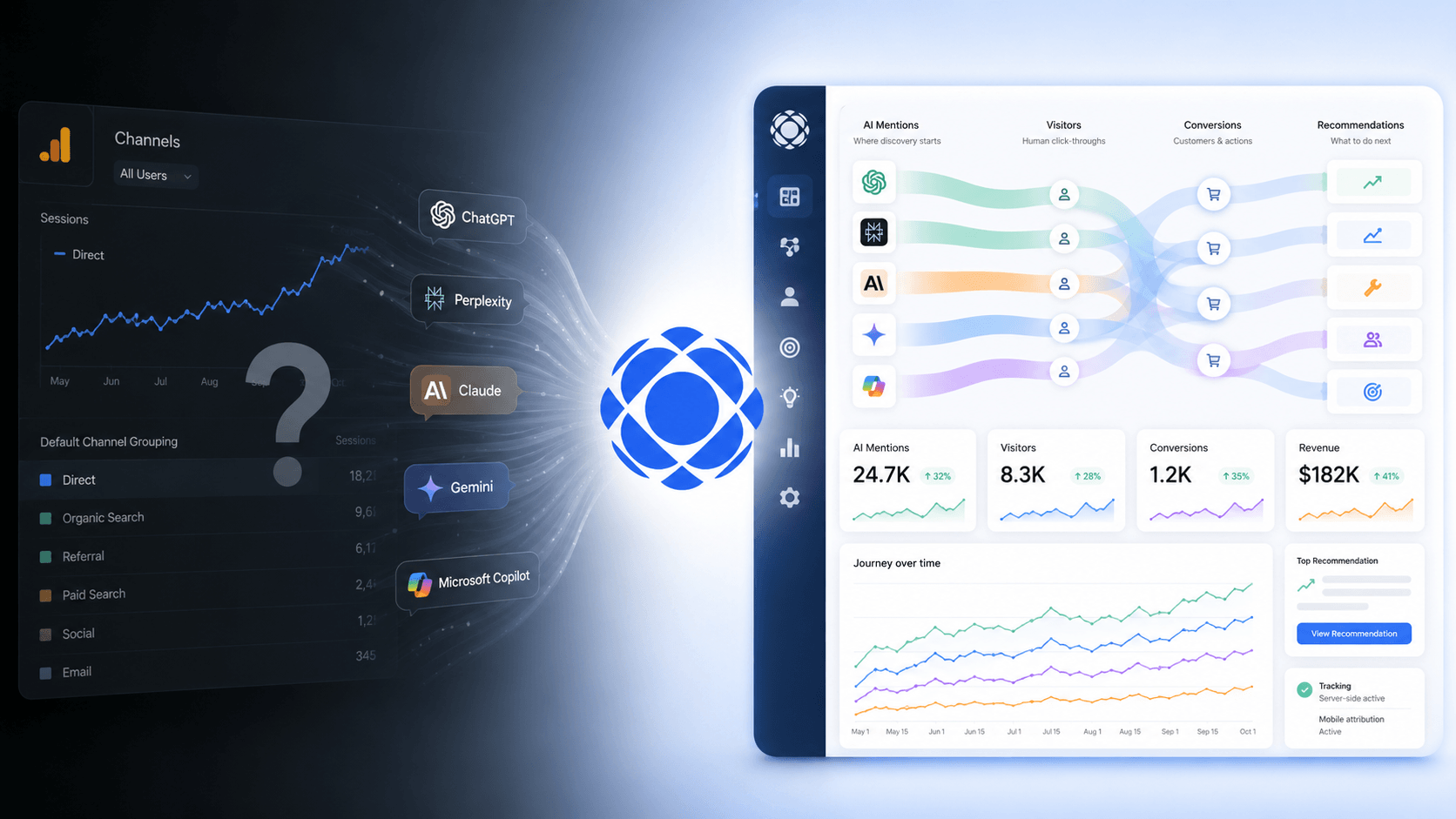
When was the last time you opened Google Analytics and felt like it was telling you the whole story? If you've noticed your "Direct" traffic line growing alongside ChatGPT, Perplexity, Claude, Gemini, and Microsoft Copilot, that isn't a coincidence. That's the new internet bleeding into the old dashboard, mislabeled.
Search isn't search anymore. Your customers are finding you through AI conversations now. The dashboard you've trusted for a decade was designed when traffic came from links and search results. It cannot see what's happening in front of it.
Today we're shipping what we believe is the first complete analytics platform built for AI search. It tracks the entire customer journey, from the AI mention that started the conversation, to the human who clicked through to your site, to the recommendation that tells you what to fix next. It runs server-side, with mobile attribution that actually works, and it's included on every plan, starting at $0/month.
This post is about why this had to be built, what it does, and how to install it in about thirty seconds.
Search isn't search anymore
For twenty years, marketers had a stable mental model. Customers searched on Google. Google sent them to your site. Google Analytics told you which keyword. Adobe Analytics told you what they did when they got there. The whole stack made sense because the world made sense.
That world is gone.
ChatGPT, Claude, Perplexity, Gemini, and Microsoft Copilot have changed the shape of customer discovery in eighteen months. Google itself responded by inserting AI Overviews above the organic results, which routinely answer the user's question without sending them anywhere. The traffic patterns shifted. The platforms shifted. The data layer underneath did not catch up.
This is the same magnitude of shift as search replacing directories in the early 2000s, or social media replacing portals in the 2010s. The dashboards you trust for the rest of your business have not been rebuilt for it.
Legacy analytics is blind by design
Google Analytics, Adobe Analytics, every marketing dashboard you have was built around one assumption: traffic arrives with a referrer that names where it came from. When a user clicked through from a search result or an external site, the browser sent that source along in the Referer HTTP header, and your dashboard recorded it.
That assumption broke in mobile.
When a user clicks a link inside ChatGPT iOS, Perplexity iOS, Gemini iOS, or Microsoft Copilot mobile, the in-app browser opens the destination URL but strips the Referer header on the way out. Your server sees the request. Your server has no idea where it came from. GA4 logs it as (direct) / (none).
A February 2026 analysis of 20,428 AI-driven visits found that 70.6% of them landed in GA4 with no referrer at all. The mechanisms are well documented. Mobile in-app WebView and Custom Tabs strip referrers by default. The strict-origin-when-cross-origin policy on chatgpt.com strips referrers even on desktop in many cases. Some AI links use rel="noreferrer" on inline citations.
Your traffic is real. Your conversions are real. Your visibility in AI is real. The legacy dashboard cannot see it. Not because GA is broken; because GA was built for the wrong internet.
The 70% number isn't the story. It's the proof that there's a story.
The first wave of AI tools gave you half an answer
Over the last two years, a wave of AI visibility tools shipped to fill the gap. Otterly, Peec, Scrunch, LLMrefs, Goodie, AthenaHQ, Authoritas, Knowatoa, Promptwatch, Rankscale. They built monitoring for what AI says about you. They tell you when ChatGPT cites your brand, when Perplexity mentions your product, when Claude recommends your category. Useful. Important.
Mention monitoring is half a tool.
Knowing that AI mentioned you doesn't tell you whether anyone clicked through. It doesn't tell you what they did when they got to your site. It doesn't tell you whether your conversion rate on AI traffic is higher or lower than your search traffic. It doesn't tell you what to fix.
Profound is the only platform in the existing AI visibility category that has shipped traffic data alongside mentions. They charge $399/month for it, and their own documentation confirms that human-conversion tracking requires connecting a GA4 property. Which means the moment they do their best work, they hand it to a dashboard that loses 70% of the signal in mobile.
That's the state of the market. Mention-only tools see half. The one tool that promises the other half punts to legacy analytics, which inherits the same blind spot.
This is why we built our own analytics layer.
AI Sightline: the analytics platform for AI search
AI Sightline now ships three coordinated layers, in one platform, on every plan including Free.
Layer 1: Where AI mentions you
The original AI Sightline product. Visibility scans across ChatGPT, Claude, Perplexity, Gemini, Microsoft Copilot, and Google AI Overviews. Citation rates, mention sentiment, brand share-of-voice, topic authority. The "what is AI saying about us" layer.
Layer 2: Where AI sends you traffic
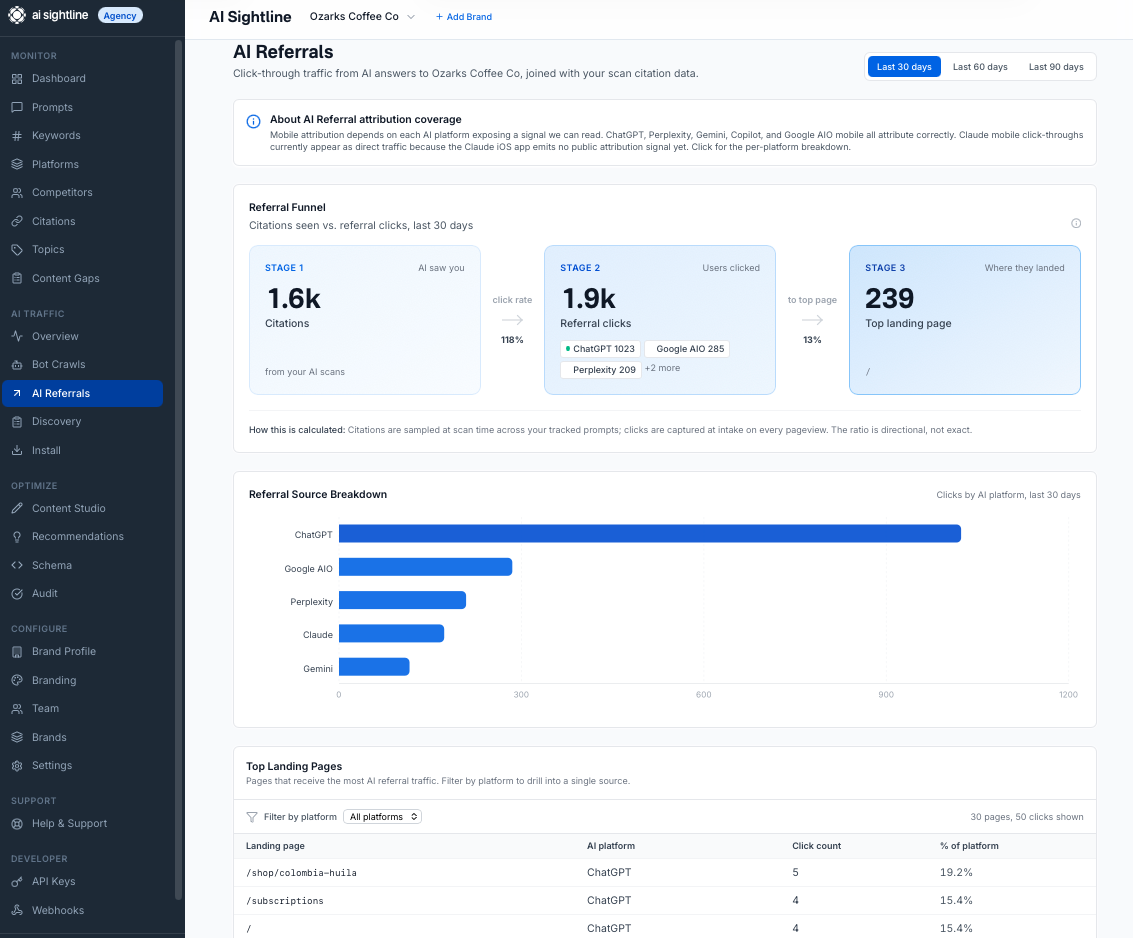
The new layer. Server-side tracking of every AI bot crawl, every AI referral click, every discovery-file event, classified by AI engine, with mobile attribution that actually works. The "who is AI sending us, and from where" layer.
We read the Referer header first. If it's missing or stripped by a mobile in-app browser, we fall back to reading utm_source URL parameters, which the AI providers increasingly include. ChatGPT iOS, Perplexity iOS, Gemini iOS, and Microsoft Copilot iOS all attribute correctly to AI Sightline. Claude iOS is the only documented vendor gap, and we disclose it in-product so you don't think we're hiding it.
Layer 3: Exactly what to fix
The closing piece. The recommendations engine takes your visibility data and your traffic data, ranks fixes by predicted score lift, and outputs plain-English action items. Examples we've shipped this quarter:
Bot is blocked, content is high-quality: "GPTBot is being denied at robots.txt but your /pricing page has the answer to a query you're losing on. Allow the bot."
Discovery file missing: "We don't see a llms.txt at your root. Adding one increases the chance of being indexed by Anthropic."
Underperforming AI landing page: "ChatGPT is sending traffic to /old-blog-post-slug, but your conversion rate on that page is 0.4%. Fix the page or redirect."
Thin content for an active bot: "PerplexityBot is crawling /faq weekly but the page is 200 words. Bots eat structure; expand."
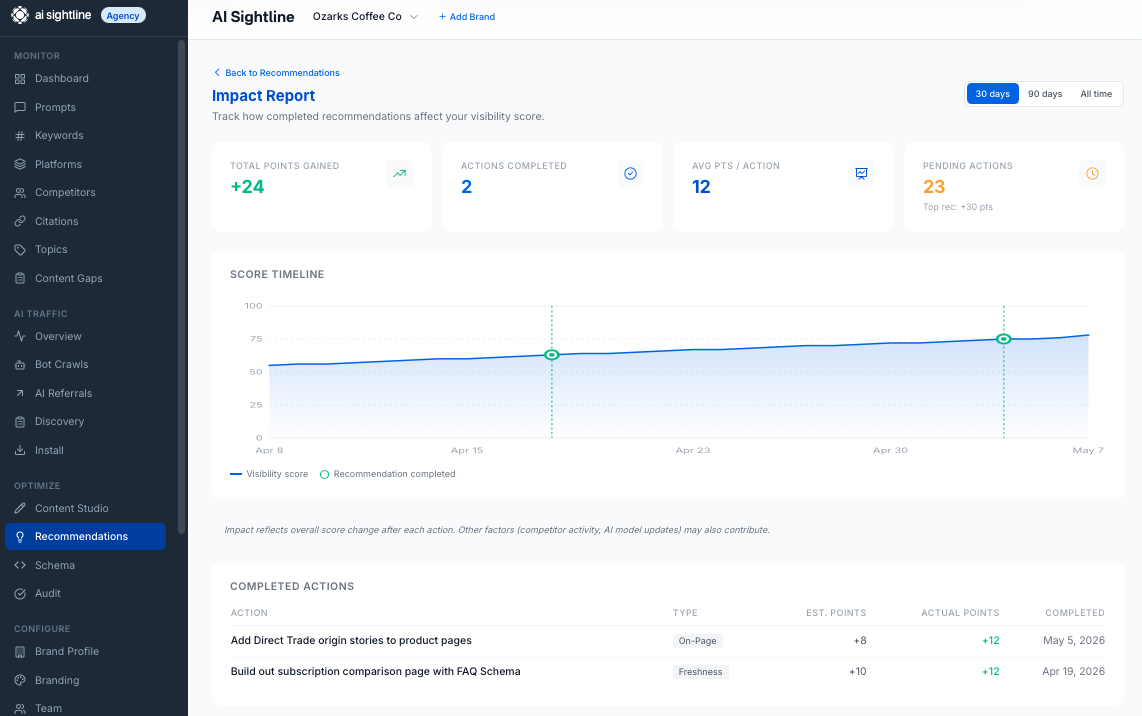
You ship the work. We re-scan. The impact tracker shows whether the score moved. The whole loop, finally closed.
Why all three layers, in one platform
The reason we built three layers instead of selling them separately is that they aren't separately useful.
Knowing your visibility score is 47/100 doesn't tell you what to do. Knowing GPTBot crawled you 1,800 times last month doesn't tell you what to do. The combination, ranked by predicted impact, does. Mentions tell you the demand. Traffic tells you the conversion. Recommendations tell you the lever to pull.
This is the analytics shape Google Analytics had for the search era. Demand (impressions), conversion (sessions and goals), insights (where to optimize). It worked because it covered the whole funnel.
AI search needs the same shape, built for the new mechanics. That's what AI Sightline is.
The market math
Tool | What it covers | Entry price |
|---|---|---|
Google Analytics 4 | Built for the search era. Cannot see AI traffic. | $0 (blind to AI) |
Otterly | Mention tracking only. | $189/mo Standard |
Peec | Mention tracking only. AI models extra. | €85/mo Starter |
Scrunch | Mention tracking only. | $189/mo Core |
Profound | Mentions + traffic. Requires GA4 (inherits the blind spot). | $399/mo Growth |
AI Sightline | Mentions + traffic + recommendations. Server-side. Mobile attribution. | $0/mo Free |
AI Sightline
Mentions + traffic + recommendations. Server-side. Mobile attribution.
$0/mo Free
We didn't include traffic on the Free tier because we were trying to be the cheapest. We included it because closed-loop AI search analytics is the table-stakes product for this category. Gating it behind a $400/month wall would have meant only enterprise teams ever got the full picture. The category needs a default. We're shipping it.
Pricing: every plan includes the whole loop
Plan | Price | Pageviews/mo | Bot platforms | Referral platforms | Retention |
|---|---|---|---|---|---|
Free | $0 | 10,000 | 2 | 2 | 7 days |
Starter | $29.95 | 100,000 | 4 | 4 | 14 days |
Pro | $149.95 | 500,000 | 5 | 5 | 30 days |
Business | $289.95 | 1,000,000 | 6 | 6 | 60 days |
Agency | $549.95 | 2,500,000 | All 17 | 7 | 90 days |
Numbers come from tiers.ts and they're enforced at the edge. Bot crawls bypass the pageview cap, so even at-cap Free customers see all bot data.
Install in 30 seconds
Three paths. Pick the one that matches your stack.
Vercel marketplace integration. If your site is on Vercel, install the AI Sightline integration and our middleware ships as part of your deploy. Zero config. Auto-updates as we ship new bot detections.
Cloudflare Worker. A Wrangler-ready Worker template lives inside your AI Sightline portal at /portal/ai-traffic/install. Copy, deploy, done.
Generic middleware. For any other framework (Next.js outside Vercel, Express, Fastify, Hono, Astro, Remix, anything else), we ship a generic middleware snippet. The portal install wizard gives you the exact code, the env vars to set, and a "send to developer" button if you'd rather hand it off.
All three paths use a websiteKey scoped to your brand. Bot crawls bypass your pageview cap. Static asset requests (images, CSS, JS) are excluded automatically.
What this means for your team
Three practical shifts most teams make in the first thirty days after installing.
Marketing stops trusting GA Direct as direct. A meaningful slice of what your dashboard calls direct is actually AI-driven traffic that lost its referrer in a mobile app. Once you see the AI Referrals page, you start triangulating. Did Direct go up the same week ChatGPT cited me? Probably the same traffic.
SEO and content teams change what they ship. Knowing GPTBot is crawling /pricing weekly while your /docs page is being ignored changes the content roadmap. We've seen customers rewrite legacy product pages because the AI bots are eating structured product info that the old page lacked.
DevOps adds robots.txt and llms.txt to CI checks. A missing llms.txt is a recommendation we generate constantly. Adding it once is a five-minute job that compounds for years.
Get started
If you're already on AI Sightline, log in. The new surfaces are live in your portal under the AI Traffic sidebar group. Hit /portal/ai-traffic/install to wire up the middleware.
If you're new, start free at aisightline.com/register. Free includes 3 prompts, 10 keywords, 2 AI platforms, and 10,000 AI Traffic pageviews per month. No credit card. No trial countdown. The Free tier is the on-ramp, not a timer.
Search isn't search anymore. The analytics layer for what comes next is live.
What is AI search analytics?
AI search analytics is the measurement layer for how your brand performs inside generative AI engines. It tracks impressions, citations, share of voice, sentiment, and referral traffic from sources like ChatGPT, Perplexity, Google AIO, Gemini, Claude, and Copilot. The goal is the same as Google Analytics for organic search, applied to a category that did not exist three years ago.
Does Google Analytics track AI traffic?
Partially. GA4 will record referral sessions when an AI assistant sends a clickable link, but most AI answers never produce a click and GA cannot see impressions, citations, or how often your brand was mentioned without being linked. You need a dedicated AI analytics tool to capture the zero-click majority.
How do I measure brand mentions in ChatGPT?
You need an AI visibility platform that prompts ChatGPT (and the other major assistants) on a recurring schedule with the queries your buyers ask, then parses the responses for brand mentions, citations, and competitor co-mentions. AI Sightline runs this loop daily on Pro and above and aggregates the results into a share of voice metric.
What metrics matter most for AI visibility?
Three to start: AI visibility score (how often you appear across all monitored prompts), competitive share of voice (your appearances divided by you plus your competitors), and citation rate (how often AI links to your domain when it mentions you). Add brand sentiment and bot crawl coverage once the first three are stable.
Get your free AI visibility score.
See how ChatGPT, Claude, Perplexity, Gemini, Google AIO, and Copilot talk about your brand.
Start freeSolo founder building AI visibility monitoring. Ships weekly. No venture capital, a lot of opinions about where AI search is going.