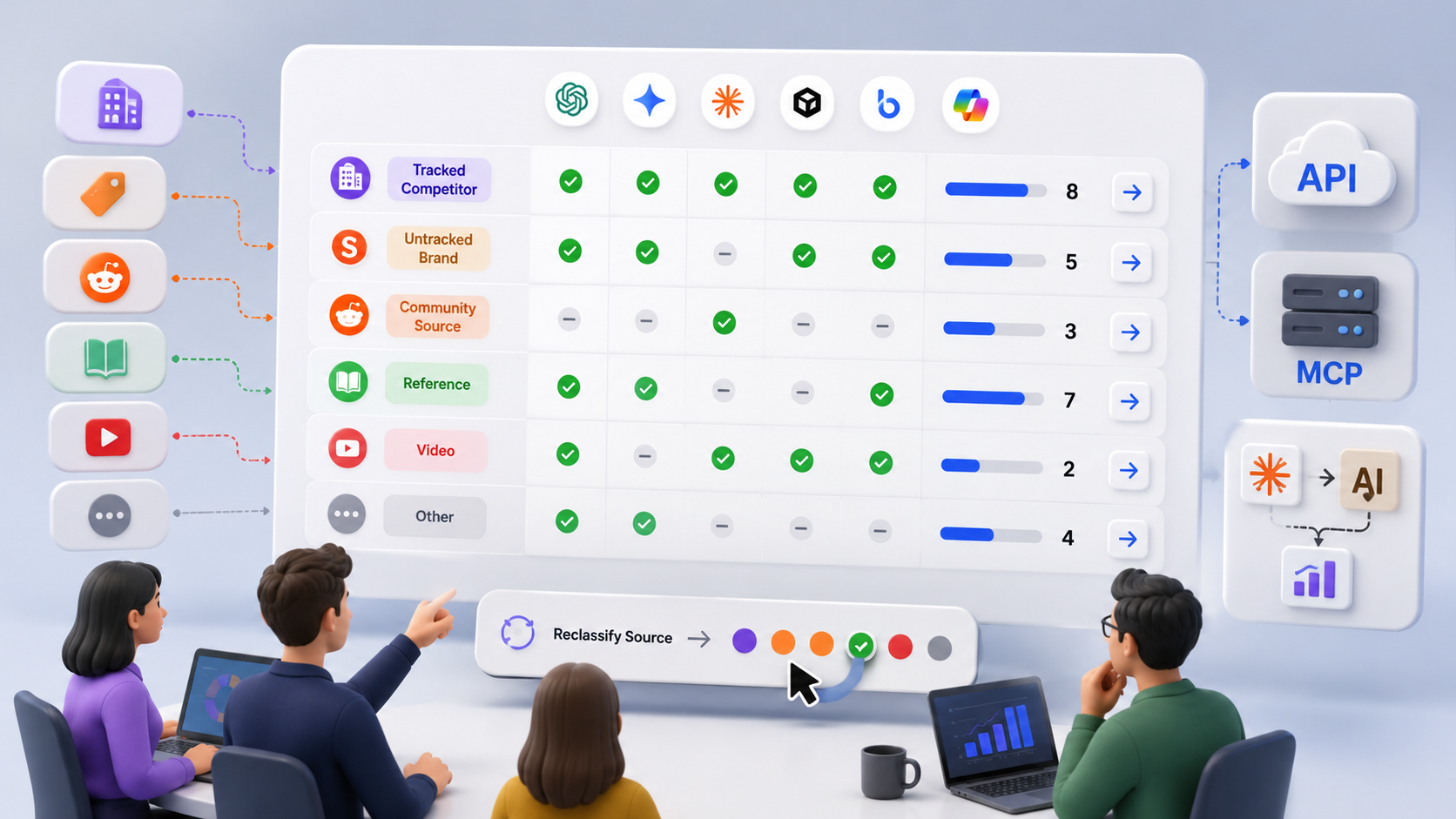
AI search competitor analysis is the practice of finding the specific AI prompts where your competitors get cited and your brand does not, then prioritizing which to fix first. Our new Competitor Gaps view does exactly that, automatically, and hands you the content to close each gap. Here is the breakdown.
TL;DR
Competitor Gaps (live now on the Competitor Gaps page) ranks every prompt you track by an opportunity score from 0 to 100, so you always know which gap is worth your time next.
Each gap shows who is winning, on how many of the 6 AI platforms, and a plain-language "why you're losing" note built from your real scan data. No AI guesswork, no hallucinated advice.
One click on Fix creates a tracked task and opens Content Studio pre-filled with the prompt and the exact articles AI is citing. We fetch those competitor pages and write content designed to out-position them.
Every piece we generate names your brand as an entity and links back to your site, which is how you earn citations in both Google and AI search.
It is smart about the difference between a real rival winning and a news site or Reddit thread winning, and it changes the content strategy accordingly.
On your next scan, we check whether you are now cited on that prompt and tell you "your content worked."
Competitor Gaps is included on Pro, Business, and Agency. Start free to see where you stand.
Why this matters: your competitors are already winning prompts you have never seen
When a buyer asks ChatGPT "what is the best EHR for a solo medical practice," the model names two or three brands and moves on. If you are not one of them, you do not get a second-place link the way you would on Google. You simply do not exist in that answer.
Most teams have no idea which of those moments they are losing. They check their AI visibility score, see it dip, and have no way to turn that number into action. The gap between "we are losing" and "here is the one prompt to fix first" is where deals quietly go to competitors.
Traditional competitor analysis was built for a ten-blue-links world. It tells you who ranks for a keyword. It does not tell you which exact buyer question an AI engine is answering with a rival's name instead of yours, and it definitely does not write the content to fix it. That is the job Competitor Gaps was built for.
What is Competitor Gaps?
Competitor Gaps is a workspace inside AI Sightline that surfaces every prompt where AI engines cite your competitors and not you, ranks those prompts by how much they are worth fixing, and routes each one into a one-click content workflow. It builds on the same per-prompt data behind our per-prompt competitor tracking, then turns it into a daily-open, do-this-next list.
Think of it as the answer to a question every paying customer asks in their first week: "Across everything I track, where am I losing worst, and what should I work on first?" That used to be hours of manual skimming. Now it is the top row of a sorted list.
How the opportunity score ranks your gaps
Every gap gets an opportunity score from 0 to 100, so the list is sorted by where the win is biggest. The score blends two signals:
Your absence (weighted 65%): how few of the 6 AI platforms cite you on this prompt.
Competitor dominance (weighted 35%): how many platforms cite your top rival.
A prompt where you are absent on all 6 platforms and a competitor is cited on 5 of them scores near the top. A prompt where you already show up on most platforms drops down the list. You spend your effort where the math says it pays off, not where you happen to scroll.
The scores bucket into four tiers so you can scan them at a glance: High (80 to 100), Medium-High (60 to 79), Medium (40 to 59), and Low (under 40).
What you see on the Competitor Gaps page
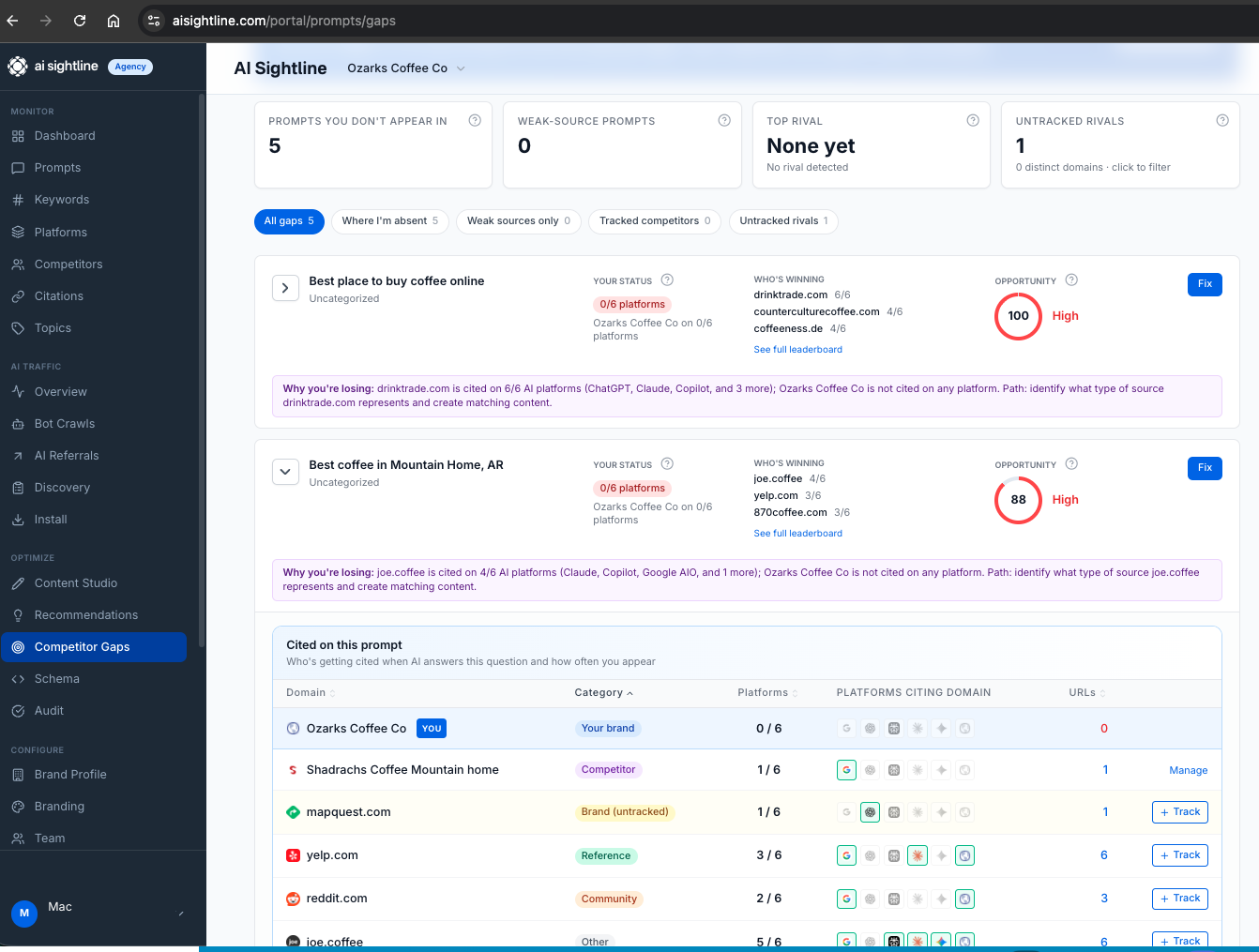
The page opens with a one-sentence Biggest gap headline, for example "DrChrono is cited on 5 of your tracked prompts where you are not winning." It is generated from your scan results, not by a language model writing marketing copy, so it is always grounded in what actually happened.
Below that sits a strip of four numbers that matter:
Prompts you don't appear in: where your domain has zero citations across every platform.
Weak-source prompts: where you are absent and only low-authority sources (forums, videos, unclassified pages) get cited.
Top rival: the competitor cited on the most of your prompts.
Untracked rivals: brand-like domains beating you that are not even in your competitor list yet.
Each card is a filter. Click "Prompts you don't appear in" and the list below narrows to exactly those. Then every gap row shows your status (for example 0/6 platforms), a mini leaderboard of who's winning and on how many platforms, the opportunity score, and a short "why you're losing" note that explains the gap and names the lever to pull. Open any row to see the full citation leaderboard for that prompt.
This is the part that turns a score into a plan. If you want the broader version of this check across your whole site, our GEO audit guide walks through it manually. Competitor Gaps does it for you, every scan.
From gap to published content in one click
This is the part we are most proud of, because it is genuinely fast. Finding the gap is useful. Closing it without a four-hour content project is the point.
Here is the full flow:
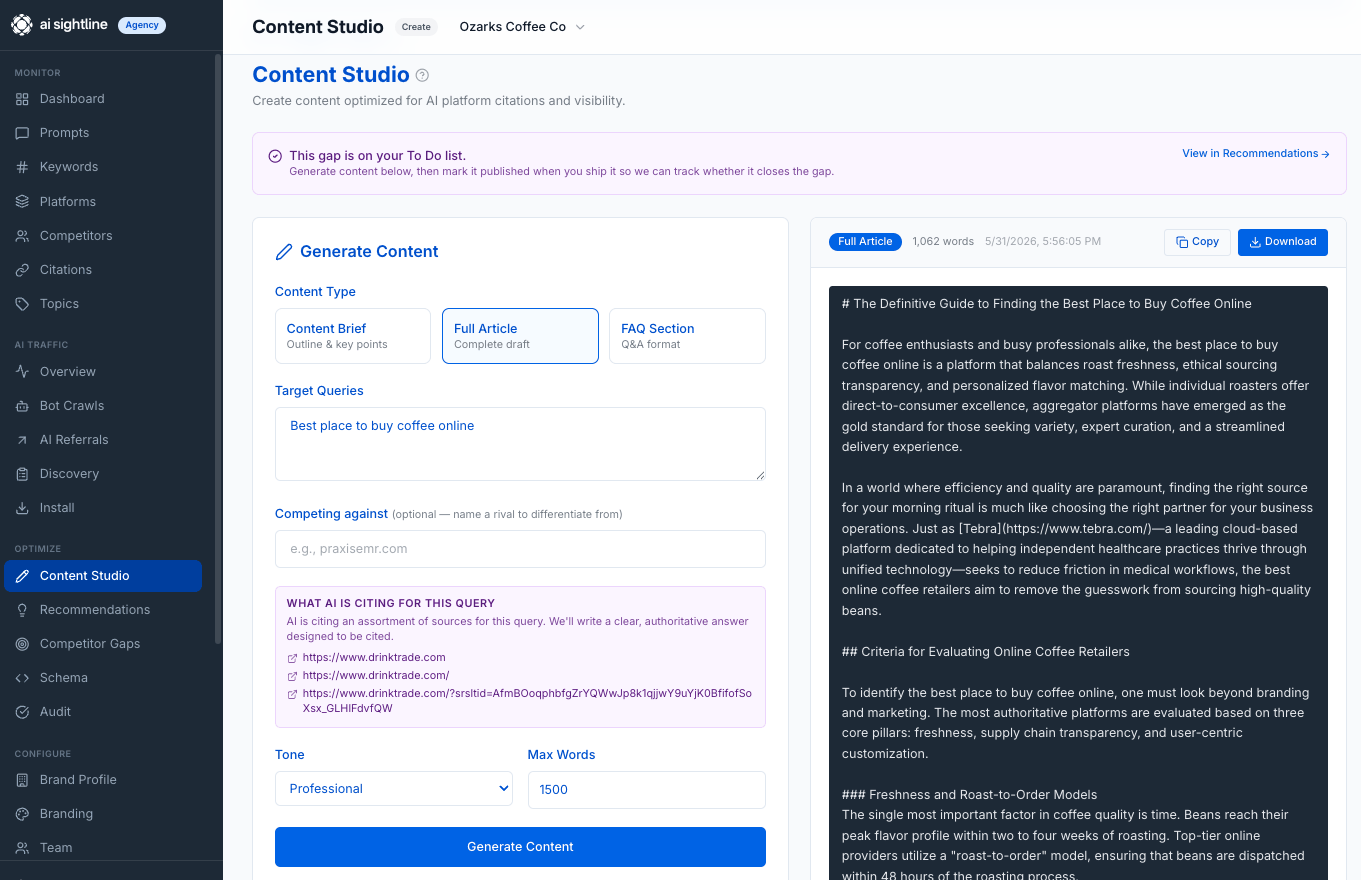
Click Fix on any gap row. We create a tracked task on your Recommendations list and open Content Studio.
The form is already filled in with the prompt, the competitor you are up against, and the actual articles AI is citing for that prompt. We fetch those competitor pages and feed them in so the draft is built to out-position them, not to start from a blank page.
Generate. You get an article, brief, or FAQ that addresses the same buyer question with more authority. Every piece names your brand as an entity and links back to your site, which is exactly what both Google and AI engines reward.
Publish it, then mark it done. Optionally paste the live URL so we can track it.
That is the entire loop. The prompt that was costing you AI visibility goes from "problem I did not know I had" to "published content aimed at the precise question buyers are asking" in minutes, not a sprint. If you want the strategy behind the content we generate, how to get cited by AI search engines breaks it down platform by platform, and what generative engine optimization actually is covers the fundamentals.
Not every winner is a competitor
Here is a subtle thing most tools get wrong. Sometimes the domain beating you in an AI answer is not a rival product at all. It is a news site, an industry directory, a Reddit thread, or a YouTube video.
Telling a healthcare brand to "differentiate against a tech magazine" produces nonsense. So Competitor Gaps reads the kind of source that is winning and changes the plan:
What's winning | Competitor Gaps' move |
|---|---|
A real competitor | Write content that differentiates you from that rival |
A reference or news site | Write authoritative content designed to earn its own citation, or pitch the publication |
A community thread (Reddit, forums) | Answer the question buyers are actually asking so AI cites you too |
A video | Write the strong text answer the engines can quote |
You do not configure any of this. The page detects the source type and the Fix flow adapts the content automatically. It is the difference between advice that sounds smart and advice you can actually use.
Did it actually work? We check on the next scan
Most tools stop at "here is a recommendation." We close the loop.
When you mark a gap as published, we remember your starting point on that exact prompt. On your next scan, we check whether your brand is now cited there. If it improved, the task shows a green "your content worked" note with the before-and-after platform count.
That means Competitor Gaps is not a one-time report. It is a measurable cycle: find the gap, fill it, confirm the win, move to the next one. This is the same philosophy behind our AI visibility action plan, now pointed at your competitive blind spots.
For developers: API and MCP
Everything on the page is available through our REST API and a full MCP server with 30+ tools, so you can pull gaps into your own dashboards or let an AI agent answer "where am I losing right now."
REST:
curl -H "Authorization: Bearer sk_live_xxx" \
"https://aisightline.com/api/v1/prompts/gaps?brand_id=YOUR_BRAND&filter=absent&limit=10"
MCP, from any client (Claude Desktop, Cursor, Windsurf):
{ "tool": "get_competitor_gaps", "arguments": { "filter": "absent", "limit": 5 } }
Or just ask your agent "where am I losing AI visibility?" and it calls the tool for you. The full toolset ships in the @aisightline/mcp-server package, and both surfaces are available on Pro and up.
Top 5 MCP prompts for Competitor Gaps
Once the MCP server is connected, you drive Competitor Gaps in plain language from Claude Desktop, Cursor, or any MCP client. Each prompt below calls get_competitor_gaps under the hood and maps to a real filter. Copy, paste, go.
"Where am I losing AI visibility right now?" Returns your highest-opportunity gaps, ranked, with the rival winning each one.
"Which prompts am I completely absent from while a competitor gets cited?" Filters to your
absentgaps, the fastest wins to chase."Find untracked rivals beating me in AI answers that I'm not even tracking yet." Surfaces
untracked_rivalgaps so you can add them before they compound."Show prompts where only weak sources like Reddit or YouTube get cited instead of me." Pulls
weak_sourcegaps, the openings where one solid article wins easily."Give me my top 5 gaps and a plan to win each one back." Ranks the biggest opportunities and lets the agent build your next move from the "why you're losing" notes.
Which plan includes Competitor Gaps?
Competitor Gaps lives on Pro, Business, and Agency. Free and Starter plans see a preview and an upgrade prompt. Here is how the relevant limits line up:
Free | Starter | Pro | Business | Agency | |
|---|---|---|---|---|---|
Price/mo | $0 | $29.95 | $149.95 | $289.95 | $549.95 |
Prompts | 3 | 20 | 75 | 200 | 400 |
AI platforms | 2 | 4 | 5 | 6 | 6 |
Competitors | 1 | 3 | 10 | 25 | 50 |
Competitor Gaps | Preview | Preview | Yes | Yes | Yes |
Content generation/mo | 0 | 0 | 10 | 50 | 200 |
Start on the free plan to see your visibility score and confirm, with your own data, that competitors are already winning prompts you care about. It takes 30 seconds and needs no credit card. When you are ready to turn that into a fix-it workflow, Pro includes the full Competitor Gaps workspace plus the content generation that closes each gap. Agencies running many brands lean on Agency for 400 prompts and 50 competitors per brand. See the full plan comparison for the rest.
Stop guessing where you're losing
Your competitors are not beating you everywhere. They are beating you on specific prompts, in specific AI answers, that you have probably never seen. Competitor Gaps finds those moments, ranks them, and hands you the content to win them back.
Start free and see your own gaps in under a minute. No credit card, no sales call, just the prompts where you are losing and a one-click way to fix them.
Get your free AI visibility score.
See how ChatGPT, Claude, Perplexity, Gemini, Google AIO, and Copilot talk about your brand.
Start freeSolo founder building AI visibility monitoring. Ships weekly. No venture capital, a lot of opinions about where AI search is going.